Important Details
IJCRT - International Peer Reviewed, Open Access Journal, Multidisciplinary, Monthly, Nominal(Low) Fees for Professional Research Services International Journal of Creative Research Thoughts - IJCRT Peer Review Journal, Refereed Journal, Peer Reviewed Journal , Referred Journal and Indexed Journal, Open access, Online and Print Journal,international Journal Open Access, Accepted by Indian and foreign university ,IJCRT Followed Norms, guidelines, requirement, listing criteria and methodology of score/point also applied from: Scopus , Web of Science , UGC Approved , UGC CARE, UGC-CARE .
UGC Approved Journal No: 49023 (18)
UGC approval Link
https://ijcrt.org/ugc%20approval.jpg
All Policy and Approval
Please Like Our Facebook Page | CrossRef DOI and Hard copy of Certificate Provide if required. | www.IJCRT.org | editor@IJCRT.org | IJCRT WhatsApp +91 7990172303
Publication Details:
- Paper Submission : 31-Jul-2026. Call For Paper (Volume 14 | Issue 7 | Month- July 2026)
- Acceptance/Rejection Notification: Within 02-04 Days.
- Paper Publish: Within 02-04 Days after submitting all documents.
-
Submit Your Paper Any time There No deadline.
-
Publication fees : 1570 INR for Indian author & 59$ for foreign International author.
Please Like Our Facebook Page | CrossRef DOI and Hard copy of Certificate Provide if required.
Licence and Indexing
Indexing In Google Scholar, SSRN, ResearcherID-Publons, Semantic Scholar | AI-Powered Research Tool, Microsoft Academic, Academia.edu, arXiv.org, Research Gate, CiteSeerX, ResearcherID Thomson Reuters, Mendeley : reference manager, DocStoc, ISSUU, Scribd, and many more | High Impact Factor: 7.97 | Digital object identifier (DOI) and Hard Copy of certificate Provided.




























Licence
DOI
ISSN Approved impact factor: 7.97 
Creative Common 
Valid as per new UGC Gazette regulations 

INTERNATIONAL JOURNAL OF CREATIVE RESEARCH THOUGHTS - IJCRT (IJCRT.ORG)
International Peer Reviewed & Refereed Journals, Open Access Journal
IJCRT Peer-Reviewed (Refereed) Journal as Per New UGC Rules.
ISSN Approved Journal No: 2320-2882 | Impact factor: 7.97 | ESTD Year: 2013
Call For Paper - Volume 14 | Issue 7 | Month- July 2026
Scholarly open access journals, Peer-reviewed, and Refereed Journals, Impact factor 7.97 (Calculate by google scholar and Semantic Scholar | AI-Powered Research Tool) , Multidisciplinary, Monthly, Indexing in all major database & Metadata, Citation Generator, Digital Object Identifier(CrossRef DOI)
IJCRT WhatsApp Contact
IJCRT Search Xplore - Search all paper by Paper Name , Author Name, and Title
Volume 14 | Issue 4 |
Volume 14 | Issue 4 | Month
Downlaod After Publication 1) Table of content index in PDF
2) Table of content index in HTML 2)Table of content index in HTML
3) Front Page 3) Front Page
4) Back Page 4) Back Page
5) Editor Board Member 5)Editor Board Member
6) OLD Style Issue 6)OLD Style Issue
 |
 |
|---|---|
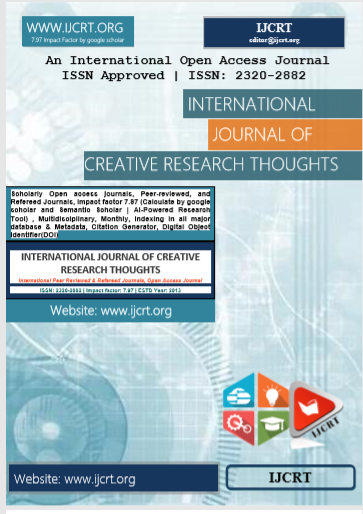
| IJCRT Journal front page | IJCRT Journal Back Page |
Paper Title: AN OVERVIEW OF IOT SECURITY DEVELOPMENTS AND ISSUES (INTERNET OF THINGS)
Author Name(s): Dr. A. NITHYA RANI, Ms. BASIL BABY K
Published Paper ID: - IJCRTBT02015
Register Paper ID - 305892
Publisher Journal Name: IJPUBLICATION, IJCRT
DOI Member ID: 10.6084/m9.doi.one.IJCRTBT02015 and DOI :
Author Country : Indian Author, India, - , -, - , | Research Area: Commerce All Published Paper URL: http://ijcrt.org/viewfull.php?&p_id=IJCRTBT02015 Published Paper PDF: download.php?file=IJCRTBT02015 Published Paper PDF: http://www.ijcrt.org/papers/IJCRTBT02015.pdf
Your Paper Publication Details:
Title: AN OVERVIEW OF IOT SECURITY DEVELOPMENTS AND ISSUES (INTERNET OF THINGS)
DOI (Digital Object Identifier) :
Pubished in Volume: 14 | Issue: 4 | Year: April 2026
Publisher Name : IJCRT | www.ijcrt.org | ISSN : 2320-2882
Subject Area: Commerce All
Author type: Indian Author
Pubished in Volume: 14
Issue: 4
Pages: 70-79
Year: April 2026
Downloads: 163
E-ISSN Number: 2320-2882
Abstract
The Internet of Things is based on the concept of layered design. A range of technologies are used by each tier for information transmission, capacity, and preparation. This study aims to assess the present Internet of Things architecture with respect to the risks and vulnerabilities associated with IoT-enabled devices, as well as potential assurance procedures in light of equipment limits and novel information transfer methodologies. We then discuss IOT applications and architecture. A list of successful real-time IOT applications now in use is as follows: Emerging technologies include things like self-driving cars, smart grids, traffic management systems, logistic management hierarchies, environment monitoring, building safety applications, and many more.
Licence: creative commons attribution 4.0
License
Creative Commons Attribution 4.0 and The Open Definition

Paper Title: AI-Driven Consumer Intelligence: Integrating Neuromarketing, Predictive Analytics, and Behavioral Insights for Strategic Marketing Decisions
Author Name(s): Dr. M . Mutharasi, Dr.Y. Fathima
Published Paper ID: - IJCRTBT02014
Register Paper ID - 305893
Publisher Journal Name: IJPUBLICATION, IJCRT
DOI Member ID: 10.6084/m9.doi.one.IJCRTBT02014 and DOI :
Author Country : Indian Author, India, - , -, - , | Research Area: Commerce All Published Paper URL: http://ijcrt.org/viewfull.php?&p_id=IJCRTBT02014 Published Paper PDF: download.php?file=IJCRTBT02014 Published Paper PDF: http://www.ijcrt.org/papers/IJCRTBT02014.pdf
Your Paper Publication Details:
Title: AI-DRIVEN CONSUMER INTELLIGENCE: INTEGRATING NEUROMARKETING, PREDICTIVE ANALYTICS, AND BEHAVIORAL INSIGHTS FOR STRATEGIC MARKETING DECISIONS
DOI (Digital Object Identifier) :
Pubished in Volume: 14 | Issue: 4 | Year: April 2026
Publisher Name : IJCRT | www.ijcrt.org | ISSN : 2320-2882
Subject Area: Commerce All
Author type: Indian Author
Pubished in Volume: 14
Issue: 4
Pages: 65-69
Year: April 2026
Downloads: 134
E-ISSN Number: 2320-2882
Abstract
Artificial Intelligence (AI) has moved the practice of marketing from a traditional activity into a domain that is intensely driven by intelligence and data. The framework combines behavioral insights, neuromarketing, and AI-driven predictive analytics to offer an innovative approach for consumer intelligence and strategic decision-making. Neuromarketing is a method for exploring unconscious emotional and cognitive responses; behavioral insights explain decision-making biases and preferences while predictive analytics employs massive data in order to anticipate consumer behavior. This research proposes a conceptual framework between marketing performance, decision quality, and customization effectiveness with Artificial Intelligence (AI)-based consumer intelligence. The Effects of Integrated Consumer Intelligence Series Using Survey Data, Evidence from Neuromarketing Experiments and AI-Based Predictive Modeling: This mixed-method study employing survey data and experimental evidence from neuromarketing as well as AI-based predictive modelling to unlock the strategic marketing effects. We anticipate that the findings can help advance theory through the can provide a bridge between cognitive neuroscience in conjunction with AI-decomposed today, precision marketing, consumer engagement, and competitive advantage in the digital economy.
Licence: creative commons attribution 4.0
License
Creative Commons Attribution 4.0 and The Open Definition
Keywords
Artificial Intelligence, Consumer Intelligence, Neuromarketing, Predictive Analytics, Behavioral Insights, Strategic Marketing, Decision Intelligence
License
Creative Commons Attribution 4.0 and The Open Definition
Paper Title: FAKE NEWS DETECTION USING NATURAL LANGUAGE PROCESSING AND MACHINE LEARNING
Author Name(s): Mrs.V. LOGANAYAKI, MS. R.GOPIKA, MS. B .VAISHANAVI.B
Published Paper ID: - IJCRTBT02013
Register Paper ID - 305894
Publisher Journal Name: IJPUBLICATION, IJCRT
DOI Member ID: 10.6084/m9.doi.one.IJCRTBT02013 and DOI :
Author Country : Indian Author, India, - , -, - , | Research Area: Science and Technology Published Paper URL: http://ijcrt.org/viewfull.php?&p_id=IJCRTBT02013 Published Paper PDF: download.php?file=IJCRTBT02013 Published Paper PDF: http://www.ijcrt.org/papers/IJCRTBT02013.pdf
Your Paper Publication Details:
Title: FAKE NEWS DETECTION USING NATURAL LANGUAGE PROCESSING AND MACHINE LEARNING
DOI (Digital Object Identifier) :
Pubished in Volume: 14 | Issue: 4 | Year: April 2026
Publisher Name : IJCRT | www.ijcrt.org | ISSN : 2320-2882
Subject Area: Science and Technology
Author type: Indian Author
Pubished in Volume: 14
Issue: 4
Pages: 61-64
Year: April 2026
Downloads: 156
E-ISSN Number: 2320-2882
Abstract
The rapid growth of social media platforms has significantly increased the spread of misinformation and fake news. Manual verification of news content is slow, expensive, and unsuitable for large- scale data processing. This paper presents an automated fake news detection system using Natural Language Processing (NLP), Machine Learning (ML), and Deep Learning techniques. Textual news data is preprocessed using tokenization, stop-word removal, and lemmatization. Feature extraction is performed using TF-IDF vectorization and word embeddings. Multiple classification models including Logistic Regression, Support Vector Machine (SVM), Naive Bayes, and Long Short-Term Memory (LSTM) networks are trained and evaluated. Experimental results show that deep learning models outperform traditional machine learning methods, achieving an accuracy of up to 96%. The proposed system provides a scalable and efficient solution for identifying fake news in digital platforms.
Licence: creative commons attribution 4.0
License
Creative Commons Attribution 4.0 and The Open Definition
Keywords
Fake News Detection, NLP, Machine Learning, Deep Learning, Text Classification, LSTM, TF-IDF.
License
Creative Commons Attribution 4.0 and The Open Definition
Paper Title: SMART DINING EXPERIENCE: AN ANDROID-BASED INTELLIGENT RESTAURANT MANAGEMENT SYSTEM BASED ON USER BEHAVIOR ANALYSIS AND HYBRID RECOMMENDATIONS
Author Name(s): Mrs. S. AHAMED JOHNSHA ALI, Mr. M. V. DHARANESAN
Published Paper ID: - IJCRTBT02012
Register Paper ID - 305895
Publisher Journal Name: IJPUBLICATION, IJCRT
DOI Member ID: 10.6084/m9.doi.one.IJCRTBT02012 and DOI :
Author Country : Indian Author, India, - , -, - , | Research Area: Science and Technology Published Paper URL: http://ijcrt.org/viewfull.php?&p_id=IJCRTBT02012 Published Paper PDF: download.php?file=IJCRTBT02012 Published Paper PDF: http://www.ijcrt.org/papers/IJCRTBT02012.pdf
Your Paper Publication Details:
Title: SMART DINING EXPERIENCE: AN ANDROID-BASED INTELLIGENT RESTAURANT MANAGEMENT SYSTEM BASED ON USER BEHAVIOR ANALYSIS AND HYBRID RECOMMENDATIONS
DOI (Digital Object Identifier) :
Pubished in Volume: 14 | Issue: 4 | Year: April 2026
Publisher Name : IJCRT | www.ijcrt.org | ISSN : 2320-2882
Subject Area: Science and Technology
Author type: Indian Author
Pubished in Volume: 14
Issue: 4
Pages: 57-60
Year: April 2026
Downloads: 119
E-ISSN Number: 2320-2882
Abstract
The rapid growth of mobile technologies and the increasing demand for contactless, efficient, and personalized services have significantly transformed the hospitality industry. Traditional restaurant management systems rely heavily on manual processes such as printed menus, verbal order taking, and counter-based billing, which often lead to inefficiencies, longer waiting times, human errors, and limited customer engagement. This paper proposes a Smart Dining Experience System, an Android-based intelligent restaurant management application designed to automate menu management, order processing, billing, and customer interaction. Developed using Android Studio, the system employs Java and XML for front-end development and SQLite for backend data management. Restaurant administrators can dynamically manage digital menus, while customers can browse food items, place orders, track preparation time, receive personalized food recommendations, and make digital payments using smart phones. A frequency-based recommendation algorithm analyzes customer order history to enhance personalization. Experimental evaluation indicates reduced service time, improved order accuracy, and increased customer satisfaction. The study demonstrates that mobile-based smart dining solutions can effectively modernize restaurant operations and enhance overall service quality.
Licence: creative commons attribution 4.0
License
Creative Commons Attribution 4.0 and The Open Definition
Keywords
Smart Dining Experience, Restaurant Automation, Android Application, Digital Menu, Food Recommendation System, SQLite, Mobile Payment
License
Creative Commons Attribution 4.0 and The Open Definition
Paper Title: DESIGN AND EVALUATION OF A FACE RECOGNITION-BASED AUTOMATED ATTENDANCE MANAGEMENT SYSTEM USING DEEP LEARNING
Author Name(s): Mrs. S . Gomathi, Ms. R. Mythili, Ms. R. Divya
Published Paper ID: - IJCRTBT02011
Register Paper ID - 305896
Publisher Journal Name: IJPUBLICATION, IJCRT
DOI Member ID: 10.6084/m9.doi.one.IJCRTBT02011 and DOI :
Author Country : Indian Author, India, - , -, - , | Research Area: Science and Technology Published Paper URL: http://ijcrt.org/viewfull.php?&p_id=IJCRTBT02011 Published Paper PDF: download.php?file=IJCRTBT02011 Published Paper PDF: http://www.ijcrt.org/papers/IJCRTBT02011.pdf
Your Paper Publication Details:
Title: DESIGN AND EVALUATION OF A FACE RECOGNITION-BASED AUTOMATED ATTENDANCE MANAGEMENT SYSTEM USING DEEP LEARNING
DOI (Digital Object Identifier) :
Pubished in Volume: 14 | Issue: 4 | Year: April 2026
Publisher Name : IJCRT | www.ijcrt.org | ISSN : 2320-2882
Subject Area: Science and Technology
Author type: Indian Author
Pubished in Volume: 14
Issue: 4
Pages: 52-56
Year: April 2026
Downloads: 135
E-ISSN Number: 2320-2882
Abstract
Attendance monitoring is an essential administrative task in educational institutions for tracking student participation and academic engagement. Conventional attendance methods such as manual roll calls and signature-based systems are time-consuming, error-prone, and vulnerable to proxy attendance. This paper presents a face recognition-based automated attendance management system using computer vision and deep learning techniques. The proposed system captures real-time facial images through a camera and performs face detection and recognition using convolutional neural network-based models. Facial features are extracted and matched against a pre-trained student database, and attendance records are automatically updated in a centralized storage system. The system eliminates manual intervention and ensures secure, contactless attendance recording. Experimental evaluation was conducted in a controlled classroom environment using a dataset of enrolled students. Performance was measured using recognition accuracy, False Acceptance Rate (FAR), and False Rejection Rate (FRR). The results demonstrate that the proposed system achieves high recognition accuracy and significantly reduces attendance processing time compared to traditional methods. The system provides a reliable and scalable solution for intelligent attendance management in educational institutions. The system achieved a recognition accuracy of 96.2%, with a False Acceptance Rate of 1.8% and a False Rejection Rate of 2.0%.
Licence: creative commons attribution 4.0
License
Creative Commons Attribution 4.0 and The Open Definition
Keywords
Face Recognition, Automated Attendance, Deep Learning, Computer Vision, Biometric Authentication, CNN, Image Processing.
License
Creative Commons Attribution 4.0 and The Open Definition
Paper Title: THE EVOLUTION OF AI CLOUD COMPUTING AND THE FUTURE IT HOLDS
Author Name(s): Ms. C. Soundarya, Mr. S. Ashwin
Published Paper ID: - IJCRTBT02010
Register Paper ID - 305897
Publisher Journal Name: IJPUBLICATION, IJCRT
DOI Member ID: 10.6084/m9.doi.one.IJCRTBT02010 and DOI :
Author Country : Indian Author, India, - , -, - , | Research Area: Science and Technology Published Paper URL: http://ijcrt.org/viewfull.php?&p_id=IJCRTBT02010 Published Paper PDF: download.php?file=IJCRTBT02010 Published Paper PDF: http://www.ijcrt.org/papers/IJCRTBT02010.pdf
Your Paper Publication Details:
Title: THE EVOLUTION OF AI CLOUD COMPUTING AND THE FUTURE IT HOLDS
DOI (Digital Object Identifier) :
Pubished in Volume: 14 | Issue: 4 | Year: April 2026
Publisher Name : IJCRT | www.ijcrt.org | ISSN : 2320-2882
Subject Area: Science and Technology
Author type: Indian Author
Pubished in Volume: 14
Issue: 4
Pages: 45-51
Year: April 2026
Downloads: 120
E-ISSN Number: 2320-2882
Abstract
The rapid advancement of digital technologies has significantly transformed modern computing environments, particularly through the integration of Artificial Intelligence (AI) with cloud computing. Cloud computing enables organizations to access scalable computing resources, storage, and services over the internet, eliminating the need for costly on-premise infrastructure. When combined with AI technologies such as machine learning, deep learning, and big data analytics, cloud platforms become powerful environments capable of processing massive datasets, generating insights, and supporting intelligent decision-making.This paper examines the evolution of AI cloud computing, beginning with early cloud infrastructure models and progressing through stages such as big data integration, machine learning adoption, and the development of AI-as-a-Service platforms. It also highlights the core technologies that enable AI cloud systems, including machine learning, deep learning, big data analytics, Internet of Things (IoT), and automated machine learning tools. The study further discusses the major benefits of AI cloud computing, such as cost efficiency, scalability, faster innovation, and improved data management.In addition, the paper explores key real-world applications across industries including healthcare, finance, transportation, smart cities, and e-commerce. While the adoption of AI cloud computing continues to grow, challenges such as data privacy concerns, cybersecurity risks, high data dependency, and technical complexity remain significant considerations.Finally, the paper outlines future trends shaping the next generation of AI cloud systems, including edge AI, intelligent automation, quantum computing integration, and advanced privacy-preserving technologies.
Licence: creative commons attribution 4.0
License
Creative Commons Attribution 4.0 and The Open Definition
Keywords
Artificial Intelligence, Cloud Computing, Machine Learning, Deep Learning, Big Data Analytics, AI-as-a-Service (AIaaS), Internet of Things (IoT), Edge Computing, Intelligent Automation, Digital Transformation
License
Creative Commons Attribution 4.0 and The Open Definition
Paper Title: Trap Intelligence Comparison: Adaptive Honeypots in Modern Cyber Defense
Author Name(s): Dr.C . YAMINI, Ms.M .NITHYA
Published Paper ID: - IJCRTBT02009
Register Paper ID - 305899
Publisher Journal Name: IJPUBLICATION, IJCRT
DOI Member ID: 10.6084/m9.doi.one.IJCRTBT02009 and DOI :
Author Country : Indian Author, India, - , -, - , | Research Area: Science and Technology Published Paper URL: http://ijcrt.org/viewfull.php?&p_id=IJCRTBT02009 Published Paper PDF: download.php?file=IJCRTBT02009 Published Paper PDF: http://www.ijcrt.org/papers/IJCRTBT02009.pdf
Your Paper Publication Details:
Title: TRAP INTELLIGENCE COMPARISON: ADAPTIVE HONEYPOTS IN MODERN CYBER DEFENSE
DOI (Digital Object Identifier) :
Pubished in Volume: 14 | Issue: 4 | Year: April 2026
Publisher Name : IJCRT | www.ijcrt.org | ISSN : 2320-2882
Subject Area: Science and Technology
Author type: Indian Author
Pubished in Volume: 14
Issue: 4
Pages: 38-44
Year: April 2026
Downloads: 161
E-ISSN Number: 2320-2882
Abstract
Honey pots have evolved from static decoy systems into intelligent, adaptive components of modern cyber security architectures. This survey paper presents a comparative analysis of traditional and modern honey pot technologies, emphasizing their integration with artificial intelligence (AI), machine learning (ML), block chain, reinforcement learning, and cloud-native orchestration. We synthesize recent advancements and categorize honey pot systems by interaction level, deployment strategy, and technological augmentation. Comparative tables highlight the evolution of capabilities, scalability, and operational effectiveness. The paper concludes with insights into best practices and future research directions for deploying deception-based defenses in dynamic threat environments.
Licence: creative commons attribution 4.0
License
Creative Commons Attribution 4.0 and The Open Definition
Keywords
Honeypots, Cyber security, Deception Technology, Machine Learning, Reinforcement Learning, Block chain,Cloud Security.
License
Creative Commons Attribution 4.0 and The Open Definition
Paper Title: REAL-TIME DISASTER MANAGEMENT SYSTEM
Author Name(s): Mrs. E . Bhakyalashmi, Ms.S.Aswitha
Published Paper ID: - IJCRTBT02008
Register Paper ID - 305901
Publisher Journal Name: IJPUBLICATION, IJCRT
DOI Member ID: 10.6084/m9.doi.one.IJCRTBT02008 and DOI :
Author Country : Indian Author, India, - , -, - , | Research Area: Science and Technology Published Paper URL: http://ijcrt.org/viewfull.php?&p_id=IJCRTBT02008 Published Paper PDF: download.php?file=IJCRTBT02008 Published Paper PDF: http://www.ijcrt.org/papers/IJCRTBT02008.pdf
Your Paper Publication Details:
Title: REAL-TIME DISASTER MANAGEMENT SYSTEM
DOI (Digital Object Identifier) :
Pubished in Volume: 14 | Issue: 4 | Year: April 2026
Publisher Name : IJCRT | www.ijcrt.org | ISSN : 2320-2882
Subject Area: Science and Technology
Author type: Indian Author
Pubished in Volume: 14
Issue: 4
Pages: 33-37
Year: April 2026
Downloads: 139
E-ISSN Number: 2320-2882
Abstract
The Real-Time Disaster Management system is designed to improve emergency response efficiency through automated processing of disaster-related information. Traditional disaster management systems rely on manual communication and delayed decision-making, which often result in slow response and increased damage. The proposed system uses rule-based artificial intelligence techniques to analyze emergency messages, determine severity levels, assign priority, and generate alerts in real time [5]. The system also detects duplicate messages to avoid repeated alerts and maintains structured records in a centralized database [7]. An admin dashboard enables monitoring of emergency messages, alert delivery status, and disaster history. The system reduces response time, improves coordination, and enhances disaster preparedness and management effectiveness.
Licence: creative commons attribution 4.0
License
Creative Commons Attribution 4.0 and The Open Definition
Keywords
Real-Time Disaster Management , Emergency Response , Artificial Intelligence, Rule-Based System ,Severity Analysis , Priority Assignment , Automated Alerts, Duplicate Detection , Centralized Database , Disaster Preparedness
License
Creative Commons Attribution 4.0 and The Open Definition
Paper Title: SMART DORMITORY MANAGEMENT TRACKING SYSTEM
Author Name(s): Dr.S.Maria Sylviaa, M.Sheevaranjani
Published Paper ID: - IJCRTBT02007
Register Paper ID - 305904
Publisher Journal Name: IJPUBLICATION, IJCRT
DOI Member ID: 10.6084/m9.doi.one.IJCRTBT02007 and DOI :
Author Country : Indian Author, India, - , -, - , | Research Area: Science and Technology Published Paper URL: http://ijcrt.org/viewfull.php?&p_id=IJCRTBT02007 Published Paper PDF: download.php?file=IJCRTBT02007 Published Paper PDF: http://www.ijcrt.org/papers/IJCRTBT02007.pdf
Your Paper Publication Details:
Title: SMART DORMITORY MANAGEMENT TRACKING SYSTEM
DOI (Digital Object Identifier) :
Pubished in Volume: 14 | Issue: 4 | Year: April 2026
Publisher Name : IJCRT | www.ijcrt.org | ISSN : 2320-2882
Subject Area: Science and Technology
Author type: Indian Author
Pubished in Volume: 14
Issue: 4
Pages: 28-32
Year: April 2026
Downloads: 121
E-ISSN Number: 2320-2882
Abstract
The Smart Dormitory Management Tracking System is a comprehensive web-based application designed to modernize and automate hostel administration processes within educational institutions. Traditional dormitory management systems rely heavily on manual record-keeping, including physical registers and spreadsheet-based documentation. These conventional approaches often result in data inconsistency, delayed updates, difficulty in monitoring occupancy, and increased administrative workload. The proposed system introduces a centralized digital platform that integrates multiple hostel management functions such as student registration, room allocation, attendance monitoring, fee management, complaint handling, and reporting. The application is structured with role-based access control to ensure that administrators, wardens, and students can access only authorized modules. The system enhances operational efficiency by automating repetitive tasks, maintaining structured database records, and enabling real-time monitoring of room occupancy and student activities. Secure authentication mechanisms are implemented to protect sensitive data and prevent unauthorized access. By reducing manual dependency and improving transparency, the Smart Dormitory Management Tracking System provides a scalable and reliable solution suitable for institutional deployment.
Licence: creative commons attribution 4.0
License
Creative Commons Attribution 4.0 and The Open Definition
Keywords
Dormitory Management System, Web-Based Automation, Occupancy Tracking, Access Control, Student Information System, Real-Time Monitoring
License
Creative Commons Attribution 4.0 and The Open Definition
Paper Title: INTENT-AWARE AI FOR PROACTIVE THREAT DETECTION IN DIGITAL COMMUNICATIONS
Author Name(s): Mrs.Dr.P.GAYATHIRI, Mrs.A.M.GAYATHRI
Published Paper ID: - IJCRTBT02006
Register Paper ID - 305906
Publisher Journal Name: IJPUBLICATION, IJCRT
DOI Member ID: 10.6084/m9.doi.one.IJCRTBT02006 and DOI :
Author Country : Indian Author, India, - , -, - , | Research Area: Science and Technology Published Paper URL: http://ijcrt.org/viewfull.php?&p_id=IJCRTBT02006 Published Paper PDF: download.php?file=IJCRTBT02006 Published Paper PDF: http://www.ijcrt.org/papers/IJCRTBT02006.pdf
Your Paper Publication Details:
Title: INTENT-AWARE AI FOR PROACTIVE THREAT DETECTION IN DIGITAL COMMUNICATIONS
DOI (Digital Object Identifier) :
Pubished in Volume: 14 | Issue: 4 | Year: April 2026
Publisher Name : IJCRT | www.ijcrt.org | ISSN : 2320-2882
Subject Area: Science and Technology
Author type: Indian Author
Pubished in Volume: 14
Issue: 4
Pages: 24-27
Year: April 2026
Downloads: 117
E-ISSN Number: 2320-2882
Abstract
With the rapid growth of digital communication platforms such as SMS, email, and social media, cyber threats like spam, phishing, and scam messages have become increasingly sophisticated and context-driven. Traditional detection systems mainly rely on keyword matching and predefined patterns, which often fail to identify the underlying intent behind malicious communications, leading to reduced detection accuracy. This paper proposes an Intent-Aware Artificial Intelligence approach for proactive threat detection in digital communications by focusing on understanding the sender's intent using Natural Language Processing (NLP), contextual analysis, and machine learning techniques. The system analyzes linguistic patterns, behavioral cues, and contextual semantics to detect manipulation strategies such as urgency, deception, and fraudulent intent before user interaction. Additionally, the proposed model supports adaptive learning to handle evolving threat patterns and can be deployed using edge Intelligence to ensure privacy preservation and real-time processing without heavy cloud dependency. This approach aims to enhance detection accuracy, reduce false positives, and provide a more intelligent, adaptive, and human-like security mechanism for modern communication systems.
Licence: creative commons attribution 4.0
License
Creative Commons Attribution 4.0 and The Open Definition
Keywords
Intent-Aware AI, Cyber Threat Detection, Natural Language Processing, Contextual Analysis, Phishing Detection, Adaptive Learning, Edge Intelligence, Spam Detection, Fraud Detection, Behavioral Analysis, Real-Time Processing
License
Creative Commons Attribution 4.0 and The Open Definition
Call For Paper July 2026
Call For Papers
July 2026
Volume 14 | Issue 7
Last Date :
31-Jul-2026
Submit Manuscript Online Impact Factor: 7.97 Review Results : Within 02-03 Days Paper Publication : Within 02-03 Days
July 2026
Volume 14 | Issue 7
Last Date :
31-Jul-2026
Submit Manuscript Online Impact Factor: 7.97 Review Results : Within 02-03 Days Paper Publication : Within 02-03 Days
Published Issue Details
For Authors
Forms / Downloads
Other IMP Links
Indexing Partner
Research Area
LICENSE





ISSN and 7.97 Impact Factor Details

ISSN: 2320-2882 Impact Factor: 7.97 and ISSN APPROVED Journal Starting Year (ESTD) : 2013


ISSN and 7.97 Impact Factor Details
ISSN: 2320-2882 Impact Factor: 7.97 and ISSN APPROVED Journal Starting Year (ESTD) : 2013
DOI Details
CONFERENCE
CONFERENCE MANAGMENT & PUBLICATION CONFERENCE PROPOSAL
RECENT CONFERENCE

CONFERENCE PROPOSAL CONFERENCE PROCEEDINGS
CONFERENCE PROPOSAL CONFERENCE PROCEEDINGS
For Reviewer /Referral (RMS) Earn 500 per paper
Important Links
NEWS & Conference
Digital Library
IJCRT RMS | Earn 500 Per Paper.

Open Access


LICENSE
Indexing Partner
Scholarly open access journals, Peer-reviewed, and Refereed Journals, Impact factor 7.97 (Calculate by google scholar and Semantic Scholar | AI-Powered Research Tool) , Multidisciplinary, Monthly, Indexing in all major database & Metadata, Citation Generator, Digital Object Identifier(DOI)