Important Details
IJCRT - International Peer Reviewed, Open Access Journal, Multidisciplinary, Monthly, Nominal(Low) Fees for Professional Research Services International Journal of Creative Research Thoughts - IJCRT Peer Review Journal, Refereed Journal, Peer Reviewed Journal , Referred Journal and Indexed Journal, Open access, Online and Print Journal,international Journal Open Access, Accepted by Indian and foreign university ,IJCRT Followed Norms, guidelines, requirement, listing criteria and methodology of score/point also applied from: Scopus , Web of Science , UGC Approved , UGC CARE, UGC-CARE .
UGC Approved Journal No: 49023 (18)
UGC approval Link
https://ijcrt.org/ugc%20approval.jpg
All Policy and Approval
Please Like Our Facebook Page | CrossRef DOI and Hard copy of Certificate Provide if required. | www.IJCRT.org | editor@IJCRT.org | WhatsApp: 7990172303
Publication Details:
- Paper Submission : 31-Mar-2026. Call For Paper (Volume 14 | Issue 3 | Month- March 2026)
- Acceptance/Rejection Notification: Within 02-04 Days.
- Paper Publish: Within 02-04 Days after submitting all documents.
-
Submit Your Paper Any time There No deadline.
-
Publication fees : 1570 INR for Indian author & 59$ for foreign International author.
Please Like Our Facebook Page | CrossRef DOI and Hard copy of Certificate Provide if required.
Licence and Indexing
Indexing In Google Scholar, SSRN, ResearcherID-Publons, Semantic Scholar | AI-Powered Research Tool, Microsoft Academic, Academia.edu, arXiv.org, Research Gate, CiteSeerX, ResearcherID Thomson Reuters, Mendeley : reference manager, DocStoc, ISSUU, Scribd, and many more | High Impact Factor: 7.97 | Digital object identifier (DOI) and Hard Copy of certificate Provided.




























Licence
DOI
ISSN Approved impact factor: 7.97 
Creative Common 
Valid as per new UGC Gazette regulations 

INTERNATIONAL JOURNAL OF CREATIVE RESEARCH THOUGHTS - IJCRT (IJCRT.ORG)
International Peer Reviewed & Refereed Journals, Open Access Journal
IJCRT Peer-Reviewed (Refereed) Journal as Per New UGC Rules.
ISSN Approved Journal No: 2320-2882 | Impact factor: 7.97 | ESTD Year: 2013
Call For Paper - Volume 14 | Issue 3 | Month- March 2026
Scholarly open access journals, Peer-reviewed, and Refereed Journals, Impact factor 7.97 (Calculate by google scholar and Semantic Scholar | AI-Powered Research Tool) , Multidisciplinary, Monthly, Indexing in all major database & Metadata, Citation Generator, Digital Object Identifier(CrossRef DOI)
Contact Us Click Here
WhatsApp Contact Click Here
IJCRT Search Xplore - Search all paper by Paper Name , Author Name, and Title
Volume 13 | Issue 8 |
Volume 13 | Issue 8 | Month
Downlaod After Publication 1) Table of content index in PDF
2) Table of content index in HTML 2)Table of content index in HTML
3) Front Page 3) Front Page
4) Back Page 4) Back Page
5) Editor Board Member 5)Editor Board Member
6) OLD Style Issue 6)OLD Style Issue
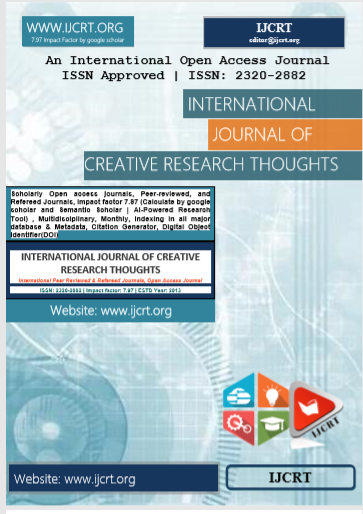 |
 |
|---|---|
| IJCRT Journal front page | IJCRT Journal Back Page |
Paper Title: Exploring the Role of Artificial Intelligence in Customer Behavior Prediction for Digital Marketing
Author Name(s): Prof.(Dr.) Kapila Chavda, Mr. Bhavya Fattania
Published Paper ID: - IJCRT2508213
Register Paper ID - 292217
Publisher Journal Name: IJPUBLICATION, IJCRT
DOI Member ID: 10.6084/m9.doi.one.IJCRT2508213 and DOI :
Author Country : Indian Author, India, 382481 , Ahmedabad, 382481 , | Research Area: Commerce and Management, MBA All Branch Published Paper URL: http://ijcrt.org/viewfull.php?&p_id=IJCRT2508213 Published Paper PDF: download.php?file=IJCRT2508213 Published Paper PDF: http://www.ijcrt.org/papers/IJCRT2508213.pdf
Your Paper Publication Details:
Title: EXPLORING THE ROLE OF ARTIFICIAL INTELLIGENCE IN CUSTOMER BEHAVIOR PREDICTION FOR DIGITAL MARKETING
DOI (Digital Object Identifier) :
Pubished in Volume: 13 | Issue: 8 | Year: August 2025
Publisher Name : IJCRT | www.ijcrt.org | ISSN : 2320-2882
Subject Area: Commerce and Management, MBA All Branch
Author type: Indian Author
Pubished in Volume: 13
Issue: 8
Pages: b834-b841
Year: August 2025
Downloads: 162
E-ISSN Number: 2320-2882
Abstract
Artificial Intelligence (AI) is transforming the digital marketing landscape, primarily by enabling businesses to analyze and predict customer behavior with unprecedented accuracy. This descriptive research paper explores how AI technologies--such as recommendation systems, predictive analytics, and customer segmentation--are being utilized to enhance digital marketing strategies. The paper provides a comprehensive review of current AI tools used in customer behavior analysis and elaborates on their real-world applications. This study aims to summarize the existing literature and technological advancements, insights into how marketers can effectively leverage AI for better consumer targeting, personalization, and strategic decision-making.
Licence: creative commons attribution 4.0
License
Creative Commons Attribution 4.0 and The Open Definition

Keywords
Artificial Intelligence, Customer Behavior, Digital Marketing, Recommendation Systems, Predictive Analytics, Customer Segmentation, Consumer Insights
License
Creative Commons Attribution 4.0 and The Open Definition
Paper Title: Heat Distribution In Smart Buildings: A Numerical Approach Using Scilab By Finite Difference Method
Author Name(s): P.Gowri, P.Soundarya, S.Siva Chandru, S.C.Sree Sanchanaa
Published Paper ID: - IJCRT2508212
Register Paper ID - 292048
Publisher Journal Name: IJPUBLICATION, IJCRT
DOI Member ID: 10.6084/m9.doi.one.IJCRT2508212 and DOI :
Author Country : Indian Author, India, 641007 , COIMBATORE, 641007 , | Research Area: Mathematics All Published Paper URL: http://ijcrt.org/viewfull.php?&p_id=IJCRT2508212 Published Paper PDF: download.php?file=IJCRT2508212 Published Paper PDF: http://www.ijcrt.org/papers/IJCRT2508212.pdf
Your Paper Publication Details:
Title: HEAT DISTRIBUTION IN SMART BUILDINGS: A NUMERICAL APPROACH USING SCILAB BY FINITE DIFFERENCE METHOD
DOI (Digital Object Identifier) :
Pubished in Volume: 13 | Issue: 8 | Year: August 2025
Publisher Name : IJCRT | www.ijcrt.org | ISSN : 2320-2882
Subject Area: Mathematics All
Author type: Indian Author
Pubished in Volume: 13
Issue: 8
Pages: b822-b833
Year: August 2025
Downloads: 149
E-ISSN Number: 2320-2882
Abstract
This paper presents a numerical simulation of the steady-state temperature distribution in a square metallic plate using the Finite Difference Method (FDM) implemented in Scilab. The results demonstrate a smooth and physically consistent temperature gradient influenced by the boundary conditions. The study highlights the effectiveness of FDM for solving heat conduction problems and confirms Scilab as a viable open-source tool for engineering simulations related to thermal management in smart buildings.
Licence: creative commons attribution 4.0
License
Creative Commons Attribution 4.0 and The Open Definition
Keywords
Numerical simulation, Finite Difference Method, Boundary conditions, Thermal management in smart buildings.
License
Creative Commons Attribution 4.0 and The Open Definition
Paper Title: Bridging Epistemologies: Exploring Common Threads in Muslim and Hindu Thought
Author Name(s): Dr. Naseem Gul, Habib Bilal
Published Paper ID: - IJCRT2508211
Register Paper ID - 292210
Publisher Journal Name: IJPUBLICATION, IJCRT
DOI Member ID: 10.6084/m9.doi.one.IJCRT2508211 and DOI :
Author Country : Indian Author, India, 185234 , Rajouri, 185234 , | Research Area: Social Science All Published Paper URL: http://ijcrt.org/viewfull.php?&p_id=IJCRT2508211 Published Paper PDF: download.php?file=IJCRT2508211 Published Paper PDF: http://www.ijcrt.org/papers/IJCRT2508211.pdf
Your Paper Publication Details:
Title: BRIDGING EPISTEMOLOGIES: EXPLORING COMMON THREADS IN MUSLIM AND HINDU THOUGHT
DOI (Digital Object Identifier) :
Pubished in Volume: 13 | Issue: 8 | Year: August 2025
Publisher Name : IJCRT | www.ijcrt.org | ISSN : 2320-2882
Subject Area: Social Science All
Author type: Indian Author
Pubished in Volume: 13
Issue: 8
Pages: b812-b821
Year: August 2025
Downloads: 163
E-ISSN Number: 2320-2882
Abstract
Epistemology that talks about philosophical truth and falsehood, validity of knowledge, limits of knowledge and nature of knowledge, the knower and the known etc. and is commonly described as study of knowledge and justified belief. This paper explores the rich epistemological traditions of the Muslim and Hindu thinkers and how there are transparent strands connecting these two deep traditions. Analyzing historical readings, philosophical ideas and findings through history, the paper seeks to shed light on the commonalities of the ways in which both the traditions view truth, knowledge and the way things are. It also explores the ways in which conversations between thinkers of the two traditions have not only led to mutual understanding and a deepening of the intellectual discourse by the two schools. When approaching the issue of managing modern-day dilemmas of interfaith relations, the paper focuses on the possibilities of these mutual epistemological frames to become a force of collaboration and dialogue. By recognizing the commonalities in thought, this study advocates for a deeper engagement between Muslim and Hindu communities, promoting a spirit of coexistence and respect in an increasingly pluralistic world. Finally, the study aims at making its contribution to a larger conversation about interfaith dialogue by demonstrating the potential of inter-epistemological bridging to between-and among-beliefs understanding and connectivity.
Licence: creative commons attribution 4.0
License
Creative Commons Attribution 4.0 and The Open Definition
Keywords
Epistemology, Similarities, Muslim, Hindu, Islam, Hinduism, Interfaith Dialogue
License
Creative Commons Attribution 4.0 and The Open Definition
Paper Title: CORRELATION OF UPPER AND LOWER LIMB ANTHROPOMETRY ON JAVELIN THROWING PERFORMANCE OF INDIAN ATHLETES
Author Name(s): Virendra Kumar Patel, Prof. Ratnesh Singh
Published Paper ID: - IJCRT2508210
Register Paper ID - 292197
Publisher Journal Name: IJPUBLICATION, IJCRT
DOI Member ID: 10.6084/m9.doi.one.IJCRT2508210 and DOI :
Author Country : Indian Author, India, - , -, - , | Research Area: Science and Technology Published Paper URL: http://ijcrt.org/viewfull.php?&p_id=IJCRT2508210 Published Paper PDF: download.php?file=IJCRT2508210 Published Paper PDF: http://www.ijcrt.org/papers/IJCRT2508210.pdf
Your Paper Publication Details:
Title: CORRELATION OF UPPER AND LOWER LIMB ANTHROPOMETRY ON JAVELIN THROWING PERFORMANCE OF INDIAN ATHLETES
DOI (Digital Object Identifier) :
Pubished in Volume: 13 | Issue: 8 | Year: August 2025
Publisher Name : IJCRT | www.ijcrt.org | ISSN : 2320-2882
Subject Area: Science and Technology
Author type: Indian Author
Pubished in Volume: 13
Issue: 8
Pages: b803-b811
Year: August 2025
Downloads: 176
E-ISSN Number: 2320-2882
Abstract
The present study investigated the relationship between selected anthropometrical variables and their impact on javelin throwing performance This study aimed to examine the relationship between selected upper and lower limb anthropometric parameters and javelin throwing performance. The sample consisted of five top-level javelin throwers representing Indian Railways in the 88th All India Inter Railway Athletics Championship (2023-24), with an average performance of 66.80 meters. Anthropometric measurements included full arm length (FAL), upper arm length (UAL), lower arm length (LAL), full leg length (FLL), upper leg length (ULL), and lower leg length (LLL). Correlation analysis revealed a statistically significant and strong positive relationship between throwing distance and both FAL (r = 0.888, p = 0.044) and LAL (r = 0.935, p = 0.020), suggesting that longer arm segments contribute to enhanced lever mechanics and release efficiency. While UAL showed a positive trend (r = 0.767), it did not reach statistical significance (p = 0.130). Leg segment lengths demonstrated moderate, yet statistically insignificant, positive correlations with performance, indicating a potential but less decisive role in supporting stride dynamics and stability. These findings highlight the relevance of upper limb proportions--especially full and lower arm lengths--as key predictors of javelin throwing success and emphasize their value in athlete assessment, training optimization, and talent identification processes.
Licence: creative commons attribution 4.0
License
Creative Commons Attribution 4.0 and The Open Definition
Keywords
The present study investigated the relationship between selected anthropometrical variables and their impact on javelin throwing performance This study aimed to examine the relationship between selected upper and lower limb anthropometric parameters and javelin throwing performance. The sample consisted of five top-level javelin throwers representing Indian Railways in the 88th All India Inter Railway Athletics Championship (2023-24), with an average performance of 66.80 meters. Anthropometric m
License
Creative Commons Attribution 4.0 and The Open Definition
Paper Title: Social networking sites and adolescent mind: impact on Critical Thinking amongHigher secondary students in Odisha
Author Name(s): Rasmita Mallick
Published Paper ID: - IJCRT2508209
Register Paper ID - 290965
Publisher Journal Name: IJPUBLICATION, IJCRT
DOI Member ID: 10.6084/m9.doi.one.IJCRT2508209 and DOI :
Author Country : Indian Author, India, 755019 , Jajpur road, 755019 , | Research Area: Arts All Published Paper URL: http://ijcrt.org/viewfull.php?&p_id=IJCRT2508209 Published Paper PDF: download.php?file=IJCRT2508209 Published Paper PDF: http://www.ijcrt.org/papers/IJCRT2508209.pdf
Your Paper Publication Details:
Title: SOCIAL NETWORKING SITES AND ADOLESCENT MIND: IMPACT ON CRITICAL THINKING AMONGHIGHER SECONDARY STUDENTS IN ODISHA
DOI (Digital Object Identifier) :
Pubished in Volume: 13 | Issue: 8 | Year: August 2025
Publisher Name : IJCRT | www.ijcrt.org | ISSN : 2320-2882
Subject Area: Arts All
Author type: Indian Author
Pubished in Volume: 13
Issue: 8
Pages: b789-b802
Year: August 2025
Downloads: 184
E-ISSN Number: 2320-2882
Abstract
In the quickly evolving digital age, social networking sites (SNS), such as Facebook, Instagram, WhatsApp etc., become increasingly important in the lives of teenagers. They have an impact on teens' brain development in addition to how they interact with one another. This study looks at how students in higher secondary schools in Odisha (Arts, Science, and Commerce) utilize social networking sites (SNS) and how it affects their ability to think critically. In order to determine whether there were changes in the critical thinking abilities of 150 students (50 from each stream) based on the degree to which they used social networking sites, we used paired t-tests, two-sample t-tests, and ANOVA. The results show that SNS has a statistically significant impact on the critical thinking abilities of students studying the arts and sciences, but not those studying commerce. The Comparative studies and ANOVA also showed that the effects of SNS on different streams had wildly disparate outcomes. According to the findings, children in both streams need different digital education techniques, and they should use social media responsibly to help their brains develop.
Licence: creative commons attribution 4.0
License
Creative Commons Attribution 4.0 and The Open Definition
Keywords
Social Networking Sites (SNS), Critical Thinking, Higher Secondary Students, Academic Streams, Digital Literacy, Cognitive Development
License
Creative Commons Attribution 4.0 and The Open Definition
Paper Title: WHO OWNS AI-GENERATED CONTENT? A LEGAL BLINDSPOT IN COPYRIGHT LAW
Author Name(s): Ishita Malhotra
Published Paper ID: - IJCRT2508208
Register Paper ID - 292187
Publisher Journal Name: IJPUBLICATION, IJCRT
DOI Member ID: 10.6084/m9.doi.one.IJCRT2508208 and DOI :
Author Country : Indian Author, India, - , -, - , | Research Area: Science and Technology Published Paper URL: http://ijcrt.org/viewfull.php?&p_id=IJCRT2508208 Published Paper PDF: download.php?file=IJCRT2508208 Published Paper PDF: http://www.ijcrt.org/papers/IJCRT2508208.pdf
Your Paper Publication Details:
Title: WHO OWNS AI-GENERATED CONTENT? A LEGAL BLINDSPOT IN COPYRIGHT LAW
DOI (Digital Object Identifier) :
Pubished in Volume: 13 | Issue: 8 | Year: August 2025
Publisher Name : IJCRT | www.ijcrt.org | ISSN : 2320-2882
Subject Area: Science and Technology
Author type: Indian Author
Pubished in Volume: 13
Issue: 8
Pages: b784-b788
Year: August 2025
Downloads: 157
E-ISSN Number: 2320-2882
Abstract
The rapid advancement of artificial intelligence (AI) has revolutionized content creation, leading to increasingly sophisticated outputs such as literature, music, art, and code generated with minimal or no human input. However, this technological evolution has outpaced the development of legal frameworks, particularly in the realm of copyright law. Traditional copyright systems are built upon the notion of human authorship, leaving AI-generated content in a legal grey area. This paper critically examines the existing legal lacuna surrounding the ownership and protection of AI-generated works. It explores global perspectives, including approaches by jurisdictions such as the United States, the United Kingdom, and India, and highlights the inconsistencies and challenges in attributing authorship and rights. The study argues that the current copyright regime inadequately addresses the complexities of machine-generated creativity, thereby posing significant risks to creators, developers, and users. Through a doctrinal and comparative legal analysis, the paper underscores the urgent need for legal reform to redefine authorship and ownership in the age of artificial intelligence.
Licence: creative commons attribution 4.0
License
Creative Commons Attribution 4.0 and The Open Definition
Keywords
AI-generated content, copyright law, intellectual property, artificial intelligence, machine creativity, legal lacuna, ownership rights, doctrinal analysis.
License
Creative Commons Attribution 4.0 and The Open Definition
Paper Title: The Self as Light (?tma-Jyoti?): A Unified Vision of Consciousness in the Upani?ads and Yogas?tra
Author Name(s): SANJEEV KUMAR
Published Paper ID: - IJCRT2508207
Register Paper ID - 292174
Publisher Journal Name: IJPUBLICATION, IJCRT
DOI Member ID: 10.6084/m9.doi.one.IJCRT2508207 and DOI :
Author Country : Indian Author, India, 803120 , NALANDA, 803120 , | Research Area: Arts All Published Paper URL: http://ijcrt.org/viewfull.php?&p_id=IJCRT2508207 Published Paper PDF: download.php?file=IJCRT2508207 Published Paper PDF: http://www.ijcrt.org/papers/IJCRT2508207.pdf
Your Paper Publication Details:
Title: THE SELF AS LIGHT (?TMA-JYOTI?): A UNIFIED VISION OF CONSCIOUSNESS IN THE UPANI?ADS AND YOGAS?TRA
DOI (Digital Object Identifier) :
Pubished in Volume: 13 | Issue: 8 | Year: August 2025
Publisher Name : IJCRT | www.ijcrt.org | ISSN : 2320-2882
Subject Area: Arts All
Author type: Indian Author
Pubished in Volume: 13
Issue: 8
Pages: b779-b783
Year: August 2025
Downloads: 155
E-ISSN Number: 2320-2882
Abstract
This paper, titled "The Self as Light (?tma-Jyoti?): A Unified Vision of Consciousness in the Upani?ads and Yogas?tra", presents a comparative analysis of the concept of consciousness in the Indian philosophical tradition. In particular, the nature of the Self is critically examined through the three states of consciousness--waking, dreaming and deep sleep--described in the Upani?ads and the various forms of Sam?dhi described in the Yogas?tra. The main objective is to examine how the Self is viewed as 'light' or '?tman-Jyoti' in both the Upani?ads and Yoga-Darshan and how this view contributes to the process of self-realization and liberation. While the Upani?ad portray the Self as a witnessing and self-illuminating entity, the Yogas?tras reveal higher states of consciousness through Sam?dhi. This article explains the unifying philosophy underlying both traditions--in which the Self is not only the ground of experience but also the light of all knowledge and liberation. Ultimately, this research presents an esoteric view of the nature of the Self that lies beyond the three states of consciousness and Sam?dhi.
Licence: creative commons attribution 4.0
License
Creative Commons Attribution 4.0 and The Open Definition
Keywords
?tma-Jyoti?, Avasth?traya, Sam?dhi, Turiya, Upani?adic Consciousness Yogas?tra Philosophy, Self-realization
License
Creative Commons Attribution 4.0 and The Open Definition
Paper Title: DSF (DynSecFrag): A Dynamic Fragmentation-Based Approach for Secure and Efficient Cloud Storage
Author Name(s): SALMA KHANUM, VIRENDRA KUMAR SHARMA
Published Paper ID: - IJCRT2508206
Register Paper ID - 292150
Publisher Journal Name: IJPUBLICATION, IJCRT
DOI Member ID: 10.6084/m9.doi.one.IJCRT2508206 and DOI : https://doi.org/10.56975/ijcrt.v13i8.292150
Author Country : Indian Author, India, 572103 , tumakuaru, 572103 , | Research Area: Science and Technology Published Paper URL: http://ijcrt.org/viewfull.php?&p_id=IJCRT2508206 Published Paper PDF: download.php?file=IJCRT2508206 Published Paper PDF: http://www.ijcrt.org/papers/IJCRT2508206.pdf
Your Paper Publication Details:
Title: DSF (DYNSECFRAG): A DYNAMIC FRAGMENTATION-BASED APPROACH FOR SECURE AND EFFICIENT CLOUD STORAGE
DOI (Digital Object Identifier) : https://doi.org/10.56975/ijcrt.v13i8.292150
Pubished in Volume: 13 | Issue: 8 | Year: August 2025
Publisher Name : IJCRT | www.ijcrt.org | ISSN : 2320-2882
Subject Area: Science and Technology
Author type: Indian Author
Pubished in Volume: 13
Issue: 8
Pages: b770-b778
Year: August 2025
Downloads: 195
E-ISSN Number: 2320-2882
Abstract
As the demand for cloud storage increases, ensuring data security while maintaining system performance remains a significant challenge. Traditional encryption methods, while providing robust protection, often lead to performance bottlenecks and inefficient resource utilization. This paper presents DSF (DynSecFrag), a novel cloud storage security framework that combines dynamic data fragmentation, location-based key generation, and chain encryption to address these challenges. By using random number generation (RNG) for dynamic fragmentation, DSF ensures unpredictability, making it resistant to targeted attacks. Each data fragment is encrypted with a unique location-based key, adding an additional layer of security, while the chain encryption technique links each fragment's encryption to its predecessor, creating a complex decryption process. Our experimental evaluation demonstrates that DSF outperforms traditional encryption methods by offering superior security, reduced computational overhead, and minimal impact on network bandwidth. The results indicate that DSF is a scalable and efficient solution for securing sensitive cloud data while optimizing performance. Future work will focus on optimizing the system for post-quantum security and integrating it with decentralized cloud storage models.
Licence: creative commons attribution 4.0
License
Creative Commons Attribution 4.0 and The Open Definition
Keywords
Cloud Storage, Data Fragmentation, Dynamic Security, Chain Encryption, Location-Based Key Generation, Random Number Generation, Secure Cloud, Performance Optimization
License
Creative Commons Attribution 4.0 and The Open Definition
Paper Title: Unveiling the Dynamic Impact of Remittances on GDP in India: An Empirical Analysis
Author Name(s): Sanjana Prakash, Prof. Rachna Mujoo
Published Paper ID: - IJCRT2508205
Register Paper ID - 292169
Publisher Journal Name: IJPUBLICATION, IJCRT
DOI Member ID: 10.6084/m9.doi.one.IJCRT2508205 and DOI :
Author Country : Indian Author, India, 226010 , Lucknow, 226010 , | Research Area: Commerce All Published Paper URL: http://ijcrt.org/viewfull.php?&p_id=IJCRT2508205 Published Paper PDF: download.php?file=IJCRT2508205 Published Paper PDF: http://www.ijcrt.org/papers/IJCRT2508205.pdf
Your Paper Publication Details:
Title: UNVEILING THE DYNAMIC IMPACT OF REMITTANCES ON GDP IN INDIA: AN EMPIRICAL ANALYSIS
DOI (Digital Object Identifier) :
Pubished in Volume: 13 | Issue: 8 | Year: August 2025
Publisher Name : IJCRT | www.ijcrt.org | ISSN : 2320-2882
Subject Area: Commerce All
Author type: Indian Author
Pubished in Volume: 13
Issue: 8
Pages: b760-b769
Year: August 2025
Downloads: 175
E-ISSN Number: 2320-2882
Abstract
The trajectory of growth is often not linear, relationship between macroeconomic variable changes a number of times before we can actually ascertain the actual impact of remittances on the GDP. This study employs threshold regression analysis to identify the threshold limit beyond which remittances significantly impact GDP growth in India. Furthermore, the dynamic relationship between remittances and GDP growth has been studied by incorporating structural breaks in remittance inflows as dummy variables in interaction with remittances which was done using ARDL. The study aims to identify various points in the timeline of remittances inflow in India and their respective impacts on the GDP. The results suggest that remittances can drive secular growth in the long run, subject to certain exogenous and endogenous factors. The analysis covers the time period from 1975 to 2023 and the data has been extracted from World Bank.
Licence: creative commons attribution 4.0
License
Creative Commons Attribution 4.0 and The Open Definition
Keywords
Remittances, GDP, India, Threshold Regression, Structural Break, ARDL
License
Creative Commons Attribution 4.0 and The Open Definition
Paper Title: Methanol fuel utilization in dual fuel Compression Ignition (CI) Engine
Author Name(s): Laxman Subhash Done
Published Paper ID: - IJCRT2508203
Register Paper ID - 292198
Publisher Journal Name: IJPUBLICATION, IJCRT
DOI Member ID: 10.6084/m9.doi.one.IJCRT2508203 and DOI :
Author Country : Indian Author, India, 414203 , Beed, 414203 , | Research Area: Science and Technology Published Paper URL: http://ijcrt.org/viewfull.php?&p_id=IJCRT2508203 Published Paper PDF: download.php?file=IJCRT2508203 Published Paper PDF: http://www.ijcrt.org/papers/IJCRT2508203.pdf
Your Paper Publication Details:
Title: METHANOL FUEL UTILIZATION IN DUAL FUEL COMPRESSION IGNITION (CI) ENGINE
DOI (Digital Object Identifier) :
Pubished in Volume: 13 | Issue: 8 | Year: August 2025
Publisher Name : IJCRT | www.ijcrt.org | ISSN : 2320-2882
Subject Area: Science and Technology
Author type: Indian Author
Pubished in Volume: 13
Issue: 8
Pages: b737-b755
Year: August 2025
Downloads: 166
E-ISSN Number: 2320-2882
Abstract
The experimentation was carried out on a setup consists of single cylinder port injection dual fuel, four stroke Common rail direct injection (CRDI), Variable Compression Ratio (VCR) and open Electronic Control Unit (ECU) engine connected to eddy current dynamometer. The diesel fuel is injected directly into the combustion chamber as a pilot fuel with common rail fuel injection system and methanol fuel is injected into the intake manifold by using separate fuel injector as main fuel. The aim of this project is to perform the experimentation for Methanol (CH3OH) utilization in Dual fuel compression ignition and investigation of the Combustion characteristics and performance analysis and emission analysis of the engine running at constant 1500 rpm and 100% load. Five methanol replacement ratios (MRR) such as 0% (pure diesel), 15 %, 25%, 35%, and 45% were conducted. From study it is observed that, premixed diesel combustion was retarded as well as improved, diffusion diesel combustion was increased and progressed, ignition delay was longer, combustion duration was lowered, methanol is the most beneficial in terms of extending ignition delay and lowering combustion duration for the specific methanol replacement ratio.Net heat release rate (HRR) and NOx increases consistently for increasing MRR at 100% load. The BTE decreases consistently with increasing the MRR. Lower CO and smoke opacity emission was reported with high MRR. HC and CO2emissions were higher for high MRR.
Licence: creative commons attribution 4.0
License
Creative Commons Attribution 4.0 and The Open Definition
Keywords
Keywords: Compression Ignition Engine, Dual fuel, port injection, Methanol, Pilot fuel.
License
Creative Commons Attribution 4.0 and The Open Definition
Call For Paper March 2026
Call For Papers
March 2026
Volume 14 | Issue 3
Last Date :
31-Mar-2026
Submit Manuscript Online Impact Factor: 7.97 Review Results : Within 02-03 Days Paper Publication : Within 02-03 Days
March 2026
Volume 14 | Issue 3
Last Date :
31-Mar-2026
Submit Manuscript Online Impact Factor: 7.97 Review Results : Within 02-03 Days Paper Publication : Within 02-03 Days
Published Issue Details
For Authors
Forms / Downloads
Other IMP Links
Indexing Partner
Research Area
LICENSE





ISSN and 7.97 Impact Factor Details

ISSN: 2320-2882 Impact Factor: 7.97 and ISSN APPROVED Journal Starting Year (ESTD) : 2013


ISSN and 7.97 Impact Factor Details
ISSN: 2320-2882 Impact Factor: 7.97 and ISSN APPROVED Journal Starting Year (ESTD) : 2013
DOI Details
CONFERENCE
CONFERENCE MANAGMENT & PUBLICATION CONFERENCE PROPOSAL
RECENT CONFERENCE

CONFERENCE PROPOSAL CONFERENCE PROCEEDINGS
CONFERENCE PROPOSAL CONFERENCE PROCEEDINGS
For Reviewer /Referral (RMS) Earn 500 per paper
Important Links
NEWS & Conference
Digital Library
IJCRT RMS | Earn 500 Per Paper.

Open Access


LICENSE
Indexing Partner
Scholarly open access journals, Peer-reviewed, and Refereed Journals, Impact factor 7.97 (Calculate by google scholar and Semantic Scholar | AI-Powered Research Tool) , Multidisciplinary, Monthly, Indexing in all major database & Metadata, Citation Generator, Digital Object Identifier(DOI)