Important Details
IJCRT - International Peer Reviewed, Open Access Journal, Multidisciplinary, Monthly, Nominal(Low) Fees for Professional Research Services International Journal of Creative Research Thoughts - IJCRT Peer Review Journal, Refereed Journal, Peer Reviewed Journal , Referred Journal and Indexed Journal, Open access, Online and Print Journal,international Journal Open Access, Accepted by Indian and foreign university ,IJCRT Followed Norms, guidelines, requirement, listing criteria and methodology of score/point also applied from: Scopus , Web of Science , UGC Approved , UGC CARE, UGC-CARE .
UGC Approved Journal No: 49023 (18)
UGC approval Link
https://ijcrt.org/ugc%20approval.jpg
All Policy and Approval
Please Like Our Facebook Page | CrossRef DOI and Hard copy of Certificate Provide if required. | www.IJCRT.org | editor@IJCRT.org | WhatsApp: 7990172303
Publication Details:
- Paper Submission : 31-May-2026. Call For Paper (Volume 14 | Issue 5 | Month- May 2026)
- Acceptance/Rejection Notification: Within 02-04 Days.
- Paper Publish: Within 02-04 Days after submitting all documents.
-
Submit Your Paper Any time There No deadline.
-
Publication fees : 1570 INR for Indian author & 59$ for foreign International author.
Please Like Our Facebook Page | CrossRef DOI and Hard copy of Certificate Provide if required.
Licence and Indexing
Indexing In Google Scholar, SSRN, ResearcherID-Publons, Semantic Scholar | AI-Powered Research Tool, Microsoft Academic, Academia.edu, arXiv.org, Research Gate, CiteSeerX, ResearcherID Thomson Reuters, Mendeley : reference manager, DocStoc, ISSUU, Scribd, and many more | High Impact Factor: 7.97 | Digital object identifier (DOI) and Hard Copy of certificate Provided.




























Licence
DOI
ISSN Approved impact factor: 7.97 
Creative Common 
Valid as per new UGC Gazette regulations 

INTERNATIONAL JOURNAL OF CREATIVE RESEARCH THOUGHTS - IJCRT (IJCRT.ORG)
International Peer Reviewed & Refereed Journals, Open Access Journal
IJCRT Peer-Reviewed (Refereed) Journal as Per New UGC Rules.
ISSN Approved Journal No: 2320-2882 | Impact factor: 7.97 | ESTD Year: 2013
Call For Paper - Volume 14 | Issue 5 | Month- May 2026
Scholarly open access journals, Peer-reviewed, and Refereed Journals, Impact factor 7.97 (Calculate by google scholar and Semantic Scholar | AI-Powered Research Tool) , Multidisciplinary, Monthly, Indexing in all major database & Metadata, Citation Generator, Digital Object Identifier(CrossRef DOI)
Contact Us Click Here
WhatsApp Contact Click Here
IJCRT Search Xplore - Search all paper by Paper Name , Author Name, and Title
Volume 14 | Issue 5 |
Volume 14 | Issue 5 | Month
Downlaod After Publication 1) Table of content index in PDF
2) Table of content index in HTML 2)Table of content index in HTML
3) Front Page 3) Front Page
4) Back Page 4) Back Page
5) Editor Board Member 5)Editor Board Member
6) OLD Style Issue 6)OLD Style Issue
 |
 |
|---|---|
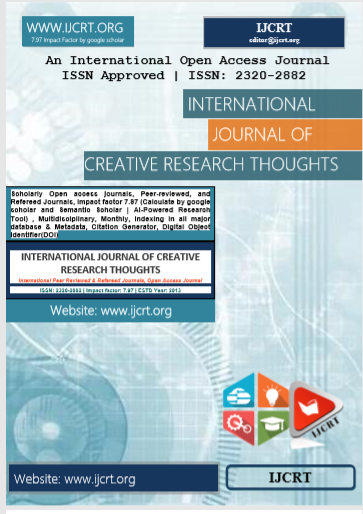
| IJCRT Journal front page | IJCRT Journal Back Page |
Paper Title: Climate change as a violation of right to life: a comparative analysis
Author Name(s): Saumya, Sarita Yadav
Published Paper ID: - IJCRT2605003
Register Paper ID - 307639
Publisher Journal Name: IJPUBLICATION, IJCRT
DOI Member ID: 10.6084/m9.doi.one.IJCRT2605003 and DOI :
Author Country : Indian Author, India, 212635 , Fatehpur , 212635 , | Research Area: Others area Published Paper URL: http://ijcrt.org/viewfull.php?&p_id=IJCRT2605003 Published Paper PDF: download.php?file=IJCRT2605003 Published Paper PDF: http://www.ijcrt.org/papers/IJCRT2605003.pdf
Your Paper Publication Details:
Title: CLIMATE CHANGE AS A VIOLATION OF RIGHT TO LIFE: A COMPARATIVE ANALYSIS
DOI (Digital Object Identifier) :
Pubished in Volume: 14 | Issue: 5 | Year: May 2026
Publisher Name : IJCRT | www.ijcrt.org | ISSN : 2320-2882
Subject Area: Others area
Author type: Indian Author
Pubished in Volume: 14
Issue: 5
Pages: a12-a20
Year: May 2026
Downloads: 58
E-ISSN Number: 2320-2882
Abstract
Climate change is no longer a distant or theoretical concern; it has become an immediate and lived reality, particularly in India. Increasing heatwaves, floods, landslides , rising sea levels, and growing threats to food security demonstrate how climate impacts are affecting everyday life rather than remaining isolated environmental events. India's legal framework has historically addressed environmental protection by expanding the scope of Article 21 of the Constitution to include the right to a clean and healthy environment. However, a significant development occurred in 2024 when the Supreme Court recognised freedom from the adverse effects of climate change as a fundamental right. This marked a shift from traditional environmental regulation toward the broader concept of climate constitutionalism. This study examines how climate change has become embedded within the constitutional right to life by analysing judicial developments, human rights principles, climate justice, and intergenerational equity. While the judiciary has played a crucial role in advancing climate rights, the effectiveness of these protections ultimately depends on the creation of comprehensive legislation and strong institutional mechanisms. Without practical implementation, constitutional recognition alone risks remaining symbolic rather than transformative.
Licence: creative commons attribution 4.0
License
Creative Commons Attribution 4.0 and The Open Definition

Keywords
Climate Change; Right to Life; Article 21; Climate Constitutionalism; Human Rights; Climate Justice; Intergenerational Equity.
License
Creative Commons Attribution 4.0 and The Open Definition
Paper Title: Child labour in global supply chains with reference to India
Author Name(s): Saniya Khan, Mr Abhishek Mishra
Published Paper ID: - IJCRT2605002
Register Paper ID - 307632
Publisher Journal Name: IJPUBLICATION, IJCRT
DOI Member ID: 10.6084/m9.doi.one.IJCRT2605002 and DOI :
Author Country : Indian Author, India, 208016 , Kanpur, 208016 , | Research Area: Other area not in list Published Paper URL: http://ijcrt.org/viewfull.php?&p_id=IJCRT2605002 Published Paper PDF: download.php?file=IJCRT2605002 Published Paper PDF: http://www.ijcrt.org/papers/IJCRT2605002.pdf
Your Paper Publication Details:
Title: CHILD LABOUR IN GLOBAL SUPPLY CHAINS WITH REFERENCE TO INDIA
DOI (Digital Object Identifier) :
Pubished in Volume: 14 | Issue: 5 | Year: May 2026
Publisher Name : IJCRT | www.ijcrt.org | ISSN : 2320-2882
Subject Area: Other area not in list
Author type: Indian Author
Pubished in Volume: 14
Issue: 5
Pages: a6-a11
Year: May 2026
Downloads: 55
E-ISSN Number: 2320-2882
Abstract
Child labour remains a pervasive and deeply entrenched issue in many parts of the world, with its manifestations often hidden within the complex and opaque networks of global supply chains. India, with its vast population, diverse economy, and historical socioeconomic challenges, presents a particularly significant context for examining child labour within these intricate production systems. The phenomenon is not merely a by-product of poverty but is deeply interwoven with issues of inadequate education, weak governance, cultural norms, and the relentless pursuit of profit by multinational corporations. Global supply chains, characterized by their fragmented nature, subcontracting practices, and the pressure to reduce costs, create fertile ground for the exploitation of children, particularly in sectors where oversight is minimal and the labour force is largely informal. This essay will delve into the multifaceted problem of child labour in global supply chains, with a specific focus on India. It will explore the root causes, the sectors most affected, the impact on children, the role of global corporations and consumers, and the legal and policy frameworks in place, as well as their limitations. Finally, it will consider potential pathways and strategies for its eradication.
Licence: creative commons attribution 4.0
License
Creative Commons Attribution 4.0 and The Open Definition
Keywords
Child Labour, Global Supply Chains, India, Exploitation, Informal Sector
License
Creative Commons Attribution 4.0 and The Open Definition
Paper Title: Asian Crop Yield Prediction System
Author Name(s): Adarsh Pandey, Ayush Kumar Maurya, Sidh Jain
Published Paper ID: - IJCRT2605001
Register Paper ID - 307673
Publisher Journal Name: IJPUBLICATION, IJCRT
DOI Member ID: 10.6084/m9.doi.one.IJCRT2605001 and DOI :
Author Country : Indian Author, India, 250005 , Meerut, 250005 , | Research Area: Science and Technology Published Paper URL: http://ijcrt.org/viewfull.php?&p_id=IJCRT2605001 Published Paper PDF: download.php?file=IJCRT2605001 Published Paper PDF: http://www.ijcrt.org/papers/IJCRT2605001.pdf
Your Paper Publication Details:
Title: ASIAN CROP YIELD PREDICTION SYSTEM
DOI (Digital Object Identifier) :
Pubished in Volume: 14 | Issue: 5 | Year: May 2026
Publisher Name : IJCRT | www.ijcrt.org | ISSN : 2320-2882
Subject Area: Science and Technology
Author type: Indian Author
Pubished in Volume: 14
Issue: 5
Pages: a1-a5
Year: May 2026
Downloads: 103
E-ISSN Number: 2320-2882
Abstract
Agriculture is a part of Indias economy. We need to guess how much crops will grow so we can make sure we have food and plan the economy. In this paper we are talking about a system that uses computers to guess how much crops will grow. This system also uses pictures to show how well crops will do in Indias three growing seasons: Kharif, Rabi and Zaid. Our system uses a method called Linear Regression. It looks at things like how rain falls how hot it is how much pesticide is used and how much fertilizer is used to guess how much crops will grow. We measure how much crops grow in tons per hectare. We are using how much crops grow. Linear Regression to make guesses. We made a website using a tool called Streamlit. It lets people get guesses away. It also shows pictures of the guess results using a tool called Plotly. This is really helpful for people who want to see the results of how much crops grow. Our system is good at guessing how much crops will grow. It also helps farmers and people who plan agriculture by giving them tools to make decisions through dashboards. This means farmers and planners can use our system to make decisions about how much crops will grow. We tested our system with a lot of data. 3,000 Points. The results were good. We were able to guess how 30 crops would grow across three cycles. Our system guessed how much crops would grow. The results were good. Our system is helpful for precision agriculture. This lets farmers and people who plan agriculture make decisions based on facts. This helps them choose the crops and use resources in the way. Precision agriculture and how much crops grow are important, for Indias economy. Index Terms--Crop yield prediction, machine learning, linear regression, precision agriculture, Streamlit, Indian agriculture, seasonal crops, data visualization, agricultural informatics
Licence: creative commons attribution 4.0
License
Creative Commons Attribution 4.0 and The Open Definition
Keywords
Crop yield prediction, machine learning, linear regression, precision agriculture, Streamlit, Indian agriculture, seasonal crops, data visualization, agricultural informatics
License
Creative Commons Attribution 4.0 and The Open Definition
Paper Title: Evaluating the Effectiveness Of Workplace Sexual Harassment Protections For Women In India: A Critical Study
Author Name(s): Varshita Yadav
Published Paper ID: - IJCRT21X0404
Register Paper ID - 308082
Publisher Journal Name: IJPUBLICATION, IJCRT
DOI Member ID: 10.6084/m9.doi.one.IJCRT21X0404 and DOI :
Author Country : Indian Author, India, 201017 , Ghaziabad, 201017 , | Research Area: Medical Science All Published Paper URL: http://ijcrt.org/viewfull.php?&p_id=IJCRT21X0404 Published Paper PDF: download.php?file=IJCRT21X0404 Published Paper PDF: http://www.ijcrt.org/papers/IJCRT21X0404.pdf
Your Paper Publication Details:
Title: EVALUATING THE EFFECTIVENESS OF WORKPLACE SEXUAL HARASSMENT PROTECTIONS FOR WOMEN IN INDIA: A CRITICAL STUDY
DOI (Digital Object Identifier) :
Pubished in Volume: 14 | Issue: 5 | Year: May 2026
Publisher Name : IJCRT | www.ijcrt.org | ISSN : 2320-2882
Subject Area: Medical Science All
Author type: Indian Author
Pubished in Volume: 14
Issue: 5
Pages: w319-w395
Year: May 2026
Downloads: 47
E-ISSN Number: 2320-2882
Abstract
Workplace sexual harassment remains a significant barrier to achieving gender equality and ensuring safe working environments for women in India, despite the existence of a comprehensive legal framework. The enactment of the Sexual Harassment of Women at Workplace (Prevention, Prohibition and Redressal) Act, 2013, inspired by the landmark Vishaka v. State of Rajasthan judgment, marked a crucial step toward recognizing and addressing such violations. However, the effectiveness of these legal protections in practice continues to raise important concerns. This study critically examines the extent to which existing legal mechanisms safeguard women against workplace sexual harassment. It adopts a doctrinal and analytical approach, drawing upon statutory provisions, judicial decisions, and secondary literature to evaluate both the theoretical strength and practical implementation of the law. The research also incorporates a socio-legal perspective to understand how workplace culture, power dynamics, and societal attitudes influence the reporting and redressal of such incidents. The findings reveal a persistent gap between law and practice. While the legal framework appears robust on paper, its effectiveness is undermined by widespread underreporting, lack of awareness among employees, and inefficiencies in institutional mechanisms such as Internal Complaints Committees. Additionally, socio-cultural barriers, including fear of retaliation, stigma, and patriarchal norms, continue to discourage victims from seeking justice. Challenges are further compounded in the unorganized sector, where enforcement remains particularly weak. The study concludes that addressing workplace sexual harassment requires more than legal provisions alone. Strengthening implementation, ensuring accountability, promoting awareness, and fostering a culture of zero tolerance are essential for translating legal intent into meaningful protection. The research highlights the need for systemic reforms and sustained efforts to create safer, more inclusive workplaces for women in India.
Licence: creative commons attribution 4.0
License
Creative Commons Attribution 4.0 and The Open Definition
Keywords
Workplace Sexual Harassment; POSH Act, 2013; Gender Equality; Women's Rights; Legal Framework in India; Internal Complaints Committee (ICC); Underreporting; Socio-legal Challenges
License
Creative Commons Attribution 4.0 and The Open Definition
Call For Paper May 2026
Call For Papers
May 2026
Volume 14 | Issue 5
Last Date :
31-May-2026
Submit Manuscript Online Impact Factor: 7.97 Review Results : Within 02-03 Days Paper Publication : Within 02-03 Days
May 2026
Volume 14 | Issue 5
Last Date :
31-May-2026
Submit Manuscript Online Impact Factor: 7.97 Review Results : Within 02-03 Days Paper Publication : Within 02-03 Days
Published Issue Details
For Authors
Forms / Downloads
Other IMP Links
Indexing Partner
Research Area
LICENSE





ISSN and 7.97 Impact Factor Details

ISSN: 2320-2882 Impact Factor: 7.97 and ISSN APPROVED Journal Starting Year (ESTD) : 2013


ISSN and 7.97 Impact Factor Details
ISSN: 2320-2882 Impact Factor: 7.97 and ISSN APPROVED Journal Starting Year (ESTD) : 2013
DOI Details
CONFERENCE
CONFERENCE MANAGMENT & PUBLICATION CONFERENCE PROPOSAL
RECENT CONFERENCE

CONFERENCE PROPOSAL CONFERENCE PROCEEDINGS
CONFERENCE PROPOSAL CONFERENCE PROCEEDINGS
For Reviewer /Referral (RMS) Earn 500 per paper
Important Links
NEWS & Conference
Digital Library
IJCRT RMS | Earn 500 Per Paper.

Open Access


LICENSE
Indexing Partner
Scholarly open access journals, Peer-reviewed, and Refereed Journals, Impact factor 7.97 (Calculate by google scholar and Semantic Scholar | AI-Powered Research Tool) , Multidisciplinary, Monthly, Indexing in all major database & Metadata, Citation Generator, Digital Object Identifier(DOI)