Important Details
IJCRT - International Peer Reviewed, Open Access Journal, Multidisciplinary, Monthly, Nominal(Low) Fees for Professional Research Services International Journal of Creative Research Thoughts - IJCRT Peer Review Journal, Refereed Journal, Peer Reviewed Journal , Referred Journal and Indexed Journal, Open access, Online and Print Journal,international Journal Open Access, Accepted by Indian and foreign university ,IJCRT Followed Norms, guidelines, requirement, listing criteria and methodology of score/point also applied from: Scopus , Web of Science , UGC Approved , UGC CARE, UGC-CARE .
UGC Approved Journal No: 49023 (18)
UGC approval Link
https://ijcrt.org/ugc%20approval.jpg
All Policy and Approval
Please Like Our Facebook Page | CrossRef DOI and Hard copy of Certificate Provide if required. | www.IJCRT.org | editor@IJCRT.org | IJCRT WhatsApp +91 7990172303
Publication Details:
- Paper Submission : 31-Jul-2026. Call For Paper (Volume 14 | Issue 7 | Month- July 2026)
- Acceptance/Rejection Notification: Within 02-04 Days.
- Paper Publish: Within 02-04 Days after submitting all documents.
-
Submit Your Paper Any time There No deadline.
-
Publication fees : 1570 INR for Indian author & 59$ for foreign International author.
Please Like Our Facebook Page | CrossRef DOI and Hard copy of Certificate Provide if required.
Licence and Indexing
Indexing In Google Scholar, SSRN, ResearcherID-Publons, Semantic Scholar | AI-Powered Research Tool, Microsoft Academic, Academia.edu, arXiv.org, Research Gate, CiteSeerX, ResearcherID Thomson Reuters, Mendeley : reference manager, DocStoc, ISSUU, Scribd, and many more | High Impact Factor: 7.97 | Digital object identifier (DOI) and Hard Copy of certificate Provided.




























Licence
DOI
ISSN Approved impact factor: 7.97 
Creative Common 
Valid as per new UGC Gazette regulations 

INTERNATIONAL JOURNAL OF CREATIVE RESEARCH THOUGHTS - IJCRT (IJCRT.ORG)
International Peer Reviewed & Refereed Journals, Open Access Journal
IJCRT Peer-Reviewed (Refereed) Journal as Per New UGC Rules.
ISSN Approved Journal No: 2320-2882 | Impact factor: 7.97 | ESTD Year: 2013
Call For Paper - Volume 14 | Issue 7 | Month- July 2026
Scholarly open access journals, Peer-reviewed, and Refereed Journals, Impact factor 7.97 (Calculate by google scholar and Semantic Scholar | AI-Powered Research Tool) , Multidisciplinary, Monthly, Indexing in all major database & Metadata, Citation Generator, Digital Object Identifier(CrossRef DOI)
IJCRT WhatsApp Contact
IJCRT Search Xplore - Search all paper by Paper Name , Author Name, and Title
Volume 13 | Issue 4 |
Volume 13 | Issue 4 | Month
Downlaod After Publication 1) Table of content index in PDF
2) Table of content index in HTML 2)Table of content index in HTML
3) Front Page 3) Front Page
4) Back Page 4) Back Page
5) Editor Board Member 5)Editor Board Member
6) OLD Style Issue 6)OLD Style Issue
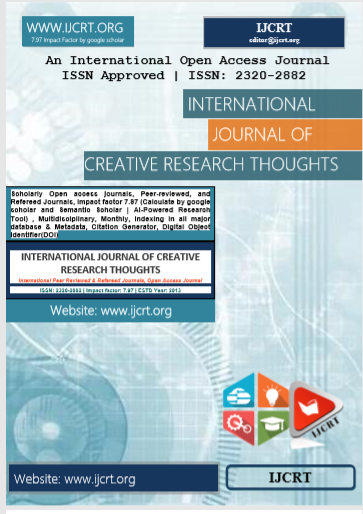 |
 |
|---|---|
| IJCRT Journal front page | IJCRT Journal Back Page |
Paper Title: VLSI Implementation Of Error Detection And Correction Codes For Space Engineering
Author Name(s): D.Mani Ayyappa, J. Vishala Devi, M. Durga Prasad, Y. Abhi Ram
Published Paper ID: - IJCRT21X0329
Register Paper ID - 281019
Publisher Journal Name: IJPUBLICATION, IJCRT
DOI Member ID: 10.6084/m9.doi.one.IJCRT21X0329 and DOI :
Author Country : Indian Author, India, 534101 , Tadepalligudem, 534101 , | Research Area: Science and Technology Published Paper URL: http://ijcrt.org/viewfull.php?&p_id=IJCRT21X0329 Published Paper PDF: download.php?file=IJCRT21X0329 Published Paper PDF: http://www.ijcrt.org/papers/IJCRT21X0329.pdf
Your Paper Publication Details:
Title: VLSI IMPLEMENTATION OF ERROR DETECTION AND CORRECTION CODES FOR SPACE ENGINEERING
DOI (Digital Object Identifier) :
Pubished in Volume: 13 | Issue: 4 | Year: April 2025
Publisher Name : IJCRT | www.ijcrt.org | ISSN : 2320-2882
Subject Area: Science and Technology
Author type: Indian Author
Pubished in Volume: 13
Issue: 4
Pages: s1-s40
Year: April 2025
Downloads: 463
E-ISSN Number: 2320-2882
Abstract
On behalf of technology scaling, on-chip memories in a die undergoes bit errors because of single events or multiple cell upsets by the ecological factors such as cosmic radiation, alpha, neutron particles or due to maximum temperature in space, leads to data corruption. Error detection and correction techniques (ECC) recognize and rectify the corrupted data over communication channel. In this paper, an advanced error correction 2-dimensional code based on divide-symbol is proposed to weaken radiationinduced MCUs in memory for space applications. For encoding data bits, diagonal bits, parity bits and check bits were analyzed by XOR operation. To recover the data, again XOR operation was performed between the encoded bits and the recalculated encoded bits. After analyzing, verification, selection and correction process takes place. The proposed scheme was simulated and synthesized using Xilinx Vivado implemented in Verilog HDL. Compared with the well known existing methods, this encoding-decoding process consumes low power and occupies minimum area and delay.
Licence: creative commons attribution 4.0
License
Creative Commons Attribution 4.0 and The Open Definition

Paper Title: Cross-Cultural Differences in Decision-Making Styles Between North and South Indians
Author Name(s): YESHWINI SHARMA, BHUMIKA BN
Published Paper ID: - IJCRT21X0328
Register Paper ID - 282072
Publisher Journal Name: IJPUBLICATION, IJCRT
DOI Member ID: 10.6084/m9.doi.one.IJCRT21X0328 and DOI :
Author Country : Indian Author, India, 560085 , Bangalore , 560085 , | Research Area: Other area not in list Published Paper URL: http://ijcrt.org/viewfull.php?&p_id=IJCRT21X0328 Published Paper PDF: download.php?file=IJCRT21X0328 Published Paper PDF: http://www.ijcrt.org/papers/IJCRT21X0328.pdf
Your Paper Publication Details:
Title: CROSS-CULTURAL DIFFERENCES IN DECISION-MAKING STYLES BETWEEN NORTH AND SOUTH INDIANS
DOI (Digital Object Identifier) :
Pubished in Volume: 13 | Issue: 4 | Year: April 2025
Publisher Name : IJCRT | www.ijcrt.org | ISSN : 2320-2882
Subject Area: Other area not in list
Author type: Indian Author
Pubished in Volume: 13
Issue: 4
Pages: r931-r981
Year: April 2025
Downloads: 463
E-ISSN Number: 2320-2882
Abstract
This research investigates variations in decision-making approaches between individuals from North India and South India, focusing on cultural, psychological, and organizational influences. The study evaluates how regional traditions, historical contexts, and societal values impact five decision-making categories: analytical, emotion-driven, group-oriented, delay-prone, and impulsive strategies. A blended methodology was adopted, incorporating a 20-item survey calibrated for cultural relevance and distributed to 209 participants (balanced regional representation), covering diverse age groups (19-55), genders, and professions. Advanced statistical techniques, including factor validation and multivariate testing, were used to isolate cultural factors, while frameworks such as individualism-collectivism theory contextualized behavioral outcomes. Core insights reveal that North Indian respondents prioritized methodical decision-making, marked by structured evaluation, risk mitigation, and adherence to established norms--traits consistent with societal emphasis on hierarchy and individual achievement. South Indian participants, however, leaned toward emotionally informed choices, reflecting adaptive, context-sensitive reasoning, potentially shaped by communal values and indirect communication practices. Collaborative decision-making was more frequent in South Indian groups, aligning with collective social structures, whereas North Indians often deferred decisions in high-pressure scenarios, possibly due to fear of individual accountability. Impulsive choices showed minimal regional disparity, though younger demographics universally favored rapid, instinctive actions. The analysis emphasizes cultural self-awareness--recognizing inherent cognitive biases--as vital for reducing misinterpretations in cross-cultural collaborations, such as multinational team projects. Practical applications include adapting leadership models (e.g., task-focused strategies for North Indians vs. relationship-driven approaches for South Indians) and developing region-specific evaluation metrics for workplace assessments. Policymakers could apply these insights to improve intercultural training programs, while integrating cultural flexibility indices may enhance global personality assessments. Theoretical advancements explore potential neurobiological foundations for decision-making styles, suggesting brain network variations (e.g., analytical vs. emotional processing pathways) as areas for future inquiry. Limitations include urban participant overrepresentation and snapshot data collection, which may exclude rural or less-educated perspectives. Subsequent studies should employ longitudinal tracking to observe cultural adaptation over time and neuroscientific methods (e.g., brain imaging) to map decision-making neural pathways. Comparative subregional analyses (e.g., Gujarat vs. Kerala) and qualitative fieldwork could further elucidate localized cultural nuances. By merging behavioral science and cultural anthropology, this work advances understanding of how societal norms and cognitive patterns jointly shape decision architectures in evolving global landscapes.
Licence: creative commons attribution 4.0
License
Creative Commons Attribution 4.0 and The Open Definition
Keywords
Cultural decision-making, Analytical reasoning, Emotion-driven choices, Collective social dynamics, Cognitive bias mitigation, Individualism-collectivism theory, Leadership adaptation, Neurobehavioral correlates, Intercultural training.
License
Creative Commons Attribution 4.0 and The Open Definition
Paper Title: The Role of Influencer Marketing in consumer trust in Skin Care Industry
Author Name(s): Vaibhav Khanna, Dr. Sailaja Bohra
Published Paper ID: - IJCRT21X0327
Register Paper ID - 279719
Publisher Journal Name: IJPUBLICATION, IJCRT
DOI Member ID: 10.6084/m9.doi.one.IJCRT21X0327 and DOI : http://doi.one/10.1729/Journal.44760
Author Country : Indian Author, India, 201011 , Gaziabad, 201011 , | Research Area: Management All Published Paper URL: http://ijcrt.org/viewfull.php?&p_id=IJCRT21X0327 Published Paper PDF: download.php?file=IJCRT21X0327 Published Paper PDF: http://www.ijcrt.org/papers/IJCRT21X0327.pdf
Your Paper Publication Details:
Title: THE ROLE OF INFLUENCER MARKETING IN CONSUMER TRUST IN SKIN CARE INDUSTRY
DOI (Digital Object Identifier) : http://doi.one/10.1729/Journal.44760
Pubished in Volume: 13 | Issue: 4 | Year: April 2025
Publisher Name : IJCRT | www.ijcrt.org | ISSN : 2320-2882
Subject Area: Management All
Author type: Indian Author
Pubished in Volume: 13
Issue: 4
Pages: r873-r930
Year: April 2025
Downloads: 499
E-ISSN Number: 2320-2882
Abstract
Licence: creative commons attribution 4.0
License
Creative Commons Attribution 4.0 and The Open Definition
Keywords
Influencer Marketing, Consumer Trust,,Skincare Industry, Digital Marketing, Social Media Influencers, Brand Engagement, Market Segmentation, Consumer Behavior, Authenticity in Marketing, Micro-Influencers, Macro-Influencers, Skincare Product Recommendations, Brand Loyalty, Purchase Intentions, Social Media Advertising, Online Consumer Perception, Content Marketing, Transparency in Influencer Marketing, Digital Advertising Trends, Influencer Endorsements, Consumer Psychology, Product Reviews, Tru
License
Creative Commons Attribution 4.0 and The Open Definition
Call For Paper July 2026
Call For Papers
July 2026
Volume 14 | Issue 7
Last Date :
31-Jul-2026
Submit Manuscript Online Impact Factor: 7.97 Review Results : Within 02-03 Days Paper Publication : Within 02-03 Days
July 2026
Volume 14 | Issue 7
Last Date :
31-Jul-2026
Submit Manuscript Online Impact Factor: 7.97 Review Results : Within 02-03 Days Paper Publication : Within 02-03 Days
Published Issue Details
For Authors
Forms / Downloads
Other IMP Links
Indexing Partner
Research Area
LICENSE





ISSN and 7.97 Impact Factor Details

ISSN: 2320-2882 Impact Factor: 7.97 and ISSN APPROVED Journal Starting Year (ESTD) : 2013


ISSN and 7.97 Impact Factor Details
ISSN: 2320-2882 Impact Factor: 7.97 and ISSN APPROVED Journal Starting Year (ESTD) : 2013
DOI Details
CONFERENCE
CONFERENCE MANAGMENT & PUBLICATION CONFERENCE PROPOSAL
RECENT CONFERENCE

CONFERENCE PROPOSAL CONFERENCE PROCEEDINGS
CONFERENCE PROPOSAL CONFERENCE PROCEEDINGS
For Reviewer /Referral (RMS) Earn 500 per paper
Important Links
NEWS & Conference
Digital Library
IJCRT RMS | Earn 500 Per Paper.

Open Access


LICENSE
Indexing Partner
Scholarly open access journals, Peer-reviewed, and Refereed Journals, Impact factor 7.97 (Calculate by google scholar and Semantic Scholar | AI-Powered Research Tool) , Multidisciplinary, Monthly, Indexing in all major database & Metadata, Citation Generator, Digital Object Identifier(DOI)