Important Details
IJCRT - International Peer Reviewed, Open Access Journal, Multidisciplinary, Monthly, Nominal(Low) Fees for Professional Research Services International Journal of Creative Research Thoughts - IJCRT Peer Review Journal, Refereed Journal, Peer Reviewed Journal , Referred Journal and Indexed Journal, Open access, Online and Print Journal,international Journal Open Access, Accepted by Indian and foreign university ,IJCRT Followed Norms, guidelines, requirement, listing criteria and methodology of score/point also applied from: Scopus , Web of Science , UGC Approved , UGC CARE, UGC-CARE .
UGC Approved Journal No: 49023 (18)
UGC approval Link
https://ijcrt.org/ugc%20approval.jpg
All Policy and Approval
Please Like Our Facebook Page | CrossRef DOI and Hard copy of Certificate Provide if required. | www.IJCRT.org | editor@IJCRT.org | WhatsApp: 7990172303
Publication Details:
- Paper Submission : 31-Mar-2026. Call For Paper (Volume 14 | Issue 3 | Month- March 2026)
- Acceptance/Rejection Notification: Within 02-04 Days.
- Paper Publish: Within 02-04 Days after submitting all documents.
-
Submit Your Paper Any time There No deadline.
-
Publication fees : 1570 INR for Indian author & 59$ for foreign International author.
Please Like Our Facebook Page | CrossRef DOI and Hard copy of Certificate Provide if required.
Licence and Indexing
Indexing In Google Scholar, SSRN, ResearcherID-Publons, Semantic Scholar | AI-Powered Research Tool, Microsoft Academic, Academia.edu, arXiv.org, Research Gate, CiteSeerX, ResearcherID Thomson Reuters, Mendeley : reference manager, DocStoc, ISSUU, Scribd, and many more | High Impact Factor: 7.97 | Digital object identifier (DOI) and Hard Copy of certificate Provided.




























Licence
DOI
ISSN Approved impact factor: 7.97 
Creative Common 
Valid as per new UGC Gazette regulations 

INTERNATIONAL JOURNAL OF CREATIVE RESEARCH THOUGHTS - IJCRT (IJCRT.ORG)
International Peer Reviewed & Refereed Journals, Open Access Journal
IJCRT Peer-Reviewed (Refereed) Journal as Per New UGC Rules.
ISSN Approved Journal No: 2320-2882 | Impact factor: 7.97 | ESTD Year: 2013
Call For Paper - Volume 14 | Issue 3 | Month- March 2026
Scholarly open access journals, Peer-reviewed, and Refereed Journals, Impact factor 7.97 (Calculate by google scholar and Semantic Scholar | AI-Powered Research Tool) , Multidisciplinary, Monthly, Indexing in all major database & Metadata, Citation Generator, Digital Object Identifier(CrossRef DOI)
Contact Us Click Here
WhatsApp Contact Click Here
IJCRT Search Xplore - Search all paper by Paper Name , Author Name, and Title
Volume 13 | Issue 4 |
Volume 13 | Issue 4 | Month
Downlaod After Publication 1) Table of content index in PDF
2) Table of content index in HTML 2)Table of content index in HTML
3) Front Page 3) Front Page
4) Back Page 4) Back Page
5) Editor Board Member 5)Editor Board Member
6) OLD Style Issue 6)OLD Style Issue
 |
 |
|---|---|
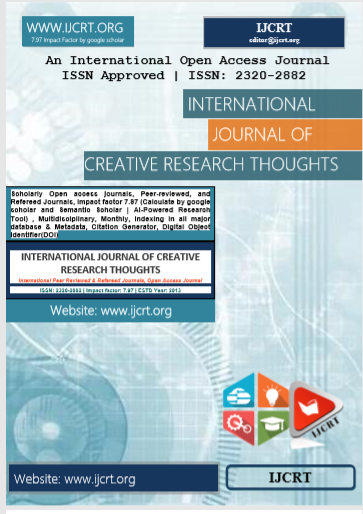
| IJCRT Journal front page | IJCRT Journal Back Page |
Paper Title: ECONOMIC LIBERALISATION AND EMERGING TRENDS OF INDIAN AGRICULTURE
Author Name(s): Amit Kumar Singh Panwar, Dr. S.N Sahoo
Published Paper ID: - IJCRT2504591
Register Paper ID - 281074
Publisher Journal Name: IJPUBLICATION, IJCRT
DOI Member ID: 10.6084/m9.doi.one.IJCRT2504591 and DOI : http://doi.one/10.1729/Journal.44938
Author Country : Indian Author, India, 122001 , Sohna , 122001 , | Research Area: Management All Published Paper URL: http://ijcrt.org/viewfull.php?&p_id=IJCRT2504591 Published Paper PDF: download.php?file=IJCRT2504591 Published Paper PDF: http://www.ijcrt.org/papers/IJCRT2504591.pdf
Your Paper Publication Details:
Title: ECONOMIC LIBERALISATION AND EMERGING TRENDS OF INDIAN AGRICULTURE
DOI (Digital Object Identifier) : http://doi.one/10.1729/Journal.44938
Pubished in Volume: 13 | Issue: 4 | Year: April 2025
Publisher Name : IJCRT | www.ijcrt.org | ISSN : 2320-2882
Subject Area: Management All
Author type: Indian Author
Pubished in Volume: 13
Issue: 4
Pages: f140-f152
Year: April 2025
Downloads: 269
E-ISSN Number: 2320-2882
Abstract
Abstract Liberalization policies pushed for deregulation, privatization, and globalization. These changes changed agriculture by focusing on high-value foods, advancing technology, and expanding the export and agro-processing sectors. Even with these improvements, problems like unstable global prices, small farmers not being able to get enough loans, and gaps in technology still exist. India's high-value flower exports and use of genetically modified crops both went up from 2001 to 2010. From 2011 to 2020, the country focused on sustainability, digital agriculture, and growing methods that are resistant to climate change. In recent years, new technologies like AI and drones have changed the way farming is done. However, problems like shrinking landholdings and a lack of water are still very important. The agro-export industry has been strong, but it has to deal with competition, problems with technology, and limited infrastructure. Adopting new technologies, improving public-private partnerships, increasing export surpluses, encouraging the corporatization of agriculture, and pushing for global subsidy reforms are some of the suggestions made to make countries more competitive. For the sector to grow in the long run, it is also important to use sustainable methods and invest in technologies that can handle changes in climate. This research looks at the new trends in Indian agriculture since it became more open to foreign investment. It talks about improvements in gardening, food processing, and digital integration, as well as the problems that come with globalization and differences in technology. In addition, it talks about new government programs and the future of Indian farmland.
Licence: creative commons attribution 4.0
License
Creative Commons Attribution 4.0 and The Open Definition

Keywords
Economic Liberalisation, Indian Agriculture, Corporatisation of Agriculture,
License
Creative Commons Attribution 4.0 and The Open Definition
Paper Title: A Developer Centered Bug Prediction Model
Author Name(s): Dr. A. Radhika, Sowjanya Paluri, Mythili Potla, Munaga Jhansi, Sowmya Peetla
Published Paper ID: - IJCRT2504590
Register Paper ID - 282121
Publisher Journal Name: IJPUBLICATION, IJCRT
DOI Member ID: 10.6084/m9.doi.one.IJCRT2504590 and DOI :
Author Country : Indian Author, India, 521108 , Vijayawada, 521108 , | Research Area: Science and Technology Published Paper URL: http://ijcrt.org/viewfull.php?&p_id=IJCRT2504590 Published Paper PDF: download.php?file=IJCRT2504590 Published Paper PDF: http://www.ijcrt.org/papers/IJCRT2504590.pdf
Your Paper Publication Details:
Title: A DEVELOPER CENTERED BUG PREDICTION MODEL
DOI (Digital Object Identifier) :
Pubished in Volume: 13 | Issue: 4 | Year: April 2025
Publisher Name : IJCRT | www.ijcrt.org | ISSN : 2320-2882
Subject Area: Science and Technology
Author type: Indian Author
Pubished in Volume: 13
Issue: 4
Pages: f133-f139
Year: April 2025
Downloads: 126
E-ISSN Number: 2320-2882
Abstract
Software bugs are a critical challenge in the development lifecycle, impacting product quality, user satisfaction, and maintenance costs. Traditional bug prediction models often focus on static code metrics or historical bug data, without considering the developer-centric context. This paper proposes a Developer-centered bug prediction model that leverages both code-level features and developer-specific behavioral patterns to enhance prediction accuracy. The model integrates features such as code complexity, change history, developer expertise, and commit frequency, using advanced machine learning techniques like ensemble learning and deep neural networks. We validate our approach on real-world datasets from open-source repositories, demonstrating significant improvements over conventional models in terms of precision, recall, and F1-score. The results suggest that incorporating developer-related factors provides a more nuanced understanding of bug-prone code, enabling more targeted and effective bug management strategies.
Licence: creative commons attribution 4.0
License
Creative Commons Attribution 4.0 and The Open Definition
Keywords
Developer-Centric Analysis, Change Scattering, Code Quality Assessment, Predictive modeling, Logistic Regression, Cross-Validation
License
Creative Commons Attribution 4.0 and The Open Definition
Paper Title: "Blue Victorianism and the Gendered Waters: Fluid Identities in The Octoroon and The Odd Women"
Author Name(s): POYIR TAIPODIA
Published Paper ID: - IJCRT2504589
Register Paper ID - 281414
Publisher Journal Name: IJPUBLICATION, IJCRT
DOI Member ID: 10.6084/m9.doi.one.IJCRT2504589 and DOI :
Author Country : Indian Author, India, - , -, - , | Research Area: Science and Technology Published Paper URL: http://ijcrt.org/viewfull.php?&p_id=IJCRT2504589 Published Paper PDF: download.php?file=IJCRT2504589 Published Paper PDF: http://www.ijcrt.org/papers/IJCRT2504589.pdf
Your Paper Publication Details:
Title: "BLUE VICTORIANISM AND THE GENDERED WATERS: FLUID IDENTITIES IN THE OCTOROON AND THE ODD WOMEN"
DOI (Digital Object Identifier) :
Pubished in Volume: 13 | Issue: 4 | Year: April 2025
Publisher Name : IJCRT | www.ijcrt.org | ISSN : 2320-2882
Subject Area: Science and Technology
Author type: Indian Author
Pubished in Volume: 13
Issue: 4
Pages: f120-f132
Year: April 2025
Downloads: 150
E-ISSN Number: 2320-2882
Abstract
This research examines the convergence of Blue Victorianism, gender dynamics, and water symbolism in two lesser-studied yet thematically significant Victorian novels: The Octoroon (1861) by William Gilmore Simms, also known as Mayne Reid, and The Odd Women (1893) by George Gissing. Engaging with interdisciplinary critical frameworks--including blue Victorian and ecocriticism the study argues that water in these texts functions not merely as a setting but as an active symbolic force that reflects and shapes the conditions of women's lives in Victorian society. The concept of Blue Victorianism, encompassing affective states such as melancholy, nostalgia, and aesthetic estrangement, is employed to examine how fluid spaces such as rivers, oceans, and coastal landscapes become metaphors for female subjectivity, social instability, and resistance to normative gender roles. In The Octoroon, the Mississippi River and the Atlantic Ocean emerge as charged and paradoxical spaces--sites where ideologies of race, gender, and colonialism intersect. The novel's mixed-race heroine, Zoe, is positioned at the confluence of freedom and constraint, where water signifies both escape and fatal entrapment. In contrast, The Odd Women presents water in more domestic and introspective forms: coastal fog, rain, and reflective seascapes that parallel the emotional and social displacement of unmarried, economically precarious women. In both novels, water mediates themes of marginality, transition, and emotional isolation, rendering it central to the construction of gendered space and narrative movement. By offering a comparative reading of these two novels through the lens of water symbolism and Blue Victorian aesthetics, this study contributes to broader scholarly conversations surrounding gendered spatiality, ecofeminist criticism, and Victorian representations of emotional and social transgression. However, it argues that water operates as a transformative and often destabilising narrative force--simultaneously marking boundaries and enabling resistance--within the gendered imaginaries of nineteenth-century fiction.
Licence: creative commons attribution 4.0
License
Creative Commons Attribution 4.0 and The Open Definition
Keywords
Blue Victorianism, gender, water symbolism, Victorian fiction, The Octoroon, The Odd Women, ecocriticism, feminist theory, maritime space.
License
Creative Commons Attribution 4.0 and The Open Definition
Paper Title: Mathematics Achievement of Secondary School Students in Relation to Their Intelligence
Author Name(s): Megha Ahirwar, Wahida Rias
Published Paper ID: - IJCRT2504588
Register Paper ID - 282045
Publisher Journal Name: IJPUBLICATION, IJCRT
DOI Member ID: 10.6084/m9.doi.one.IJCRT2504588 and DOI :
Author Country : Indian Author, India, 226012 , Lucknow, 226012 , | Research Area: Arts1 All Published Paper URL: http://ijcrt.org/viewfull.php?&p_id=IJCRT2504588 Published Paper PDF: download.php?file=IJCRT2504588 Published Paper PDF: http://www.ijcrt.org/papers/IJCRT2504588.pdf
Your Paper Publication Details:
Title: MATHEMATICS ACHIEVEMENT OF SECONDARY SCHOOL STUDENTS IN RELATION TO THEIR INTELLIGENCE
DOI (Digital Object Identifier) :
Pubished in Volume: 13 | Issue: 4 | Year: April 2025
Publisher Name : IJCRT | www.ijcrt.org | ISSN : 2320-2882
Subject Area: Arts1 All
Author type: Indian Author
Pubished in Volume: 13
Issue: 4
Pages: f112-f119
Year: April 2025
Downloads: 129
E-ISSN Number: 2320-2882
Abstract
Abstract: Mathematics achievement is a critical component of academic success, often influenced by multiple factors, including intelligence, gender, and school type. This study examines the relationship between intelligence and mathematics achievement among secondary school students in Lucknow, with a particular focus on how school type (boys-only, girls-only, and co-educational) affects performance differences between male and female students. A quantitative research design was employed, involving a sample of students from six different schools representing different educational environments. Intelligence and mathematics achievement were assessed using standardized tests, and data were analysed through statistics, correlation analysis, and comparative techniques. The results suggest a strong positive correlation between intelligence and mathematics achievement, confirming that students with higher intelligence scores tend to perform better in mathematics. However, intelligence alone was not the sole determinant of success. The results also reveal gender-based differences in mathematics performance, with girls outperforming boys across all intelligence levels. Additionally, students from girls-only and co-educational schools scored higher on average compared to those from boys-only schools, suggesting that a structured and supportive learning environment plays a crucial role in academic performance. The study's findings challenge traditional gender stereotypes and highlight the importance of effective teaching strategies, personalized learning interventions, and gender-sensitive education policies. While intelligence remains a significant factor in mathematics achievement, the study emphasizes the role of external influences such as school environment, motivation, and instructional quality. The research underscores the need for inclusive and equitable educational approaches to improve mathematics learning outcomes for all students.
Licence: creative commons attribution 4.0
License
Creative Commons Attribution 4.0 and The Open Definition
Keywords
Mathematics achievement, Intelligence, Gender differences, Academic performance, Learning environment
License
Creative Commons Attribution 4.0 and The Open Definition
Paper Title: Dilli gharane ke Ustad Latif Ahmed Khan Sahab Ka jeewan - parichay
Author Name(s): Arti Gupta, Dr. Shivendra Pratap Tripathi
Published Paper ID: - IJCRT2504587
Register Paper ID - 282040
Publisher Journal Name: IJPUBLICATION, IJCRT
DOI Member ID: 10.6084/m9.doi.one.IJCRT2504587 and DOI :
Author Country : Indian Author, India, 207123 , KASGANJ, 207123 , | Research Area: Arts All Published Paper URL: http://ijcrt.org/viewfull.php?&p_id=IJCRT2504587 Published Paper PDF: download.php?file=IJCRT2504587 Published Paper PDF: http://www.ijcrt.org/papers/IJCRT2504587.pdf
Your Paper Publication Details:
Title: DILLI GHARANE KE USTAD LATIF AHMED KHAN SAHAB KA JEEWAN - PARICHAY
DOI (Digital Object Identifier) :
Pubished in Volume: 13 | Issue: 4 | Year: April 2025
Publisher Name : IJCRT | www.ijcrt.org | ISSN : 2320-2882
Subject Area: Arts All
Author type: Indian Author
Pubished in Volume: 13
Issue: 4
Pages: f104-f111
Year: April 2025
Downloads: 166
E-ISSN Number: 2320-2882
Abstract
Dilli gharane ke Ustad Latif Ahmed Khan Sahab Ka jeewan - parichay
Licence: creative commons attribution 4.0
License
Creative Commons Attribution 4.0 and The Open Definition
Keywords
Dilli gharane ke Ustad Latif Ahmed Khan Sahab Ka jeewan - parichay
License
Creative Commons Attribution 4.0 and The Open Definition
Paper Title: Leadership and Governance in Ancient Indian Texts: Insights from Thirukkural, Vidura Niti, and Arthashastra
Author Name(s): Dr. K. Kavitha Maheswari, Mr. B. Alwin Jute
Published Paper ID: - IJCRT2504586
Register Paper ID - 281124
Publisher Journal Name: IJPUBLICATION, IJCRT
DOI Member ID: 10.6084/m9.doi.one.IJCRT2504586 and DOI :
Author Country : Indian Author, India, 620002 , Tiruchirappalli , 620002 , | Research Area: Social Science All Published Paper URL: http://ijcrt.org/viewfull.php?&p_id=IJCRT2504586 Published Paper PDF: download.php?file=IJCRT2504586 Published Paper PDF: http://www.ijcrt.org/papers/IJCRT2504586.pdf
Your Paper Publication Details:
Title: LEADERSHIP AND GOVERNANCE IN ANCIENT INDIAN TEXTS: INSIGHTS FROM THIRUKKURAL, VIDURA NITI, AND ARTHASHASTRA
DOI (Digital Object Identifier) :
Pubished in Volume: 13 | Issue: 4 | Year: April 2025
Publisher Name : IJCRT | www.ijcrt.org | ISSN : 2320-2882
Subject Area: Social Science All
Author type: Indian Author
Pubished in Volume: 13
Issue: 4
Pages: f94-f103
Year: April 2025
Downloads: 207
E-ISSN Number: 2320-2882
Abstract
The ancient Indian texts Thirukkural, Vidura Niti, and Arthashastra provide timeless wisdom on leadership, governance, and ethics, shaping principles that remain relevant in modern society. These texts offer diverse yet complementary perspectives on ethical leadership, political strategy, and economic governance, making them invaluable for understanding both historical and contemporary governance models. Thirukkural, authored by Thiruvalluvar, places a strong emphasis on morality, justice, and righteousness in governance. It highlights the importance of a leader's integrity, fairness, and commitment to the well-being of the people. The text argues that a just ruler fosters societal harmony and economic prosperity by upholding ethical principles and making decisions based on dharma (righteousness). Vidura Niti, extracted from the Mahabharata, serves as a guide for ethical rulership, decision-making, and statecraft. Vidura, the wise counselor, advises rulers on the importance of wisdom, humility, and self-discipline in governance. His teachings stress fairness, accountability, and the dangers of greed and arrogance, warning that unethical leadership leads to instability and downfall. Arthashastra, written by Kautilya (Chanakya), provides a pragmatic approach to administration, diplomacy, military strategy, and economic policies. Unlike Thirukkural and Vidura Niti, which focus on moral virtues, Arthashastra emphasizes realpolitik--strategic governance that balances ethics with practical necessity. It offers detailed insights into law enforcement, taxation, wealth management, and national security, making it a comprehensive guide for statecraft. This article explores the relevance of these ancient texts in modern governance and leadership, comparing their principles with contemporary ethical frameworks such as transformational leadership, corporate social responsibility (CSR), and sustainable governance. By evaluating their contributions, this study highlights the enduring impact of Indian knowledge systems on ethical statecraft and policymaking in the 21st century.
Licence: creative commons attribution 4.0
License
Creative Commons Attribution 4.0 and The Open Definition
Keywords
Thirukkural, Vidura Niti, Arthashastra, ethics, governance, leadership, Indian philosophy
License
Creative Commons Attribution 4.0 and The Open Definition
Paper Title: AN EXPERIMENTAL STUDY ON PARTIAL REPLACEMENT OF CEMENT WITH GRANITE POWDER IN CONCRETE
Author Name(s): Ms.M.Vishnu Priya, Mr.S.Adarsh, Mr.A.Tharun Naik, Ms.K.Vennela, Ms.S.Deepa ,Ms.T.Sai Kalyani
Published Paper ID: - IJCRT2504585
Register Paper ID - 282207
Publisher Journal Name: IJPUBLICATION, IJCRT
DOI Member ID: 10.6084/m9.doi.one.IJCRT2504585 and DOI :
Author Country : Indian Author, India, - , -, - , | Research Area: Science and Technology Published Paper URL: http://ijcrt.org/viewfull.php?&p_id=IJCRT2504585 Published Paper PDF: download.php?file=IJCRT2504585 Published Paper PDF: http://www.ijcrt.org/papers/IJCRT2504585.pdf
Your Paper Publication Details:
Title: AN EXPERIMENTAL STUDY ON PARTIAL REPLACEMENT OF CEMENT WITH GRANITE POWDER IN CONCRETE
DOI (Digital Object Identifier) :
Pubished in Volume: 13 | Issue: 4 | Year: April 2025
Publisher Name : IJCRT | www.ijcrt.org | ISSN : 2320-2882
Subject Area: Science and Technology
Author type: Indian Author
Pubished in Volume: 13
Issue: 4
Pages: f63-f93
Year: April 2025
Downloads: 187
E-ISSN Number: 2320-2882
Abstract
This project report entitled to "An Experimental study on partial replacement of cement with granite powder in concrete". The main object of This experimental study is to analyse and investigates the feasibility of utilizing granite powder as a partial replacement for cement in concrete production. With the growing concerns over the environmental impact of cement manufacturing and the need for sustainable construction materials, granite powder--an industrial by-product from the granite cutting and polishing process--presents a promising alternative. The study involved preparing concrete mixes with varying percentages of granite powder (ranging from 0% to 30%) as a partial replacement for cement. Tests were conducted to evaluate the workability, compressive strength, split tensile strength, and durability of the concrete at different curing periods. The results indicate that the inclusion of granite powder enhances the strength properties of concrete up to an optimal replacement level, beyond which the performance slightly declines. Additionally, granite powder contributed to improved sustainability and cost-effectiveness without compromising the structural integrity. This research supports the potential application of granite powder in green concrete technology and promotes the efficient management of industrial waste.
Licence: creative commons attribution 4.0
License
Creative Commons Attribution 4.0 and The Open Definition
Keywords
Granite powder,Cement replacement,Concrete properties,Mechanical proporties.
License
Creative Commons Attribution 4.0 and The Open Definition
Paper Title: Use of AI in Deepfake Detection
Author Name(s): Swati Lonare, Aniket Kakde, Apoorva Bhagat
Published Paper ID: - IJCRT2504584
Register Paper ID - 281756
Publisher Journal Name: IJPUBLICATION, IJCRT
DOI Member ID: 10.6084/m9.doi.one.IJCRT2504584 and DOI :
Author Country : Indian Author, India, 440022 , Nagpur, 440022 , | Research Area: Science All Published Paper URL: http://ijcrt.org/viewfull.php?&p_id=IJCRT2504584 Published Paper PDF: download.php?file=IJCRT2504584 Published Paper PDF: http://www.ijcrt.org/papers/IJCRT2504584.pdf
Your Paper Publication Details:
Title: USE OF AI IN DEEPFAKE DETECTION
DOI (Digital Object Identifier) :
Pubished in Volume: 13 | Issue: 4 | Year: April 2025
Publisher Name : IJCRT | www.ijcrt.org | ISSN : 2320-2882
Subject Area: Science All
Author type: Indian Author
Pubished in Volume: 13
Issue: 4
Pages: f58-f62
Year: April 2025
Downloads: 127
E-ISSN Number: 2320-2882
Abstract
The rapid advancement of artificial intelligence (AI) has led to the emergence of deepfakes--synthetic media in which a person's likeness is convincingly replaced with another's. While these AI-generated manipulations have potential applications in entertainment and education, they also pose significant risks to privacy, misinformation, and digital security. To combat this growing threat, AI-driven deepfake detection systems have been developed, leveraging machine learning, computer vision, and neural networks. This paper explores the current state of AI technologies in detecting deepfakes, including the use of convolutional neural networks (CNNs), recurrent neural networks (RNNs), and transformer-based models. Techniques such as facial landmark analysis, inconsistencies in blinking patterns, and frequency domain artifacts are examined. Moreover, the paper highlights the role of large datasets, adversarial training, and explainable AI in improving detection accuracy. Despite significant progress, challenges remain in generalizing detection models across diverse datasets and evolving deepfake techniques. The ongoing arms race between deepfake generation and detection necessitates continued innovation and collaboration across academia, industry, and policy-making spheres.
Licence: creative commons attribution 4.0
License
Creative Commons Attribution 4.0 and The Open Definition
Keywords
1.Deepfake Detection 2.Artificial Intelligence (AI) 3.Machine Learning 4.Computer Vision 5.Convolutional Neural Networks (CNNs) 6.Recurrent Neural Networks (RNNs) 7.Transformer Models 8.Facial Landmark Analysis 9.Synthetic Media 10.Adversarial Training 11.Digital Forensics 12.Deep Learning 13.Misinformation Detection 14.Video Manipulation 15.Explainable AI (XAI)
License
Creative Commons Attribution 4.0 and The Open Definition
Paper Title: A study on Green Human Resource Practices in India
Author Name(s): Ms Mukesh, Ms Ambika Shukla
Published Paper ID: - IJCRT2504583
Register Paper ID - 282143
Publisher Journal Name: IJPUBLICATION, IJCRT
DOI Member ID: 10.6084/m9.doi.one.IJCRT2504583 and DOI :
Author Country : Indian Author, India, 160055 , Mohali, 160055 , | Research Area: Management All Published Paper URL: http://ijcrt.org/viewfull.php?&p_id=IJCRT2504583 Published Paper PDF: download.php?file=IJCRT2504583 Published Paper PDF: http://www.ijcrt.org/papers/IJCRT2504583.pdf
Your Paper Publication Details:
Title: A STUDY ON GREEN HUMAN RESOURCE PRACTICES IN INDIA
DOI (Digital Object Identifier) :
Pubished in Volume: 13 | Issue: 4 | Year: April 2025
Publisher Name : IJCRT | www.ijcrt.org | ISSN : 2320-2882
Subject Area: Management All
Author type: Indian Author
Pubished in Volume: 13
Issue: 4
Pages: f53-f57
Year: April 2025
Downloads: 123
E-ISSN Number: 2320-2882
Abstract
Twenty first century is facing many changes in the environmental issues like consequences from pollution, bio waste, e-waste, techno waste etc. which are badly affecting natural resources, negative effect on human life and health and negative effect on society. Green Human Resource Management (Green HRM) combines environmental aspects with HRM policies and practices to facilitates sustainability. Green HRM is the use of HRM policies to promote the sustainable use of resources within the organizations and promotes the cause of environmental sustainability. The objective of this study is to understand the concept of green human resource management and to explore the green human resource management practices of organizations based on the existing literature. The major areas of the study is to find out various the problems faced by organizations in successful implementation of Green HRM Practices and finally, the paper suggests initiatives for Green HRM for Green organizations.
Licence: creative commons attribution 4.0
License
Creative Commons Attribution 4.0 and The Open Definition
Keywords
Human Resource Management, Green HRM, Environment Sustainability, Organization,
License
Creative Commons Attribution 4.0 and The Open Definition
Paper Title: Ai Integrated Remote Patient Vital Tracking System
Author Name(s): K Bhavani, P Pavani, Ch Purnima, S Mercy Angel, PVK Chaitanya
Published Paper ID: - IJCRT2504582
Register Paper ID - 282224
Publisher Journal Name: IJPUBLICATION, IJCRT
DOI Member ID: 10.6084/m9.doi.one.IJCRT2504582 and DOI :
Author Country : Indian Author, India, 530008 , visakhapatnam, 530008 , | Research Area: Science and Technology Published Paper URL: http://ijcrt.org/viewfull.php?&p_id=IJCRT2504582 Published Paper PDF: download.php?file=IJCRT2504582 Published Paper PDF: http://www.ijcrt.org/papers/IJCRT2504582.pdf
Your Paper Publication Details:
Title: AI INTEGRATED REMOTE PATIENT VITAL TRACKING SYSTEM
DOI (Digital Object Identifier) :
Pubished in Volume: 13 | Issue: 4 | Year: April 2025
Publisher Name : IJCRT | www.ijcrt.org | ISSN : 2320-2882
Subject Area: Science and Technology
Author type: Indian Author
Pubished in Volume: 13
Issue: 4
Pages: f43-f52
Year: April 2025
Downloads: 169
E-ISSN Number: 2320-2882
Abstract
In critical situations like battlefields, disaster zones, rural areas, and medical emergencies, doctors and healthcare workers may not always be able to reach patients immediately. This project introduces a remote-controlled health monitoring and medicine delivery system that allows medical personnel to assess a patient's condition and provide necessary aid from a distance. The system uses an ESP32-CAM for live video streaming, enabling health workers to remotely navigate the chassis and collect patients vitals using a web interface. It is equipped with a pulse oximeter and a temperature sensor to measure oxygen levels, heart rate, and body temperature. A machine learning model running on the ESP32 analyzes the collected data and classifies the patient's condition as Good, Bad, or Critical, allowing for faster medical decisions and prioritization of critical cases to alert doctors via telegram. Along with tracking, this system can also deliver essential medicines to patients in remote or high-risk areas. Its lightweight and mobile design ensures easy deployment in hospitals, military camps, and disaster relief operations, making it a valuable tool for telemedicine and emergency healthcare.
Licence: creative commons attribution 4.0
License
Creative Commons Attribution 4.0 and The Open Definition
Keywords
Remote Patient Monitoring, ESP32-CAM, Vital Signs, Pulse Oximeter, Temperature Sensor, Machine Learning, Edge Impulse, Telemedicine, Emergency Healthcare, IoT-based Healthcare, Wireless Health Tracking, Telegram Alert System, Embedded Systems, Mobile Robotic Chassis.
License
Creative Commons Attribution 4.0 and The Open Definition
Call For Paper March 2026
Call For Papers
March 2026
Volume 14 | Issue 3
Last Date :
31-Mar-2026
Submit Manuscript Online Impact Factor: 7.97 Review Results : Within 02-03 Days Paper Publication : Within 02-03 Days
March 2026
Volume 14 | Issue 3
Last Date :
31-Mar-2026
Submit Manuscript Online Impact Factor: 7.97 Review Results : Within 02-03 Days Paper Publication : Within 02-03 Days
Published Issue Details
For Authors
Forms / Downloads
Other IMP Links
Indexing Partner
Research Area
LICENSE





ISSN and 7.97 Impact Factor Details

ISSN: 2320-2882 Impact Factor: 7.97 and ISSN APPROVED Journal Starting Year (ESTD) : 2013


ISSN and 7.97 Impact Factor Details
ISSN: 2320-2882 Impact Factor: 7.97 and ISSN APPROVED Journal Starting Year (ESTD) : 2013
DOI Details
CONFERENCE
CONFERENCE MANAGMENT & PUBLICATION CONFERENCE PROPOSAL
RECENT CONFERENCE

CONFERENCE PROPOSAL CONFERENCE PROCEEDINGS
CONFERENCE PROPOSAL CONFERENCE PROCEEDINGS
For Reviewer /Referral (RMS) Earn 500 per paper
Important Links
NEWS & Conference
Digital Library
IJCRT RMS | Earn 500 Per Paper.

Open Access


LICENSE
Indexing Partner
Scholarly open access journals, Peer-reviewed, and Refereed Journals, Impact factor 7.97 (Calculate by google scholar and Semantic Scholar | AI-Powered Research Tool) , Multidisciplinary, Monthly, Indexing in all major database & Metadata, Citation Generator, Digital Object Identifier(DOI)