Important Details
IJCRT - International Peer Reviewed, Open Access Journal, Multidisciplinary, Monthly, Nominal(Low) Fees for Professional Research Services International Journal of Creative Research Thoughts - IJCRT Peer Review Journal, Refereed Journal, Peer Reviewed Journal , Referred Journal and Indexed Journal, Open access, Online and Print Journal,international Journal Open Access, Accepted by Indian and foreign university ,IJCRT Followed Norms, guidelines, requirement, listing criteria and methodology of score/point also applied from: Scopus , Web of Science , UGC Approved , UGC CARE, UGC-CARE .
UGC Approved Journal No: 49023 (18)
UGC approval Link
https://ijcrt.org/ugc%20approval.jpg
All Policy and Approval
Please Like Our Facebook Page | CrossRef DOI and Hard copy of Certificate Provide if required. | www.IJCRT.org | editor@IJCRT.org | WhatsApp: 7990172303
Publication Details:
- Paper Submission : 30-Apr-2026. Call For Paper (Volume 14 | Issue 4 | Month- April 2026)
- Acceptance/Rejection Notification: Within 02-04 Days.
- Paper Publish: Within 02-04 Days after submitting all documents.
-
Submit Your Paper Any time There No deadline.
-
Publication fees : 1570 INR for Indian author & 59$ for foreign International author.
Please Like Our Facebook Page | CrossRef DOI and Hard copy of Certificate Provide if required.
Licence and Indexing
Indexing In Google Scholar, SSRN, ResearcherID-Publons, Semantic Scholar | AI-Powered Research Tool, Microsoft Academic, Academia.edu, arXiv.org, Research Gate, CiteSeerX, ResearcherID Thomson Reuters, Mendeley : reference manager, DocStoc, ISSUU, Scribd, and many more | High Impact Factor: 7.97 | Digital object identifier (DOI) and Hard Copy of certificate Provided.




























Licence
DOI
ISSN Approved impact factor: 7.97 
Creative Common 
Valid as per new UGC Gazette regulations 

INTERNATIONAL JOURNAL OF CREATIVE RESEARCH THOUGHTS - IJCRT (IJCRT.ORG)
International Peer Reviewed & Refereed Journals, Open Access Journal
IJCRT Peer-Reviewed (Refereed) Journal as Per New UGC Rules.
ISSN Approved Journal No: 2320-2882 | Impact factor: 7.97 | ESTD Year: 2013
Call For Paper - Volume 14 | Issue 4 | Month- April 2026
Scholarly open access journals, Peer-reviewed, and Refereed Journals, Impact factor 7.97 (Calculate by google scholar and Semantic Scholar | AI-Powered Research Tool) , Multidisciplinary, Monthly, Indexing in all major database & Metadata, Citation Generator, Digital Object Identifier(CrossRef DOI)
Contact Us Click Here
WhatsApp Contact Click Here
IJCRT Search Xplore - Search all paper by Paper Name , Author Name, and Title
Volume 11 | Issue 3 |
Volume 11 | Issue 3 | Month
Downlaod After Publication 1) Table of content index in PDF
2) Table of content index in HTML 2)Table of content index in HTML
3) Front Page 3) Front Page
4) Back Page 4) Back Page
5) Editor Board Member 5)Editor Board Member
6) OLD Style Issue 6)OLD Style Issue
 |
 |
|---|---|
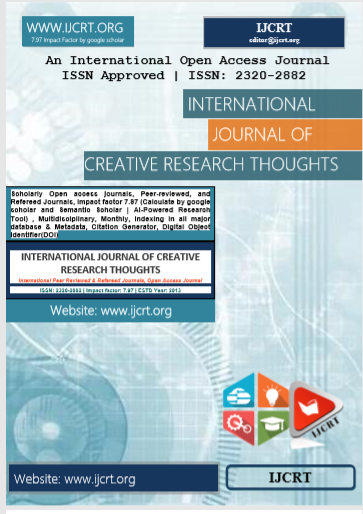
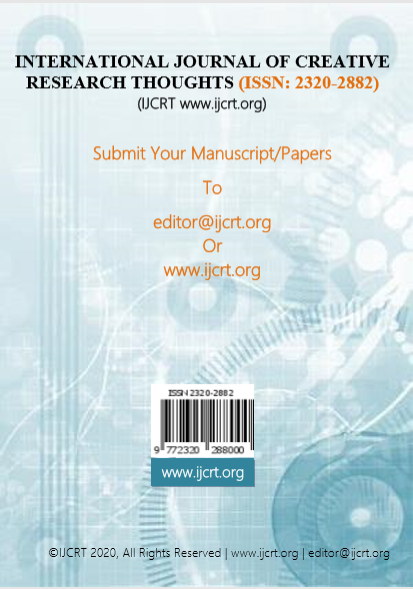
| IJCRT Journal front page | IJCRT Journal Back Page |
Paper Title: Concise study on orphanage home
Author Name(s): Dr. S.K Manju Bargavi, A. Mukul Kumar Patro, A. Tariq Anwar, Aditya Yadav, Sreerama Venkata Sai Manoj
Published Paper ID: - IJCRT2303813
Register Paper ID - 233407
Publisher Journal Name: IJPUBLICATION, IJCRT
DOI Member ID: 10.6084/m9.doi.one.IJCRT2303813 and DOI :
Author Country : Indian Author, India, - , -, - , | Research Area: Science and Technology Published Paper URL: http://ijcrt.org/viewfull.php?&p_id=IJCRT2303813 Published Paper PDF: download.php?file=IJCRT2303813 Published Paper PDF: http://www.ijcrt.org/papers/IJCRT2303813.pdf
Your Paper Publication Details:
Title: CONCISE STUDY ON ORPHANAGE HOME
DOI (Digital Object Identifier) :
Pubished in Volume: 11 | Issue: 3 | Year: March 2023
Publisher Name : IJCRT | www.ijcrt.org | ISSN : 2320-2882
Subject Area: Science and Technology
Author type: Indian Author
Pubished in Volume: 11
Issue: 3
Pages: g888-g893
Year: March 2023
Downloads: 445
E-ISSN Number: 2320-2882
Abstract
Over a hundred million orphans exist in the world today. The lack of food and clothing for everyday use are their biggest problems. Lack of money and education. Here we tend to introduce a website that will easily solve these issues. The purpose of this paper is to assist the orphans of various orphanages by people who wish to support the children and adopt the children by the application of automation. They can occasionally assist the orphanages by providing clothing and food to the specific orphanage that they find through online. The intended paper aims to reduce the time spent looking for a suitable child. The adoption procedure takes much less time when online techniques are used on a centralized data repository instead of manually looking for a suitable orphan. The weary people can use this website to learn about cause-related orphans, the basics of adopting children, and the various activities that are run in many orphanages. This website not only engages in the practice of offering orphans legal adoption procedures and refuge but also influences their lives by providing food, clothing, and financial support.
Licence: creative commons attribution 4.0
License
Creative Commons Attribution 4.0 and The Open Definition

Keywords
Adoption, Donation, Orphans, Website
License
Creative Commons Attribution 4.0 and The Open Definition
Paper Title: "STUDIES ON DYE YEILDING PLANTS FROM SOME VILLAGES OF WARORA TAHSIL, DISTRICT CHANDRAPUR."
Author Name(s): Miss. Pooja E. Nannaware, Miss. Sakshi M. Ghule, Prashant S. Jakhi
Published Paper ID: - IJCRT2303812
Register Paper ID - 233504
Publisher Journal Name: IJPUBLICATION, IJCRT
DOI Member ID: 10.6084/m9.doi.one.IJCRT2303812 and DOI : http://doi.one/10.1729/Journal.33510
Author Country : Indian Author, India, 440001 , Nagpur, 440001 , | Research Area: Life Sciences All Published Paper URL: http://ijcrt.org/viewfull.php?&p_id=IJCRT2303812 Published Paper PDF: download.php?file=IJCRT2303812 Published Paper PDF: http://www.ijcrt.org/papers/IJCRT2303812.pdf
Your Paper Publication Details:
Title: "STUDIES ON DYE YEILDING PLANTS FROM SOME VILLAGES OF WARORA TAHSIL, DISTRICT CHANDRAPUR."
DOI (Digital Object Identifier) : http://doi.one/10.1729/Journal.33510
Pubished in Volume: 11 | Issue: 3 | Year: March 2023
Publisher Name : IJCRT | www.ijcrt.org | ISSN : 2320-2882
Subject Area: Life Sciences All
Author type: Indian Author
Pubished in Volume: 11
Issue: 3
Pages: g880-g887
Year: March 2023
Downloads: 412
E-ISSN Number: 2320-2882
Abstract
Since pre-historic times plants were useful for a human beings to fulfill most of their basic and other needs. Besides basic and important needs plants has been used for natural dyeing before recorded history, colouring properties of various local plants were known to our ancestors to obtain and retain the colour from the plant throughout the past period. Plants from adjoining areas are used to enhance the life of people through the decoration of animal skin, fabric, craft, hair, and even their bodies. Some of the local plants, when used for dying purpose, did not require the addition of any substance for the attachment of dye to fiber. Based on colour properties various types of dye-yielding plants are available like orange dyes, yellow dyes, red dyes, purple/ blue dyes, green dyes, grey dyes, and black dyes. Traditionally these dyes were extracted from various plant parts like bark, stem, leaves, flowers, rhizome, root, and seeds. The present study includes 35 different plants available from local areas and which are used traditionally for dyeing purposes by the local people. In the present study only plant-based dyes are extracted from various plant parts. In a present study, detailed information regarding the utilization of these plants for purpose of dye is mentioned along with their photographic images.
Licence: creative commons attribution 4.0
License
Creative Commons Attribution 4.0 and The Open Definition
Keywords
Dye yielding plants, Fabric Colours, Dye extraction, Sources of Dyes.
License
Creative Commons Attribution 4.0 and The Open Definition
Paper Title: Banking services and investment products of hdfc
Author Name(s): Sanjana Rathaur
Published Paper ID: - IJCRT2303811
Register Paper ID - 233503
Publisher Journal Name: IJPUBLICATION, IJCRT
DOI Member ID: 10.6084/m9.doi.one.IJCRT2303811 and DOI :
Author Country : Indian Author, India, 201310 , Greater Noida , 201310 , | Research Area: Management All Published Paper URL: http://ijcrt.org/viewfull.php?&p_id=IJCRT2303811 Published Paper PDF: download.php?file=IJCRT2303811 Published Paper PDF: http://www.ijcrt.org/papers/IJCRT2303811.pdf
Your Paper Publication Details:
Title: BANKING SERVICES AND INVESTMENT PRODUCTS OF HDFC
DOI (Digital Object Identifier) :
Pubished in Volume: 11 | Issue: 3 | Year: March 2023
Publisher Name : IJCRT | www.ijcrt.org | ISSN : 2320-2882
Subject Area: Management All
Author type: Indian Author
Pubished in Volume: 11
Issue: 3
Pages: g874-g879
Year: March 2023
Downloads: 441
E-ISSN Number: 2320-2882
Abstract
The study focused on exploring the range of banking services and investment products offered by HDFC, one of the leading financial institutions in India. Through an extensive review of literature and analysis of the company's website and other relevant sources, the study found that HDFC offers a wide range of banking services, including savings and current accounts, loans, credit cards, and online banking. In addition, the company provides various investment products, such as mutual funds, stocks and bonds, insurance policies, and retirement plans. The findings of the study suggest that HDFC Bank's banking services and investment products provide customers with a convenient, wide-ranging, and rewarding banking and investment experience. The study also delves into the features and benefits of these services and products, as well as their accessibility and affordability for different segments of the population. Overall, the findings of the study suggest that HDFC offers a comprehensive suite of banking services and investment products that cater to the diverse needs of its customers.
Licence: creative commons attribution 4.0
License
Creative Commons Attribution 4.0 and The Open Definition
Keywords
Banking services, investment products, financial services, Diverse needs
License
Creative Commons Attribution 4.0 and The Open Definition
Paper Title: A study on history of Kakatiya Socio, economical and religion conditions and culture
Author Name(s): NEDUNURI RAJESH
Published Paper ID: - IJCRT2303810
Register Paper ID - 233336
Publisher Journal Name: IJPUBLICATION, IJCRT
DOI Member ID: 10.6084/m9.doi.one.IJCRT2303810 and DOI :
Author Country : Indian Author, India, 533308 , MANDAPETA, Dr.B.R Ambedkar Konaseema District, 533308 , | Research Area: Arts All Published Paper URL: http://ijcrt.org/viewfull.php?&p_id=IJCRT2303810 Published Paper PDF: download.php?file=IJCRT2303810 Published Paper PDF: http://www.ijcrt.org/papers/IJCRT2303810.pdf
Your Paper Publication Details:
Title: A STUDY ON HISTORY OF KAKATIYA SOCIO, ECONOMICAL AND RELIGION CONDITIONS AND CULTURE
DOI (Digital Object Identifier) :
Pubished in Volume: 11 | Issue: 3 | Year: March 2023
Publisher Name : IJCRT | www.ijcrt.org | ISSN : 2320-2882
Subject Area: Arts All
Author type: Indian Author
Pubished in Volume: 11
Issue: 3
Pages: g870-g873
Year: March 2023
Downloads: 1279
E-ISSN Number: 2320-2882
Abstract
Abstract: The founder of the Kakatiya Empire was Kakartya Gundyana. The founder of the Kakatiya clan was the first Betaraja. The founder of the independent state of the Kakatiya Empire was Rudradeva. The capital of Kakatiya was initially in Hanumakonda. Later, the capital was shifted to Orugallu. The royal language of the Kakatiyas was Sanskrit. Initially they belonged to the Jain religion. Later he converted to Shaivism. During this period, a foreign traveler named Marco Polo visited the Kakatiya Empire. During their time there was a dance called Machaldevi. According to the scriptures, the caste deity of the Kakatiyas is 'Kakati', and there is historical information that first they became Kakatiyas because they were worshipers of Kakatiya, and then they became worshipers of Swayambhudev. According to the Kazipet inscription, it seems that they belonged to the tradition of Gummadamma. Another name of the Jain goddess Gummadamma is Kakati. She is the Jain goddess of health who protects living beings from illness. The Kakatiyas call themselves 'Durjayula'. It means they belong to the Haihaya clan. As heroes dressed in crows, they measured Kakatini as the god of war. 'Kakatiki Saidodu Ekaveera' was popular in those days. Ekaveera Devi Temple is located in Mogilich near Orugallu. In some inscriptions 'Kakati' is said to be their hometown. However, it is now difficult to locate that village or town. Kakatiyas in AD Sh. 750 to AD. Sh. A dynasty that ruled today's Telangana and Andhra Pradesh until 1323. A.D. Sh. The Kakatiyas, who started their political life as Rashtrakuta soldiers in the 8th century, provided a solid administration. After the Satavahanas, the Hindava dynasties who united the Telugu race and brought down the monopoly were the Kakatiyas. Keywords: Kakatiya , empire Abstract: The founder of the Kakatiya Empire was Kakartya Gundyana. The founder of the Kakatiya clan was the first Betaraja. The founder of the independent state of the Kakatiya Empire was Rudradeva. The capital of Kakatiya was initially in Hanumakonda. Later, the capital was shifted to Orugallu. The royal language of the Kakatiyas was Sanskrit. Initially they belonged to the Jain religion. Later he converted to Shaivism. During this period, a foreign traveler named Marco Polo visited the Kakatiya Empire. During their time there was a dance called Machaldevi. According to the scriptures, the caste deity of the Kakatiyas is 'Kakati', and there is historical information that first they became Kakatiyas because they were worshipers of Kakatiya, and then they became worshipers of Swayambhudev. According to the Kazipet inscription, it seems that they belonged to the tradition of Gummadamma. Another name of the Jain goddess Gummadamma is Kakati. She is the Jain goddess of health who protects living beings from illness. The Kakatiyas call themselves 'Durjayula'. It means they belong to the Haihaya clan. As heroes dressed in crows, they measured Kakatini as the god of war. 'Kakatiki Saidodu Ekaveera' was popular in those days. Ekaveera Devi Temple is located in Mogilich near Orugallu. In some inscriptions 'Kakati' is said to be their hometown. However, it is now difficult to locate that village or town. Kakatiyas in AD Sh. 750 to AD. Sh. A dynasty that ruled today's Telangana and Andhra Pradesh until 1323. A.D. Sh. The Kakatiyas, who started their political life as Rashtrakuta soldiers in the 8th century, provided a solid administration. After the Satavahanas, the Hindava dynasties who united the Telugu race and brought down the monopoly were the Kakatiyas. Keywords: Kakatiya , empire Abstract: The founder of the Kakatiya Empire was Kakartya Gundyana. The founder of the Kakatiya clan was the first Betaraja. The founder of the independent state of the Kakatiya Empire was Rudradeva. The capital of Kakatiya was initially in Hanumakonda. Later, the capital was shifted to Orugallu. The royal language of the Kakatiyas was Sanskrit. Initially they belonged to the Jain religion. Later he converted to Shaivism. During this period, a foreign traveler named Marco Polo visited the Kakatiya Empire. During their time there was a dance called Machaldevi. According to the scriptures, the caste deity of the Kakatiyas is 'Kakati', and there is historical information that first they became Kakatiyas because they were worshipers of Kakatiya, and then they became worshipers of Swayambhudev. According to the Kazipet inscription, it seems that they belonged to the tradition of Gummadamma. Another name of the Jain goddess Gummadamma is Kakati. She is the Jain goddess of health who protects living beings from illness. The Kakatiyas call themselves 'Durjayula'. It means they belong to the Haihaya clan. As heroes dressed in crows, they measured Kakatini as the god of war. 'Kakatiki Saidodu Ekaveera' was popular in those days. Ekaveera Devi Temple is located in Mogilich near Orugallu. In some inscriptions 'Kakati' is said to be their hometown. However, it is now difficult to locate that village or town. Kakatiyas in AD Sh. 750 to AD. Sh. A dynasty that ruled today's Telangana and Andhra Pradesh until 1323. A.D. Sh. The Kakatiyas, who started their political life as Rashtrakuta soldiers in the 8th century, provided a solid administration. After the Satavahanas, the Hindava dynasties who united the Telugu race and brought down the monopoly were the Kakatiyas. Keywords: Kakatiya , empire Abstract: The founder of the Kakatiya Empire was Kakartya Gundyana. The founder of the Kakatiya clan was the first Betaraja. The founder of the independent state of the Kakatiya Empire was Rudradeva. The capital of Kakatiya was initially in Hanumakonda. Later, the capital was shifted to Orugallu. The royal language of the Kakatiyas was Sanskrit. Initially they belonged to the Jain religion. Later he converted to Shaivism. During this period, a foreign traveler named Marco Polo visited the Kakatiya Empire. During their time there was a dance called Machaldevi. According to the scriptures, the caste deity of the Kakatiyas is 'Kakati', and there is historical information that first they became Kakatiyas because they were worshipers of Kakatiya, and then they became worshipers of Swayambhudev. According to the Kazipet inscription, it seems that they belonged to the tradition of Gummadamma. Another name of the Jain goddess Gummadamma is Kakati. She is the Jain goddess of health who protects living beings from illness. The Kakatiyas call themselves 'Durjayula'. It means they belong to the Haihaya clan. As heroes dressed in crows, they measured Kakatini as the god of war. 'Kakatiki Saidodu Ekaveera' was popular in those days. Ekaveera Devi Temple is located in Mogilich near Orugallu. In some inscriptions 'Kakati' is said to be their hometown. However, it is now difficult to locate that village or town. Kakatiyas in AD Sh. 750 to AD. Sh. A dynasty that ruled today's Telangana and Andhra Pradesh until 1323. A.D. Sh. The Kakatiyas, who started their political life as Rashtrakuta soldiers in the 8th century, provided a solid administration. After the Satavahanas, the Hindava dynasties who united the Telugu race and brought down the monopoly were the Kakatiyas. Keywords: Kakatiya , empire Abstract: The founder of the Kakatiya Empire was Kakartya Gundyana. The founder of the Kakatiya clan was the first Betaraja. The founder of the independent state of the Kakatiya Empire was Rudradeva. The capital of Kakatiya was initially in Hanumakonda. Later, the capital was shifted to Orugallu. The royal language of the Kakatiyas was Sanskrit. Initially they belonged to the Jain religion. Later he converted to Shaivism. During this period, a foreign traveler named Marco Polo visited the Kakatiya Empire. During their time there was a dance called Machaldevi. According to the scriptures, the caste deity of the Kakatiyas is 'Kakati', and there is historical information that first they became Kakatiyas because they were worshipers of Kakatiya, and then they became worshipers of Swayambhudev. According to the Kazipet inscription, it seems that they belonged to the tradition of Gummadamma. Another name of the Jain goddess Gummadamma is Kakati. She is the Jain goddess of health who protects living beings from illness. The Kakatiyas call themselves 'Durjayula'. It means they belong to the Haihaya clan. As heroes dressed in crows, they measured Kakatini as the god of war. 'Kakatiki Saidodu Ekaveera' was popular in those days. Ekaveera Devi Temple is located in Mogilich near Orugallu. In some inscriptions 'Kakati' is said to be their hometown. However, it is now difficult to locate that village or town. Kakatiyas in AD Sh. 750 to AD. Sh. A dynasty that ruled today's Telangana and Andhra Pradesh until 1323. A.D. Sh. The Kakatiyas, who started their political life as Rashtrakuta soldiers in the 8th century, provided a solid administration. After the Satavahanas, the Hindava dynasties who united the Telugu race and brought down the monopoly were the Kakatiyas. Keywords: Kakatiya , empire Abstract: The founder of the Kakatiya Empire was Kakartya Gundyana. The founder of the Kakatiya clan was the first Betaraja. The founder of the independent state of the Kakatiya Empire was Rudradeva. The capital of Kakatiya was initially in Hanumakonda. Later, the capital was shifted to Orugallu. The royal language of the Kakatiyas was Sanskrit. Initially they belonged to the Jain religion. Later he converted to Shaivism. During this period, a foreign traveler named Marco Polo visited the Kakatiya Empire. During their time there was a dance called Machaldevi. According to the scriptures, the caste deity of the Kakatiyas is 'Kakati', and there is historical information that first they became Kakatiyas because they were worshipers of Kakatiya, and then they became worshipers of Swayambhudev. According to the Kazipet inscription, it seems that they belonged to the tradition of Gummadamma. Another name of the Jain goddess Gummadamma is Kakati. She is the Jain goddess of health who protects living beings from illness. The Kakatiyas call themselves 'Durjayula'. It means they belong to the Haihaya clan. As heroes dressed in crows, they measured Kakatini as the god of war. 'Kakatiki Saidodu Ekaveera' was popular in those days. Ekaveera Devi Temple is located in Mogilich near Orugallu. In some inscriptions 'Kakati' is said to be their hometown. However, it is now difficult to locate that village or town. Kakatiyas in AD Sh. 750 to AD. Sh. A dynasty that ruled today's Telangana and Andhra Pradesh until 1323. A.D. Sh. The Kakatiyas, who started their political life as Rashtrakuta soldiers in the 8th century, provided a solid administration. After the Satavahanas, the Hindava dynasties who united the Telugu race and brought down the monopoly were the Kakatiyas. Keywords: Kakatiya , empire
Licence: creative commons attribution 4.0
License
Creative Commons Attribution 4.0 and The Open Definition
Keywords
Keywords: Kakatiya , empire, Kakartya gundyana, sanskrit,
License
Creative Commons Attribution 4.0 and The Open Definition
Paper Title: COGNIZE HUMAN THROUGH IMPRINTING OR FINGER PRINTING AND DNA-FINGER PRINTING
Author Name(s): Tanima Debnath Sarkar
Published Paper ID: - IJCRT2303809
Register Paper ID - 233397
Publisher Journal Name: IJPUBLICATION, IJCRT
DOI Member ID: 10.6084/m9.doi.one.IJCRT2303809 and DOI :
Author Country : Indian Author, India, - , -, - , | Research Area: Science and Technology Published Paper URL: http://ijcrt.org/viewfull.php?&p_id=IJCRT2303809 Published Paper PDF: download.php?file=IJCRT2303809 Published Paper PDF: http://www.ijcrt.org/papers/IJCRT2303809.pdf
Your Paper Publication Details:
Title: COGNIZE HUMAN THROUGH IMPRINTING OR FINGER PRINTING AND DNA-FINGER PRINTING
DOI (Digital Object Identifier) :
Pubished in Volume: 11 | Issue: 3 | Year: March 2023
Publisher Name : IJCRT | www.ijcrt.org | ISSN : 2320-2882
Subject Area: Science and Technology
Author type: Indian Author
Pubished in Volume: 11
Issue: 3
Pages: g859-g869
Year: March 2023
Downloads: 404
E-ISSN Number: 2320-2882
Abstract
Independent of the method of visualization through the physical pattern of finger is known as imprint or finger print where as derive the pattern through the DNA profiling is called DNA fingerprinting. Both are scientifically true tools. Imprinting or finger printing based on psychological and DNA finger printing based on gene; building blocks or coding of A-T/ C-G (adenine-thymine / cytosine-guanine). Human finger print forms when a baby is 13th to 21st week in her mother wombs (in pregnancy time). The fingerprints reveal to us what we need and how we learn, transforming our lives through a holistic education approaches. Discover our own aptitudes, interest, passion, good and bad qualities and improving or solution behavior are come to now through Dermatoglyphics Multiple Intelligent Test (DMIT). DNA profiling or Molecular Fingerprinting or DNA typing or Genetic Fingerprinting is the process of determining an individual's DNA characteristics. DNA analysis intended to identify a species, rather than an individual, is called DNA bar coding. The different sequence is the same as the word 'POST' has a different meaning from 'STOP 'or 'POTS' even though they use the same letters. Although 99.9% of human DNA sequences are the same in every person, enough of the DNA is different to distinguish one individual from another, unless they are monozygotic twins. In 1984 professor Alec Jeffreys, Leicester University first invented DNA finger printing. Finger print created by the friction ridge structure and identification by dactyloscopy. In 1926 Harold Cummins, the father of Dermatoglyphics coined the term. DMIT is the combined study of anthropology, genetics and embryology, psychology and neuro science.
Licence: creative commons attribution 4.0
License
Creative Commons Attribution 4.0 and The Open Definition
Keywords
Physical pattern, DNA profiling, building blocks, holistic education, Dermatoglyphics Multiple Intelligent Test, sequence, genetic, molecular finger print, dactyloscopy.
License
Creative Commons Attribution 4.0 and The Open Definition
Paper Title: MATERNAL SERUM MAGNESIUM AND PRETERM DELIVERY
Author Name(s): Rawaa D. Al-Janabi, Eman A. Al_kaseer, Jawad K. Al-Diwan
Published Paper ID: - IJCRT2303808
Register Paper ID - 232359
Publisher Journal Name: IJPUBLICATION, IJCRT
DOI Member ID: 10.6084/m9.doi.one.IJCRT2303808 and DOI :
Author Country : Foreign Author, Iraq, Iraq , Baghdad, Iraq , | Research Area: Humanities All Published Paper URL: http://ijcrt.org/viewfull.php?&p_id=IJCRT2303808 Published Paper PDF: download.php?file=IJCRT2303808 Published Paper PDF: http://www.ijcrt.org/papers/IJCRT2303808.pdf
Your Paper Publication Details:
Title: MATERNAL SERUM MAGNESIUM AND PRETERM DELIVERY
DOI (Digital Object Identifier) :
Pubished in Volume: 11 | Issue: 3 | Year: March 2023
Publisher Name : IJCRT | www.ijcrt.org | ISSN : 2320-2882
Subject Area: Humanities All
Author type: Foreign Author
Pubished in Volume: 11
Issue: 3
Pages: g853-g858
Year: March 2023
Downloads: 363
E-ISSN Number: 2320-2882
Abstract
Background: The unique situation of Iraq in high prevalence of low birth weight and prematurity was attributed in literature to maternal malnutrition and exposure to violence and civil war. The role of magnesium and calcium in missed abortion was tackled in Iraq. Objective: to report on the role of hypomagnesemia in preterm labor in Baghdad, Iraq. Methods: Case files of 200 women delivered in Baghdad Teaching Hospital were included in the study for the period 1st Oct. to 31st July 2021. They were with singleton pregnancy. The requested data were demographic data, parity, weight and height and serum magnesium level. Results: Half of the women gave a preterm infant. The peak of preterm was among maternal age 26-35 years. No significant impact of age on preterm delivery (p = 0.7). Parity and BMI were not significantly associated with preterm delivery (p = 0.6 and 0.3, respectively). A significant higher preterm delivery (63.01%) among women with hypomagnesemia than that among with normal magnesium level (52.7%). Conclusion: Low serum magnesium level during pregnancy precipitates preterm birth.
Licence: creative commons attribution 4.0
License
Creative Commons Attribution 4.0 and The Open Definition
Keywords
Preterm delivery, Magnesium level, Iraq, Baghdad
License
Creative Commons Attribution 4.0 and The Open Definition
Paper Title: Fabric Defect Detection
Author Name(s): Neeta Ingale, Atika Ansari, Surabhi Yerunkar, Siddhi Thakur, Sadik Sayyed
Published Paper ID: - IJCRT2303807
Register Paper ID - 233135
Publisher Journal Name: IJPUBLICATION, IJCRT
DOI Member ID: 10.6084/m9.doi.one.IJCRT2303807 and DOI :
Author Country : Indian Author, India, 400011 , Mumbai, 400011 , | Research Area: Science and Technology Published Paper URL: http://ijcrt.org/viewfull.php?&p_id=IJCRT2303807 Published Paper PDF: download.php?file=IJCRT2303807 Published Paper PDF: http://www.ijcrt.org/papers/IJCRT2303807.pdf
Your Paper Publication Details:
Title: FABRIC DEFECT DETECTION
DOI (Digital Object Identifier) :
Pubished in Volume: 11 | Issue: 3 | Year: March 2023
Publisher Name : IJCRT | www.ijcrt.org | ISSN : 2320-2882
Subject Area: Science and Technology
Author type: Indian Author
Pubished in Volume: 11
Issue: 3
Pages: g848-g852
Year: March 2023
Downloads: 409
E-ISSN Number: 2320-2882
Abstract
There are different applications of computer vision and digital image processing in various applied domains and automated production processes. Automatic defect detection is crucial in the textile industry as the quality and price of textile products rely on its efficiency and effectiveness. Fabric defect detection has been a challenging task, and manual human efforts were previously used to detect defects in the fabric production process. The major drawbacks of the manual fabric defect detection method are lack of concentration, human fatigue, and time consumption. Applications based on computer vision and digital image processing can handle the aforementioned limitations and drawbacks. Numerous computer vision-based applications have been proposed in research articles over the past two decades to overcome these limitations. The objective of this review article is to provide a comprehensive analysis of different computer vision-based techniques that are applied in the textile industry for fabric defect detection. The suggested study presents an extensive analysis of various techniques such as histogram-based methods, color-based methods, image segmentation-based methods, frequency domain operations, texture-based defect detection, sparse feature-based operations, image morphology operations, and recent advancements in deep learning. The performance evaluation criteria for automatic fabric defect detection are also presented and discussed. The disadvantages and limitations of the existing published study are thoroughly discussed, as are potential future research directions. This research study offers in-depth information on computer vision and digital image processing applications for detecting various types of fabric defects.
Licence: creative commons attribution 4.0
License
Creative Commons Attribution 4.0 and The Open Definition
Keywords
Fabric Detection, Deep Learning
License
Creative Commons Attribution 4.0 and The Open Definition
Paper Title: SUBSTANCE ABUSE IN INDIA: A CRITICAL ANALYSIS
Author Name(s): Arti Khandelwal, Dr. Baloy Bhattacharjee
Published Paper ID: - IJCRT2303806
Register Paper ID - 233269
Publisher Journal Name: IJPUBLICATION, IJCRT
DOI Member ID: 10.6084/m9.doi.one.IJCRT2303806 and DOI :
Author Country : Indian Author, India, 792103 , Namsai, 792103 , | Research Area: Medical Science All Published Paper URL: http://ijcrt.org/viewfull.php?&p_id=IJCRT2303806 Published Paper PDF: download.php?file=IJCRT2303806 Published Paper PDF: http://www.ijcrt.org/papers/IJCRT2303806.pdf
Your Paper Publication Details:
Title: SUBSTANCE ABUSE IN INDIA: A CRITICAL ANALYSIS
DOI (Digital Object Identifier) :
Pubished in Volume: 11 | Issue: 3 | Year: March 2023
Publisher Name : IJCRT | www.ijcrt.org | ISSN : 2320-2882
Subject Area: Medical Science All
Author type: Indian Author
Pubished in Volume: 11
Issue: 3
Pages: g844-g847
Year: March 2023
Downloads: 317
E-ISSN Number: 2320-2882
Abstract
Although drug use among high school students and household members has decreased in recent years, high rates of substance abuse among arrestees, homeless people, and school dropouts, as well as an increasing trend in the number of drug-related hospital emergency room incidents, suggest that substance abuse has not decreased among some populations. A variety of risk factors have been identified in prospective longitudinal studies that consistently predict a higher incidence of substance misuse. Individuals who are exposed to several risk factors and few protective influences during infancy, childhood, and early adolescence are most likely to abuse substances later in adolescence and early adulthood. Efforts to minimize risk and strengthen protective variables across various domains show promise for successful substance addiction prevention in high-risk groups. Through this paper an attempt has been made to study the trend of the escalating problem of substance abuse in India and its social impact.
Licence: creative commons attribution 4.0
License
Creative Commons Attribution 4.0 and The Open Definition
Keywords
Substance abuse, family, risks, adolescence or youth and social impact.
License
Creative Commons Attribution 4.0 and The Open Definition
Paper Title: Invigorating Inherent Capacities- A Study of Womanhood and Small-Scale Businesses
Author Name(s): Prerana Sonankar, Dr. Mayur Dande
Published Paper ID: - IJCRT2303805
Register Paper ID - 233340
Publisher Journal Name: IJPUBLICATION, IJCRT
DOI Member ID: 10.6084/m9.doi.one.IJCRT2303805 and DOI :
Author Country : Indian Author, India, 444303 , Khamgaon, 444303 , | Research Area: Management All Published Paper URL: http://ijcrt.org/viewfull.php?&p_id=IJCRT2303805 Published Paper PDF: download.php?file=IJCRT2303805 Published Paper PDF: http://www.ijcrt.org/papers/IJCRT2303805.pdf
Your Paper Publication Details:
Title: INVIGORATING INHERENT CAPACITIES- A STUDY OF WOMANHOOD AND SMALL-SCALE BUSINESSES
DOI (Digital Object Identifier) :
Pubished in Volume: 11 | Issue: 3 | Year: March 2023
Publisher Name : IJCRT | www.ijcrt.org | ISSN : 2320-2882
Subject Area: Management All
Author type: Indian Author
Pubished in Volume: 11
Issue: 3
Pages: g838-g843
Year: March 2023
Downloads: 364
E-ISSN Number: 2320-2882
Abstract
This research paper aims to study the potential of housewives to establish small-scale businesses. From an ancient period, we knew housewives as an individual typically women, who manage household chores like cooking, cleaning, child care, and caring for other family members, etc. Regarding the housewives' perspective of the world housewife means an individual who plays important role in maintaining a home and family responsibilities. In recent years, the perspective of the world and people are shifted towards women's empowerment to explore their potential in different fields including entrepreneurship.
Licence: creative commons attribution 4.0
License
Creative Commons Attribution 4.0 and The Open Definition
Keywords
womanhood, potential of housewives, challenges in entrepreneurship, business
License
Creative Commons Attribution 4.0 and The Open Definition
Paper Title: Begum Akhtar Jir kaljoyee Bangla Ragpradhan Gaan : Ekti Bishleshanatmak samikkha..
Author Name(s): PRATYUSHA ROY
Published Paper ID: - IJCRT2303804
Register Paper ID - 233412
Publisher Journal Name: IJPUBLICATION, IJCRT
DOI Member ID: 10.6084/m9.doi.one.IJCRT2303804 and DOI : https://doi.org/10.56975/ijcrt.v11i3.233412
Author Country : Indian Author, India, - , -, - , | Research Area: Science and Technology Published Paper URL: http://ijcrt.org/viewfull.php?&p_id=IJCRT2303804 Published Paper PDF: download.php?file=IJCRT2303804 Published Paper PDF: http://www.ijcrt.org/papers/IJCRT2303804.pdf
Your Paper Publication Details:
Title: BEGUM AKHTAR JIR KALJOYEE BANGLA RAGPRADHAN GAAN : EKTI BISHLESHANATMAK SAMIKKHA..
DOI (Digital Object Identifier) : https://doi.org/10.56975/ijcrt.v11i3.233412
Pubished in Volume: 11 | Issue: 3 | Year: March 2023
Publisher Name : IJCRT | www.ijcrt.org | ISSN : 2320-2882
Subject Area: Science and Technology
Author type: Indian Author
Pubished in Volume: 11
Issue: 3
Pages: g828-g837
Year: March 2023
Downloads: 534
E-ISSN Number: 2320-2882
Abstract
PRATYUSHA ROY
Licence: creative commons attribution 4.0
License
Creative Commons Attribution 4.0 and The Open Definition
Call For Paper April 2026
Call For Papers
April 2026
Volume 14 | Issue 4
Last Date :
30-Apr-2026
Submit Manuscript Online Impact Factor: 7.97 Review Results : Within 02-03 Days Paper Publication : Within 02-03 Days
April 2026
Volume 14 | Issue 4
Last Date :
30-Apr-2026
Submit Manuscript Online Impact Factor: 7.97 Review Results : Within 02-03 Days Paper Publication : Within 02-03 Days
Published Issue Details
For Authors
Forms / Downloads
Other IMP Links
Indexing Partner
Research Area
LICENSE





ISSN and 7.97 Impact Factor Details

ISSN: 2320-2882 Impact Factor: 7.97 and ISSN APPROVED Journal Starting Year (ESTD) : 2013


ISSN and 7.97 Impact Factor Details
ISSN: 2320-2882 Impact Factor: 7.97 and ISSN APPROVED Journal Starting Year (ESTD) : 2013
DOI Details
CONFERENCE
CONFERENCE MANAGMENT & PUBLICATION CONFERENCE PROPOSAL
RECENT CONFERENCE

CONFERENCE PROPOSAL CONFERENCE PROCEEDINGS
CONFERENCE PROPOSAL CONFERENCE PROCEEDINGS
For Reviewer /Referral (RMS) Earn 500 per paper
Important Links
NEWS & Conference
Digital Library
IJCRT RMS | Earn 500 Per Paper.

Open Access


LICENSE
Indexing Partner
Scholarly open access journals, Peer-reviewed, and Refereed Journals, Impact factor 7.97 (Calculate by google scholar and Semantic Scholar | AI-Powered Research Tool) , Multidisciplinary, Monthly, Indexing in all major database & Metadata, Citation Generator, Digital Object Identifier(DOI)