Important Details
IJCRT - International Peer Reviewed, Open Access Journal, Multidisciplinary, Monthly, Nominal(Low) Fees for Professional Research Services International Journal of Creative Research Thoughts - IJCRT Peer Review Journal, Refereed Journal, Peer Reviewed Journal , Referred Journal and Indexed Journal, Open access, Online and Print Journal,international Journal Open Access, Accepted by Indian and foreign university ,IJCRT Followed Norms, guidelines, requirement, listing criteria and methodology of score/point also applied from: Scopus , Web of Science , UGC Approved , UGC CARE, UGC-CARE .
UGC Approved Journal No: 49023 (18)
UGC approval Link
https://ijcrt.org/ugc%20approval.jpg
All Policy and Approval
Please Like Our Facebook Page | CrossRef DOI and Hard copy of Certificate Provide if required. | www.IJCRT.org | editor@IJCRT.org | IJCRT WhatsApp +91 7990172303
Publication Details:
- Paper Submission : 31-Jul-2026. Call For Paper (Volume 14 | Issue 7 | Month- July 2026)
- Acceptance/Rejection Notification: Within 02-04 Days.
- Paper Publish: Within 02-04 Days after submitting all documents.
-
Submit Your Paper Any time There No deadline.
-
Publication fees : 1570 INR for Indian author & 59$ for foreign International author.
Please Like Our Facebook Page | CrossRef DOI and Hard copy of Certificate Provide if required.
Licence and Indexing
Indexing In Google Scholar, SSRN, ResearcherID-Publons, Semantic Scholar | AI-Powered Research Tool, Microsoft Academic, Academia.edu, arXiv.org, Research Gate, CiteSeerX, ResearcherID Thomson Reuters, Mendeley : reference manager, DocStoc, ISSUU, Scribd, and many more | High Impact Factor: 7.97 | Digital object identifier (DOI) and Hard Copy of certificate Provided.




























Licence
DOI
ISSN Approved impact factor: 7.97 
Creative Common 
Valid as per new UGC Gazette regulations 

INTERNATIONAL JOURNAL OF CREATIVE RESEARCH THOUGHTS - IJCRT (IJCRT.ORG)
International Peer Reviewed & Refereed Journals, Open Access Journal
IJCRT Peer-Reviewed (Refereed) Journal as Per New UGC Rules.
ISSN Approved Journal No: 2320-2882 | Impact factor: 7.97 | ESTD Year: 2013
Call For Paper - Volume 14 | Issue 7 | Month- July 2026
Scholarly open access journals, Peer-reviewed, and Refereed Journals, Impact factor 7.97 (Calculate by google scholar and Semantic Scholar | AI-Powered Research Tool) , Multidisciplinary, Monthly, Indexing in all major database & Metadata, Citation Generator, Digital Object Identifier(CrossRef DOI)
IJCRT WhatsApp Contact
IJCRT Search Xplore - Search all paper by Paper Name , Author Name, and Title
Volume 13 | Issue 3 |
Volume 13 | Issue 3 | Month
Downlaod After Publication 1) Table of content index in PDF
2) Table of content index in HTML 2)Table of content index in HTML
3) Front Page 3) Front Page
4) Back Page 4) Back Page
5) Editor Board Member 5)Editor Board Member
6) OLD Style Issue 6)OLD Style Issue
 |
 |
|---|---|
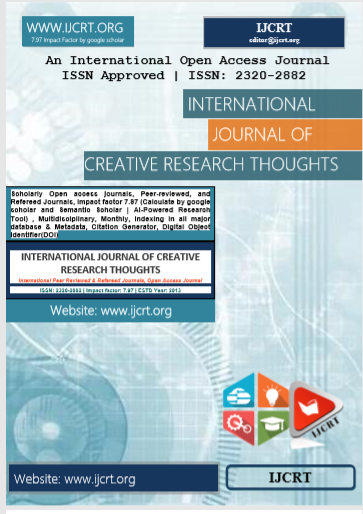
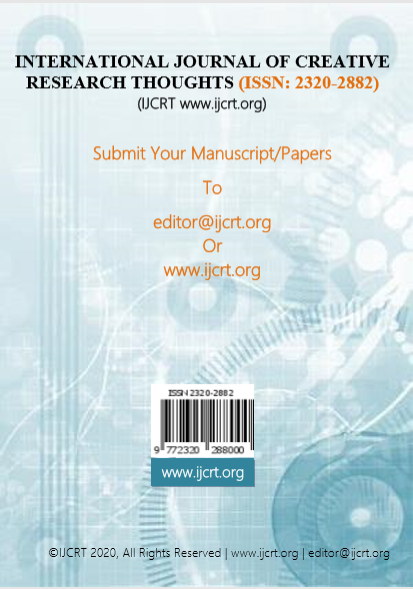
| IJCRT Journal front page | IJCRT Journal Back Page |
Paper Title: VALUE PREFERENCES OF HEARING AND HEARING IMPAIRED LATE ADOLESCENT STUDENTS
Author Name(s): DR N SAKUNTALA, DR V MALLIKARJUNA REDDY
Published Paper ID: - IJCRT25A3462
Register Paper ID - 289307
Publisher Journal Name: IJPUBLICATION, IJCRT
DOI Member ID: 10.6084/m9.doi.one.IJCRT25A3462 and DOI :
Author Country : Indian Author, India, 517502 , TIRUPATHI, 517502 , | Research Area: Arts All Published Paper URL: http://ijcrt.org/viewfull.php?&p_id=IJCRT25A3462 Published Paper PDF: download.php?file=IJCRT25A3462 Published Paper PDF: http://www.ijcrt.org/papers/IJCRT25A3462.pdf
Your Paper Publication Details:
Title: VALUE PREFERENCES OF HEARING AND HEARING IMPAIRED LATE ADOLESCENT STUDENTS
DOI (Digital Object Identifier) :
Pubished in Volume: 13 | Issue: 3 | Year: March 2025
Publisher Name : IJCRT | www.ijcrt.org | ISSN : 2320-2882
Subject Area: Arts All
Author type: Indian Author
Pubished in Volume: 13
Issue: 3
Pages: m684-m692
Year: March 2025
Downloads: 164
E-ISSN Number: 2320-2882
Abstract
The paper examines value preferences of hearing and hearing impaired late adolescent students. The sample consists of 400 hearing (normal) and 400 hearing impaired (male-200 and female-200) adolescent students (15 to 18 years age group) studying different schools and colleges in Rayalaseema region of Andhra Pradesh state. Simple random, purposive and convenient sampling techniques were used to select the sample. Mean, standard deviation and t- test were employed for the collected data. The results indicated that the adolescent students gave most preference to hedonistic and power values, and least preference to health and social values among the dimensions of personal value questionnaire.
Licence: creative commons attribution 4.0
License
Creative Commons Attribution 4.0 and The Open Definition

Keywords
Value Preferences, Hearing, Hearing Impaired, Adolescent Students, Late Adolescence, Personal Values
License
Creative Commons Attribution 4.0 and The Open Definition
Paper Title: As a teacher Maxims of Teaching in Different Strategies in Teacher Education
Author Name(s): Dr. V. JAYACHANDRAN, KOBAKU RAMA KRISHNA REDDY
Published Paper ID: - IJCRT25A3461
Register Paper ID - 289191
Publisher Journal Name: IJPUBLICATION, IJCRT
DOI Member ID: 10.6084/m9.doi.one.IJCRT25A3461 and DOI :
Author Country : Indian Author, India, 517502 , TIRUPATHI, 517502 , | Research Area: Arts All Published Paper URL: http://ijcrt.org/viewfull.php?&p_id=IJCRT25A3461 Published Paper PDF: download.php?file=IJCRT25A3461 Published Paper PDF: http://www.ijcrt.org/papers/IJCRT25A3461.pdf
Your Paper Publication Details:
Title: AS A TEACHER MAXIMS OF TEACHING IN DIFFERENT STRATEGIES IN TEACHER EDUCATION
DOI (Digital Object Identifier) :
Pubished in Volume: 13 | Issue: 3 | Year: March 2025
Publisher Name : IJCRT | www.ijcrt.org | ISSN : 2320-2882
Subject Area: Arts All
Author type: Indian Author
Pubished in Volume: 13
Issue: 3
Pages: m675-m683
Year: March 2025
Downloads: 179
E-ISSN Number: 2320-2882
Abstract
The reality is that the teaching is an art and to acquire efficiency in this art the teacher need two things I). The complete knowledge of the subject matter II).The scientific knowledge of the teaching styles for discrimination the knowledge to the people. Maxims of teaching have been discovered, not invented. They are simply statements the way in which teaching and learning go forward. They ensure efficient and effective teaching. Instruction process developments its attention to only one dimension of instruction, teaching strategy. Teaching strategy defined as patterns of behaviour, described in activity sequences. They are six major types of teaching strategies (1) Advance organizer, (2) Concept attainment, (3) cognitive development, (4) Contingency management, (5) Self-management, (6) basic practice strategy. These six strategies are the most well noted and most widely used in classroom.
Licence: creative commons attribution 4.0
License
Creative Commons Attribution 4.0 and The Open Definition
Keywords
Maxims, Stratagies, Cognitive Development Strategy
License
Creative Commons Attribution 4.0 and The Open Definition
Paper Title: Forecasting Academic Achievement Using Machine Learning Techniques on the MathE dataset using Bigdata Analysis
Author Name(s): Narayana Galla, Prof. M. Padmavathamma
Published Paper ID: - IJCRT25A3460
Register Paper ID - 289104
Publisher Journal Name: IJPUBLICATION, IJCRT
DOI Member ID: 10.6084/m9.doi.one.IJCRT25A3460 and DOI :
Author Country : Indian Author, India, - , -, - , | Research Area: Science and Technology Published Paper URL: http://ijcrt.org/viewfull.php?&p_id=IJCRT25A3460 Published Paper PDF: download.php?file=IJCRT25A3460 Published Paper PDF: http://www.ijcrt.org/papers/IJCRT25A3460.pdf
Your Paper Publication Details:
Title: FORECASTING ACADEMIC ACHIEVEMENT USING MACHINE LEARNING TECHNIQUES ON THE MATHE DATASET USING BIGDATA ANALYSIS
DOI (Digital Object Identifier) :
Pubished in Volume: 13 | Issue: 3 | Year: March 2025
Publisher Name : IJCRT | www.ijcrt.org | ISSN : 2320-2882
Subject Area: Science and Technology
Author type: Indian Author
Pubished in Volume: 13
Issue: 3
Pages: m670-m674
Year: March 2025
Downloads: 165
E-ISSN Number: 2320-2882
Abstract
This research investigates the use of machine learning classification techniques to forecast student academic outcomes based on the MathE dataset. The study focuses on data preprocessing and analysis to uncover critical attributes that affect scholastic achievement. A variety of classification algorithms--including Logistic Regression, Random Forest, and Gradient Boosting--were applied and their performances compared. Evaluation metrics such as accuracy, precision, recall, and F1-score were employed to measure model effectiveness. Findings suggest that ensemble approaches outperform conventional models in anticipating student success. This work delivers meaningful perspectives for educators and decision-makers to strengthen academic support and implement timely interventions.
Licence: creative commons attribution 4.0
License
Creative Commons Attribution 4.0 and The Open Definition
Keywords
Forecasting Academic Achievement Using Machine Learning Techniques on the MathE dataset using Bigdata Analysis
License
Creative Commons Attribution 4.0 and The Open Definition
Paper Title: A STUDY OF ACHIEVEMENT IN MATHEMATICS OF SECONDARY SCHOOL STUDENTS WITH REFERENCE TO GENDER AND MANAGEMENT
Author Name(s): Dr M MOHAN REDDY, Dr N KAVITHA
Published Paper ID: - IJCRT25A3459
Register Paper ID - 289057
Publisher Journal Name: IJPUBLICATION, IJCRT
DOI Member ID: 10.6084/m9.doi.one.IJCRT25A3459 and DOI :
Author Country : Indian Author, India, 517502 , TIRUPATHI, 517502 , | Research Area: Arts All Published Paper URL: http://ijcrt.org/viewfull.php?&p_id=IJCRT25A3459 Published Paper PDF: download.php?file=IJCRT25A3459 Published Paper PDF: http://www.ijcrt.org/papers/IJCRT25A3459.pdf
Your Paper Publication Details:
Title: A STUDY OF ACHIEVEMENT IN MATHEMATICS OF SECONDARY SCHOOL STUDENTS WITH REFERENCE TO GENDER AND MANAGEMENT
DOI (Digital Object Identifier) :
Pubished in Volume: 13 | Issue: 3 | Year: March 2025
Publisher Name : IJCRT | www.ijcrt.org | ISSN : 2320-2882
Subject Area: Arts All
Author type: Indian Author
Pubished in Volume: 13
Issue: 3
Pages: m664-m669
Year: March 2025
Downloads: 184
E-ISSN Number: 2320-2882
Abstract
ABSTRACT Achievement is of paramount importance, particularly, in the present socio-economic and cultural contexts. Obviously in the school/college level, great emphasis is placed on the academic achievement, right from the beginning of formal education. The main objective of the present study is to study the influence of gender and management on the achievement in mathematics of secondary school students The Achievement in Mathematics test constructed by Yella Reddy, B (2020) was adopted for this study. The Achievement in Mathematics test have 100 items, One mark is awarded for each correct answer and the total marks obtained by each student as Achievement in Mathematics. A sample of 320 Secondary school students representing different gender and management in Chittoor District is taken for the data analysis following stratified sampling technique. 't' test was employed for analysis of the data. There is significant influence of gender and management at 0.01 level of significance on the achievement in mathematics of secondary school students. Girls and Private secondary school students have high academic achievement than the Boys and Government secondary school students. Government has to provide good amenities for Boys and Government secondary school students.
Licence: creative commons attribution 4.0
License
Creative Commons Attribution 4.0 and The Open Definition
Keywords
Achievement in Mathematics, Gender, Management and Secondary school students
License
Creative Commons Attribution 4.0 and The Open Definition
Paper Title: Disillusionment and Identity in V.S. Naipaul's A Bend in the River
Author Name(s): Dr. Shraddha Srivastava
Published Paper ID: - IJCRT25A3458
Register Paper ID - 288664
Publisher Journal Name: IJPUBLICATION, IJCRT
DOI Member ID: 10.6084/m9.doi.one.IJCRT25A3458 and DOI :
Author Country : Indian Author, India, - , -, - , | Research Area: Science and Technology Published Paper URL: http://ijcrt.org/viewfull.php?&p_id=IJCRT25A3458 Published Paper PDF: download.php?file=IJCRT25A3458 Published Paper PDF: http://www.ijcrt.org/papers/IJCRT25A3458.pdf
Your Paper Publication Details:
Title: DISILLUSIONMENT AND IDENTITY IN V.S. NAIPAUL'S A BEND IN THE RIVER
DOI (Digital Object Identifier) :
Pubished in Volume: 13 | Issue: 3 | Year: March 2025
Publisher Name : IJCRT | www.ijcrt.org | ISSN : 2320-2882
Subject Area: Science and Technology
Author type: Indian Author
Pubished in Volume: 13
Issue: 3
Pages: m661-m663
Year: March 2025
Downloads: 180
E-ISSN Number: 2320-2882
Abstract
V.S. Naipaul's A Bend in the River is a powerful exploration of postcolonial Africa and the existential dilemmas faced by individuals navigating the collapse of colonial structures. This research paper examines the novel's central themes of identity crisis, political instability, alienation, and the disillusionment that accompanies decolonization. Through the perspective of Salim, an Indian trader in an unnamed African country, Naipaul crafts a narrative steeped in historical reflection and personal struggle. This paper argues that A Bend in the River not only critiques the failures of postcolonial governance but also meditates on the psychological ramifications of cultural dislocation. The study further explores how Naipaul uses narrative voice, setting, and character development to highlight the enduring effects of colonial legacy on modern identity.
Licence: creative commons attribution 4.0
License
Creative Commons Attribution 4.0 and The Open Definition
Keywords
Disillusionment and Identity in V.S. Naipaul's A Bend in the River
License
Creative Commons Attribution 4.0 and The Open Definition
Paper Title: THE IMPACT OF TECHNOLOGY ON CRIMINAL INVESTIGATIONS AND EVIDENCE
Author Name(s): Dr. Princy Singla
Published Paper ID: - IJCRT25A3457
Register Paper ID - 288621
Publisher Journal Name: IJPUBLICATION, IJCRT
DOI Member ID: 10.6084/m9.doi.one.IJCRT25A3457 and DOI :
Author Country : Indian Author, India, 132103 , Panipat, 132103 , | Research Area: Medical Science All Published Paper URL: http://ijcrt.org/viewfull.php?&p_id=IJCRT25A3457 Published Paper PDF: download.php?file=IJCRT25A3457 Published Paper PDF: http://www.ijcrt.org/papers/IJCRT25A3457.pdf
Your Paper Publication Details:
Title: THE IMPACT OF TECHNOLOGY ON CRIMINAL INVESTIGATIONS AND EVIDENCE
DOI (Digital Object Identifier) :
Pubished in Volume: 13 | Issue: 3 | Year: March 2025
Publisher Name : IJCRT | www.ijcrt.org | ISSN : 2320-2882
Subject Area: Medical Science All
Author type: Indian Author
Pubished in Volume: 13
Issue: 3
Pages: m650-m660
Year: March 2025
Downloads: 312
E-ISSN Number: 2320-2882
Abstract
In the evolving landscape of criminal investigations, technology has emerged as a transformative force, revolutionizing evidence collection and law enforcement operations. This study explores the integration of advanced tools such as artificial intelligence, big data analytics, digital forensics, and biometrics in modern policing. By enhancing the speed, accuracy, and credibility of investigations, these technologies address traditional limitations and adapt to the challenges posed by cybercrime and sophisticated criminal activities. Historical milestones, including fingerprint and DNA analysis, laid the groundwork for contemporary advancements such as 3D crime scene reconstruction and predictive policing. Digital forensics now plays a pivotal role in uncovering crucial electronic evidence, while surveillance technologies like CCTV, drones, and facial recognition have expanded investigative reach. However, the ethical implications of these tools, particularly concerning privacy, bias, and data security, require careful consideration. This study also highlights disparities in technological access among law enforcement agencies, stressing the need for capacity-building initiatives. Future trends point toward increased reliance on AI and data-driven policing, demanding stringent ethical standards and transparent governance. Through examining these developments, the study offers policy recommendations to guide responsible technology integration, ensuring that innovation enhances justice while safeguarding civil liberties.
Licence: creative commons attribution 4.0
License
Creative Commons Attribution 4.0 and The Open Definition
Keywords
Criminal Investigations, Law Enforcement, Artificial Intelligence, Big Data Analytics, Digital Forensics, Biometrics, Fingerprint, DNA Analysis and Facial Recognition
License
Creative Commons Attribution 4.0 and The Open Definition
Paper Title: Swami Vivekanad ke shaikshik evam darshanik vicharo ka adhyayan
Author Name(s): Dr. Harendra Kumar Sharma
Published Paper ID: - IJCRT25A3456
Register Paper ID - 288471
Publisher Journal Name: IJPUBLICATION, IJCRT
DOI Member ID: 10.6084/m9.doi.one.IJCRT25A3456 and DOI :
Author Country : Indian Author, India, - , -, - , | Research Area: Science and Technology Published Paper URL: http://ijcrt.org/viewfull.php?&p_id=IJCRT25A3456 Published Paper PDF: download.php?file=IJCRT25A3456 Published Paper PDF: http://www.ijcrt.org/papers/IJCRT25A3456.pdf
Your Paper Publication Details:
Title: SWAMI VIVEKANAD KE SHAIKSHIK EVAM DARSHANIK VICHARO KA ADHYAYAN
DOI (Digital Object Identifier) :
Pubished in Volume: 13 | Issue: 3 | Year: March 2025
Publisher Name : IJCRT | www.ijcrt.org | ISSN : 2320-2882
Subject Area: Science and Technology
Author type: Indian Author
Pubished in Volume: 13
Issue: 3
Pages: m645-m649
Year: March 2025
Downloads: 150
E-ISSN Number: 2320-2882
Abstract
Swami Vivekanad ke shaikshik evam darshanik vicharo ka adhyayan
Licence: creative commons attribution 4.0
License
Creative Commons Attribution 4.0 and The Open Definition
Keywords
Swami Vivekanad ke shaikshik evam darshanik vicharo ka adhyayan
License
Creative Commons Attribution 4.0 and The Open Definition
Paper Title: India-Sri Lanka Relations: A New Era of Cooperation Amid Economic Crisis
Author Name(s): Dr.K.Mallikarjuna
Published Paper ID: - IJCRT25A3455
Register Paper ID - 288186
Publisher Journal Name: IJPUBLICATION, IJCRT
DOI Member ID: 10.6084/m9.doi.one.IJCRT25A3455 and DOI :
Author Country : Indian Author, India, - , -, - , | Research Area: Science and Technology Published Paper URL: http://ijcrt.org/viewfull.php?&p_id=IJCRT25A3455 Published Paper PDF: download.php?file=IJCRT25A3455 Published Paper PDF: http://www.ijcrt.org/papers/IJCRT25A3455.pdf
Your Paper Publication Details:
Title: INDIA-SRI LANKA RELATIONS: A NEW ERA OF COOPERATION AMID ECONOMIC CRISIS
DOI (Digital Object Identifier) :
Pubished in Volume: 13 | Issue: 3 | Year: March 2025
Publisher Name : IJCRT | www.ijcrt.org | ISSN : 2320-2882
Subject Area: Science and Technology
Author type: Indian Author
Pubished in Volume: 13
Issue: 3
Pages: m641-m644
Year: March 2025
Downloads: 166
E-ISSN Number: 2320-2882
Abstract
The recent visit of Sri Lankan President Anura Kumara Dissanayake to India highlights the growing economic, political, and strategic ties between the two nations, particularly in the context of Sri Lanka's recovery from its severe economic crisis. This article explores the roots of Sri Lanka's economic difficulties, the role of India in providing critical financial aid, and the strengthening of bilateral relations through development initiatives. The visit also underscores the geopolitical importance of the relationship, particularly in light of China's increasing influence in the region. India's support for Sri Lanka's recovery and its assurances regarding regional security reflect a deeper strategic partnership. Moving forward, both countries aim to enhance cooperation in infrastructure, renewable energy, digital transformation, and maritime security. This evolving partnership holds the potential to contribute significantly to regional stability and prosperity.
Licence: creative commons attribution 4.0
License
Creative Commons Attribution 4.0 and The Open Definition
Keywords
Sri Lanka, India, bilateral relations, economic crisis, financial aid, development cooperation, infrastructure projects, renewable energy, geopolitical influence, China, regional security, India-Sri Lanka partnership, strategic cooperation, maritime security, Sri Lankan recovery, India's foreign policy.
License
Creative Commons Attribution 4.0 and The Open Definition
Paper Title: The functions of SLT and smoking tobacco consumers contribute to the oxidative stress in plasma of humans
Author Name(s): P. Varalakshmi, Narendra Maddu
Published Paper ID: - IJCRT25A3454
Register Paper ID - 286905
Publisher Journal Name: IJPUBLICATION, IJCRT
DOI Member ID: 10.6084/m9.doi.one.IJCRT25A3454 and DOI :
Author Country : Indian Author, India, - , -, - , | Research Area: Science and Technology Published Paper URL: http://ijcrt.org/viewfull.php?&p_id=IJCRT25A3454 Published Paper PDF: download.php?file=IJCRT25A3454 Published Paper PDF: http://www.ijcrt.org/papers/IJCRT25A3454.pdf
Your Paper Publication Details:
Title: THE FUNCTIONS OF SLT AND SMOKING TOBACCO CONSUMERS CONTRIBUTE TO THE OXIDATIVE STRESS IN PLASMA OF HUMANS
DOI (Digital Object Identifier) :
Pubished in Volume: 13 | Issue: 3 | Year: March 2025
Publisher Name : IJCRT | www.ijcrt.org | ISSN : 2320-2882
Subject Area: Science and Technology
Author type: Indian Author
Pubished in Volume: 13
Issue: 3
Pages: m635-m640
Year: March 2025
Downloads: 166
E-ISSN Number: 2320-2882
Abstract
Smokeless tobacco product (SLT) and Smoking products are available in different brands like Rajnignadha, Vimal, Hira, and RMD (Rasikala Manikchand Dhariwal) cigar manufactured by various smokeless tobacco and smoking tobacco industries. The impact of the use of SLT users and Cigar users on plasma biochemical profile especially the levels of glucose, lipids and lipoprotein patterns, proteins, free amino acids and iron. SLT/smoking tobacco (cigar)-exposure caused permissive but significant effect role by elevating the plasma glucose levels by 12% and 15% in group II and III human exposed subjects respectively when compared to control group I subjects who do not use any SLT/smoking tobacco (cigar) products, there is a net drop in plasma iron, glycolipids with a significant increase in free amino acids. There was no change in HDL-C levels among the three groups. Triglycerides and VLDL-C were significantly elevated in SLT/smoking tobacco (cigar) exposed subjects in group II and III indicating coronary risk.
Licence: creative commons attribution 4.0
License
Creative Commons Attribution 4.0 and The Open Definition
Keywords
Smokeless tobacco, smoking tobacco, Oxidative stress
License
Creative Commons Attribution 4.0 and The Open Definition
Paper Title: Long-Term Economic Sustainability of Ladli Behna Yojana's Spillover Effects
Author Name(s): Prashant Kumar Chaurasiya, Pushpendra Kumar Shah
Published Paper ID: - IJCRT25A3453
Register Paper ID - 285141
Publisher Journal Name: IJPUBLICATION, IJCRT
DOI Member ID: 10.6084/m9.doi.one.IJCRT25A3453 and DOI :
Author Country : Indian Author, India, - , -, - , | Research Area: Commerce and Management, MBA All Branch Published Paper URL: http://ijcrt.org/viewfull.php?&p_id=IJCRT25A3453 Published Paper PDF: download.php?file=IJCRT25A3453 Published Paper PDF: http://www.ijcrt.org/papers/IJCRT25A3453.pdf
Your Paper Publication Details:
Title: LONG-TERM ECONOMIC SUSTAINABILITY OF LADLI BEHNA YOJANA'S SPILLOVER EFFECTS
DOI (Digital Object Identifier) :
Pubished in Volume: 13 | Issue: 3 | Year: March 2025
Publisher Name : IJCRT | www.ijcrt.org | ISSN : 2320-2882
Subject Area: Commerce and Management, MBA All Branch
Author type: Indian Author
Pubished in Volume: 13
Issue: 3
Pages: m628-m634
Year: March 2025
Downloads: 217
E-ISSN Number: 2320-2882
Abstract
Launched in 2023, the Mukhyamantri Ladli Behna Yojana (LBY) in Madhya Pradesh provides direct monthly financial assistance to women with the aim of fostering their economic independence and improving overall socio-economic conditions. This research explores the long-term viability of the scheme's secondary effects, such as increased local market activity, enhanced participation in entrepreneurship, and expanded financial inclusion, in the context of fiscal constraints and growing state-level debt. Employing a mixed-methods approach, the study examines whether these outcomes contribute to sustained economic development or create risks of financial dependency. Findings indicate that LBY has a positive impact on grassroots economic stimulation and women's empowerment; however, its future success hinges on complementary measures like skill development, expanded access to microfinance, and diversified state revenue streams. The study recommends structural reforms to ensure the program's long-term fiscal and economic sustainability.
Licence: creative commons attribution 4.0
License
Creative Commons Attribution 4.0 and The Open Definition
Keywords
Long-Term Economic Sustainability
License
Creative Commons Attribution 4.0 and The Open Definition
Call For Paper July 2026
Call For Papers
July 2026
Volume 14 | Issue 7
Last Date :
31-Jul-2026
Submit Manuscript Online Impact Factor: 7.97 Review Results : Within 02-03 Days Paper Publication : Within 02-03 Days
July 2026
Volume 14 | Issue 7
Last Date :
31-Jul-2026
Submit Manuscript Online Impact Factor: 7.97 Review Results : Within 02-03 Days Paper Publication : Within 02-03 Days
Published Issue Details
For Authors
Forms / Downloads
Other IMP Links
Indexing Partner
Research Area
LICENSE





ISSN and 7.97 Impact Factor Details

ISSN: 2320-2882 Impact Factor: 7.97 and ISSN APPROVED Journal Starting Year (ESTD) : 2013


ISSN and 7.97 Impact Factor Details
ISSN: 2320-2882 Impact Factor: 7.97 and ISSN APPROVED Journal Starting Year (ESTD) : 2013
DOI Details
CONFERENCE
CONFERENCE MANAGMENT & PUBLICATION CONFERENCE PROPOSAL
RECENT CONFERENCE

CONFERENCE PROPOSAL CONFERENCE PROCEEDINGS
CONFERENCE PROPOSAL CONFERENCE PROCEEDINGS
For Reviewer /Referral (RMS) Earn 500 per paper
Important Links
NEWS & Conference
Digital Library
IJCRT RMS | Earn 500 Per Paper.

Open Access


LICENSE
Indexing Partner
Scholarly open access journals, Peer-reviewed, and Refereed Journals, Impact factor 7.97 (Calculate by google scholar and Semantic Scholar | AI-Powered Research Tool) , Multidisciplinary, Monthly, Indexing in all major database & Metadata, Citation Generator, Digital Object Identifier(DOI)