Important Details
IJCRT - International Peer Reviewed, Open Access Journal, Multidisciplinary, Monthly, Nominal(Low) Fees for Professional Research Services International Journal of Creative Research Thoughts - IJCRT Peer Review Journal, Refereed Journal, Peer Reviewed Journal , Referred Journal and Indexed Journal, Open access, Online and Print Journal,international Journal Open Access, Accepted by Indian and foreign university ,IJCRT Followed Norms, guidelines, requirement, listing criteria and methodology of score/point also applied from: Scopus , Web of Science , UGC Approved , UGC CARE, UGC-CARE .
UGC Approved Journal No: 49023 (18)
UGC approval Link
https://ijcrt.org/ugc%20approval.jpg
All Policy and Approval
Please Like Our Facebook Page | CrossRef DOI and Hard copy of Certificate Provide if required. | www.IJCRT.org | editor@IJCRT.org | WhatsApp: 7990172303
Publication Details:
- Paper Submission : 31-Mar-2026. Call For Paper (Volume 14 | Issue 3 | Month- March 2026)
- Acceptance/Rejection Notification: Within 02-04 Days.
- Paper Publish: Within 02-04 Days after submitting all documents.
-
Submit Your Paper Any time There No deadline.
-
Publication fees : 1570 INR for Indian author & 59$ for foreign International author.
Please Like Our Facebook Page | CrossRef DOI and Hard copy of Certificate Provide if required.
Licence and Indexing
Indexing In Google Scholar, SSRN, ResearcherID-Publons, Semantic Scholar | AI-Powered Research Tool, Microsoft Academic, Academia.edu, arXiv.org, Research Gate, CiteSeerX, ResearcherID Thomson Reuters, Mendeley : reference manager, DocStoc, ISSUU, Scribd, and many more | High Impact Factor: 7.97 | Digital object identifier (DOI) and Hard Copy of certificate Provided.




























Licence
DOI
ISSN Approved impact factor: 7.97 
Creative Common 
Valid as per new UGC Gazette regulations 

INTERNATIONAL JOURNAL OF CREATIVE RESEARCH THOUGHTS - IJCRT (IJCRT.ORG)
International Peer Reviewed & Refereed Journals, Open Access Journal
IJCRT Peer-Reviewed (Refereed) Journal as Per New UGC Rules.
ISSN Approved Journal No: 2320-2882 | Impact factor: 7.97 | ESTD Year: 2013
Call For Paper - Volume 14 | Issue 3 | Month- March 2026
Scholarly open access journals, Peer-reviewed, and Refereed Journals, Impact factor 7.97 (Calculate by google scholar and Semantic Scholar | AI-Powered Research Tool) , Multidisciplinary, Monthly, Indexing in all major database & Metadata, Citation Generator, Digital Object Identifier(CrossRef DOI)
Contact Us Click Here
WhatsApp Contact Click Here
IJCRT Search Xplore - Search all paper by Paper Name , Author Name, and Title
Volume 14 | Issue 2 |
Volume 14 | Issue 2 | Month
Downlaod After Publication 1) Table of content index in PDF
2) Table of content index in HTML 2)Table of content index in HTML
3) Front Page 3) Front Page
4) Back Page 4) Back Page
5) Editor Board Member 5)Editor Board Member
6) OLD Style Issue 6)OLD Style Issue
 |
 |
|---|---|
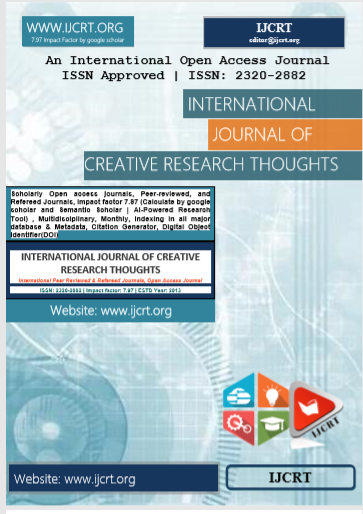
| IJCRT Journal front page | IJCRT Journal Back Page |
Paper Title: Bridging the Urban-Rural Digital Infrastructure Divide in Manipur: Challenges and Opportunities
Author Name(s): Silvia Lourembam
Published Paper ID: - IJCRT2602559
Register Paper ID - 301871
Publisher Journal Name: IJPUBLICATION, IJCRT
DOI Member ID: 10.6084/m9.doi.one.IJCRT2602559 and DOI : https://doi.org/10.56975/ijcrt.v14i2.301871
Author Country : Indian Author, India, 795001 , Imphal, 795001 , | Research Area: Social Science All Published Paper URL: http://ijcrt.org/viewfull.php?&p_id=IJCRT2602559 Published Paper PDF: download.php?file=IJCRT2602559 Published Paper PDF: http://www.ijcrt.org/papers/IJCRT2602559.pdf
Your Paper Publication Details:
Title: BRIDGING THE URBAN-RURAL DIGITAL INFRASTRUCTURE DIVIDE IN MANIPUR: CHALLENGES AND OPPORTUNITIES
DOI (Digital Object Identifier) : https://doi.org/10.56975/ijcrt.v14i2.301871
Pubished in Volume: 14 | Issue: 2 | Year: February 2026
Publisher Name : IJCRT | www.ijcrt.org | ISSN : 2320-2882
Subject Area: Social Science All
Author type: Indian Author
Pubished in Volume: 14
Issue: 2
Pages: e770-e777
Year: February 2026
Downloads: 38
E-ISSN Number: 2320-2882
Abstract
Abstract: This study investigates the persistent digital infrastructure divide between urban and rural areas in Manipur, focusing on the challenges and opportunities in bridging this gap. Despite technological progress, rural Manipur faces inadequate connectivity, limited high-speed internet access, and infrastructural shortcomings compared to urban centres. Key challenges include difficult hilly terrain, low investment in rural telecom networks, and socio-economic issues such as low digital literacy and affordability. Policy implementation gaps and limited local stakeholder involvement further worsen the divide. Opportunities stem from government initiatives to expand broadband under national digital inclusion programs, growing mobile device penetration, and potential public-private partnerships to enhance infrastructure. The study uses a qualitative approach based on secondary data from government reports, policy documents, academic sources, and digital inclusion publications, providing comprehensive insights into infrastructure, socio-economic factors, policies, and technology penetration. Bridging this divide is essential for equitable access to education, healthcare, governance, and economic opportunities, supporting Manipur's socio-economic development. This research lays the groundwork for future studies and policy development toward a digitally inclusive Manipur.
Licence: creative commons attribution 4.0
License
Creative Commons Attribution 4.0 and The Open Definition

Keywords
Digital Divide, Urban-Rural, Manipur.
License
Creative Commons Attribution 4.0 and The Open Definition
Paper Title: EXPLORING WOMEN ENTREPRENEURIAL ECOSYSTEM WITH FACTORS AFFECTING STARTUP AND GROWTH: A SPECIAL EMPHASIS ON ENTREPRENEURSHIP DEVELOPMENT PROGRAMS
Author Name(s): Yashi Singh, Shikha Dubey, Dr. Ajay Dwivedi
Published Paper ID: - IJCRT2602558
Register Paper ID - 301985
Publisher Journal Name: IJPUBLICATION, IJCRT
DOI Member ID: 10.6084/m9.doi.one.IJCRT2602558 and DOI :
Author Country : Indian Author, India, - , -, - , | Research Area: Science and Technology Published Paper URL: http://ijcrt.org/viewfull.php?&p_id=IJCRT2602558 Published Paper PDF: download.php?file=IJCRT2602558 Published Paper PDF: http://www.ijcrt.org/papers/IJCRT2602558.pdf
Your Paper Publication Details:
Title: EXPLORING WOMEN ENTREPRENEURIAL ECOSYSTEM WITH FACTORS AFFECTING STARTUP AND GROWTH: A SPECIAL EMPHASIS ON ENTREPRENEURSHIP DEVELOPMENT PROGRAMS
DOI (Digital Object Identifier) :
Pubished in Volume: 14 | Issue: 2 | Year: February 2026
Publisher Name : IJCRT | www.ijcrt.org | ISSN : 2320-2882
Subject Area: Science and Technology
Author type: Indian Author
Pubished in Volume: 14
Issue: 2
Pages: e760-e769
Year: February 2026
Downloads: 43
E-ISSN Number: 2320-2882
Abstract
In developing economies such as India, women entrepreneurship has become a significant force of inclusive economic development, creation of employment, and innovations. Nevertheless, women entrepreneurs still experience structural, socio-cultural, financial, and institutional obstacles that influence the establishment of a startup and business development. This research paper discusses women entrepreneurial ecosystem by highlighting major elements of the ecosystem networks, funding, mentorship, policy support, and Entrepreneurship Development Programs (EDP). The research formulates a theoretical construct that connects the aspects of ecosystem to the performance and growth results of a startup. It suggests that EDPs are catalytic tools that optimize human capital, entrepreneurial self-efficacy, innovativeness and market integration. The theoretical viewpoints that are incorporated in the paper are Human Capital Theory, Social Capital Theory, Resource-Based View, and Institutional Theory to elaborate the interaction between ecosystem factors and business performance. There are also policy implications and future research directions.
Licence: creative commons attribution 4.0
License
Creative Commons Attribution 4.0 and The Open Definition
Keywords
Women Entrepreneurship, Entrepreneurial Ecosystem, Startup Growth, Entrepreneurship Development Programs, Policy Support, India.
License
Creative Commons Attribution 4.0 and The Open Definition
Paper Title: A Review of Dengue & Malaria Detection Systems from PBS using Machine Learning
Author Name(s): Kunal Vinay Gohad, Dr Rajshree Pankaj Wankhade
Published Paper ID: - IJCRT2602557
Register Paper ID - 301870
Publisher Journal Name: IJPUBLICATION, IJCRT
DOI Member ID: 10.6084/m9.doi.one.IJCRT2602557 and DOI :
Author Country : Indian Author, India, 444603 , Amravati, 444603 , | Research Area: Science and Technology Published Paper URL: http://ijcrt.org/viewfull.php?&p_id=IJCRT2602557 Published Paper PDF: download.php?file=IJCRT2602557 Published Paper PDF: http://www.ijcrt.org/papers/IJCRT2602557.pdf
Your Paper Publication Details:
Title: A REVIEW OF DENGUE & MALARIA DETECTION SYSTEMS FROM PBS USING MACHINE LEARNING
DOI (Digital Object Identifier) :
Pubished in Volume: 14 | Issue: 2 | Year: February 2026
Publisher Name : IJCRT | www.ijcrt.org | ISSN : 2320-2882
Subject Area: Science and Technology
Author type: Indian Author
Pubished in Volume: 14
Issue: 2
Pages: e749-e759
Year: February 2026
Downloads: 28
E-ISSN Number: 2320-2882
Abstract
Mosquito-borne diseases such as Dengue and Malaria remain major global public health challenges, causing millions of infections and substantial mortality each year, particularly in tropical and subtropical regions. Conventional diagnostic methods for both diseases rely heavily on manual microscopic examination of peripheral blood smears, a process that is labor-intensive, time-consuming, and vulnerable to observer variability. Recent advances in digital pathology and image-processing-based automation offer promising solutions for early, accurate, and cost-effective diagnosis. In dengue detection, peripheral blood smear (PBS) analysis reveals hallmark changes such as thrombocytopenia and lymphocyte morphological alterations. Machine-learning approaches using morphological and Gray-Level Spatial Dependence Matrix (GLSDM) features extracted from lymphocyte nuclei have demonstrated high diagnostic accuracy, with Support Vector Machine-based models achieving up to 95.74% accuracy in distinguishing dengue-infected samples. Similarly, for malaria diagnosis, automated image analysis systems employing color thresholding, segmentation, blob analysis, watershed techniques, and shape-based classification have shown excellent performance in detecting Plasmodium-infected red blood cells. Systems using texture and intensity features, neural network classifiers, and morphological processing have achieved accuracies ranging from 93% to 99%, significantly reducing dependency on expert microscopists. This combined study highlights the growing potential of AI-driven digital microscopy for the automated screening of vector-borne diseases. Integrating machine learning, deep learning, and advanced image-processing techniques enables rapid detection of infected cells, accurate parasite quantification, and improved clinical decision-making. Such automated frameworks can provide scalable, low-cost diagnostic support in resource-limited settings, thereby strengthening global disease surveillance and early intervention strategies for both dengue and malaria.
Licence: creative commons attribution 4.0
License
Creative Commons Attribution 4.0 and The Open Definition
Keywords
Digital Image Processing, Machine Learning, SVM, CNN, Disease Detection, Biomedical, Dengue, Malaria.
License
Creative Commons Attribution 4.0 and The Open Definition
Paper Title: A. E. Coppard's Fifty Pounds: An Examination of the Loneliness of Two Minds
Author Name(s): Kakali Ghosh
Published Paper ID: - IJCRT2602556
Register Paper ID - 301862
Publisher Journal Name: IJPUBLICATION, IJCRT
DOI Member ID: 10.6084/m9.doi.one.IJCRT2602556 and DOI : https://doi.org/10.56975/ijcrt.v14i2.301862
Author Country : Indian Author, India, - , -, - , | Research Area: Science and Technology Published Paper URL: http://ijcrt.org/viewfull.php?&p_id=IJCRT2602556 Published Paper PDF: download.php?file=IJCRT2602556 Published Paper PDF: http://www.ijcrt.org/papers/IJCRT2602556.pdf
Your Paper Publication Details:
Title: A. E. COPPARD'S FIFTY POUNDS: AN EXAMINATION OF THE LONELINESS OF TWO MINDS
DOI (Digital Object Identifier) : https://doi.org/10.56975/ijcrt.v14i2.301862
Pubished in Volume: 14 | Issue: 2 | Year: February 2026
Publisher Name : IJCRT | www.ijcrt.org | ISSN : 2320-2882
Subject Area: Science and Technology
Author type: Indian Author
Pubished in Volume: 14
Issue: 2
Pages: e744-e748
Year: February 2026
Downloads: 45
E-ISSN Number: 2320-2882
Abstract
: Fifty Pounds is an excellent short story by A. E. Coppard. The story concerns two characters namely Philip Repton and Eulalia Burnes (Lally) who love each other and are living together without matrimonial bond. Their relationship begins after Repton finds Lally in distress and helps her. Thus, they were lonely before they met each other. This article seeks to explore how the sense of loneliness is a dominant theme in this story. If read thoroughly, it is noticeable that the story begins with the idea of loneliness and ends with the same idea. They feel loneliness even when they are together as despite being together for several months, they are unable to understand each other as somehow, they are more concerned about themselves and their own thoughts and minds rather than that of the other person. The titular fifty pounds is largely responsible for their future life of loneliness. Then, their loneliness is the result of their ego, misunderstandings, emotional aloofness and rash judgements. Circumstances are also responsible for their feeling of loneliness. How much they struggle to endow their lives with a meaning by trying to lead a peaceful and happy life together, they fail in their attempts. Thus, this article also explores how their fight against loneliness reflects their enactment of absurd life.
Licence: creative commons attribution 4.0
License
Creative Commons Attribution 4.0 and The Open Definition
Keywords
Loneliness, fifty pounds, misunderstandings, circumstances, absurd.
License
Creative Commons Attribution 4.0 and The Open Definition
Paper Title: A Lacanian Reading of Virginia Woolf's 'To the Lighthouse' and Sylvia Plath's 'The Bell Jar
Author Name(s): Saloni Saraf, Dr. Jayatee Bhattacharya
Published Paper ID: - IJCRT2602555
Register Paper ID - 301861
Publisher Journal Name: IJPUBLICATION, IJCRT
DOI Member ID: 10.6084/m9.doi.one.IJCRT2602555 and DOI :
Author Country : Indian Author, India, - , -, - , | Research Area: Science and Technology Published Paper URL: http://ijcrt.org/viewfull.php?&p_id=IJCRT2602555 Published Paper PDF: download.php?file=IJCRT2602555 Published Paper PDF: http://www.ijcrt.org/papers/IJCRT2602555.pdf
Your Paper Publication Details:
Title: A LACANIAN READING OF VIRGINIA WOOLF'S 'TO THE LIGHTHOUSE' AND SYLVIA PLATH'S 'THE BELL JAR
DOI (Digital Object Identifier) :
Pubished in Volume: 14 | Issue: 2 | Year: February 2026
Publisher Name : IJCRT | www.ijcrt.org | ISSN : 2320-2882
Subject Area: Science and Technology
Author type: Indian Author
Pubished in Volume: 14
Issue: 2
Pages: e719-e743
Year: February 2026
Downloads: 32
E-ISSN Number: 2320-2882
Abstract
Modernist literature is marked by an acute preoccupation with the instability of identity, the breakdown of coherent selfhood, and the disintegration of linear consciousness. Emerging in the aftermath of rapid industrialisation, world wars, and shifting social structures, modernist writers sought new narrative forms capable of articulating the fractured inner lives of individuals confronting a destabilised world. Within this context, questions of subjectivity--how the self is formed, sustained, and undone--occupy a central position. As Virginia Woolf observes in The Waves, "I am not one and simple, but complex and many," a sentiment that resonates deeply with the modernist understanding of the self as plural, unstable, and perpetually in flux.
Licence: creative commons attribution 4.0
License
Creative Commons Attribution 4.0 and The Open Definition
Keywords
A Lacanian Reading of Virginia Woolf's 'To the Lighthouse' and Sylvia Plath's 'The Bell Jar
License
Creative Commons Attribution 4.0 and The Open Definition
Paper Title: Laparoscopic Management of Imperforate Hymen Associated With Large Hematometra and Uterine Fibroid: A Rare Case Report
Author Name(s): Vaishnavi Wasudeo Dongare, Minal Pravin Dikondwar, Ritu Manoj Deshmukh, Tejaswini Gopal Bhasme, Chaitali Uday Meshram
Published Paper ID: - IJCRT2602554
Register Paper ID - 301226
Publisher Journal Name: IJPUBLICATION, IJCRT
DOI Member ID: 10.6084/m9.doi.one.IJCRT2602554 and DOI :
Author Country : Indian Author, India, 440027 , Nagpur, 440027 , | Research Area: Humanities All Published Paper URL: http://ijcrt.org/viewfull.php?&p_id=IJCRT2602554 Published Paper PDF: download.php?file=IJCRT2602554 Published Paper PDF: http://www.ijcrt.org/papers/IJCRT2602554.pdf
Your Paper Publication Details:
Title: LAPAROSCOPIC MANAGEMENT OF IMPERFORATE HYMEN ASSOCIATED WITH LARGE HEMATOMETRA AND UTERINE FIBROID: A RARE CASE REPORT
DOI (Digital Object Identifier) :
Pubished in Volume: 14 | Issue: 2 | Year: February 2026
Publisher Name : IJCRT | www.ijcrt.org | ISSN : 2320-2882
Subject Area: Humanities All
Author type: Indian Author
Pubished in Volume: 14
Issue: 2
Pages: e715-e718
Year: February 2026
Downloads: 50
E-ISSN Number: 2320-2882
Abstract
Licence: creative commons attribution 4.0
License
Creative Commons Attribution 4.0 and The Open Definition
Keywords
Fibroid Uterus, Myomectomy (Laparoscopic/Open), Microwave Ablation, Hysterectomy Risk, Pleural Effusion
License
Creative Commons Attribution 4.0 and The Open Definition
Paper Title: Panchkosh-Based Holistic Empowerment for Sustainable Livelihoods: A Case Study of Poddar Sansthan, Jaipur
Author Name(s): DR REEMA SINGH, DR AMITA VIJAY
Published Paper ID: - IJCRT2602553
Register Paper ID - 302036
Publisher Journal Name: IJPUBLICATION, IJCRT
DOI Member ID: 10.6084/m9.doi.one.IJCRT2602553 and DOI :
Author Country : Indian Author, India, 302020 , JAIPUR, 302020 , | Research Area: Commerce and Management, MBA All Branch Published Paper URL: http://ijcrt.org/viewfull.php?&p_id=IJCRT2602553 Published Paper PDF: download.php?file=IJCRT2602553 Published Paper PDF: http://www.ijcrt.org/papers/IJCRT2602553.pdf
Your Paper Publication Details:
Title: PANCHKOSH-BASED HOLISTIC EMPOWERMENT FOR SUSTAINABLE LIVELIHOODS: A CASE STUDY OF PODDAR SANSTHAN, JAIPUR
DOI (Digital Object Identifier) :
Pubished in Volume: 14 | Issue: 2 | Year: February 2026
Publisher Name : IJCRT | www.ijcrt.org | ISSN : 2320-2882
Subject Area: Commerce and Management, MBA All Branch
Author type: Indian Author
Pubished in Volume: 14
Issue: 2
Pages: e710-e714
Year: February 2026
Downloads: 31
E-ISSN Number: 2320-2882
Abstract
Abstract "Annamaya? pra?amaya? manomaya? vijnanamaya? anandamaya?" -- Taittiriya Upani?ad ("Human existence unfolds through the physical, vital, mental, intellectual, and blissful layers.") Ancient Indian knowledge systems articulate holistic human development through the Panchkosh framework, which integrates the physical, vital, emotional, intellectual, and spiritual dimensions of life. This chapter examines the contemporary relevance of Panchkosh philosophy in sustainable livelihood development through a case-based study of Poddar Sansthan. The chapter proposes a Panchkosh-inspired life skills development model that aligns traditional wisdom with modern socio-economic needs. Drawing on initiatives such as natural dye practices, eco-friendly craft training, community mentoring, and women-centric empowerment programs, the study demonstrates how livelihood development can transcend income generation to foster dignity of labor, ethical discernment, emotional resilience, and cultural identity. By mapping Poddar Sansthan's practices across the five koshas--Annamaya, Pranamaya, Manomaya, Vijnanamaya, and Anandamaya--the chapter highlights a replicable, human-centered framework for inclusive growth. The study contributes to the discourse on Indian Knowledge Systems, sustainable development, and holistic empowerment in contemporary society.
Licence: creative commons attribution 4.0
License
Creative Commons Attribution 4.0 and The Open Definition
Keywords
Keywords Ancient Knowledge Systems,Life Skills, Panchkosh, Poddar Sansthan, Sustainable Livelihoods, Traditional Crafts and Women Empowerment
License
Creative Commons Attribution 4.0 and The Open Definition
Paper Title: Context-Aware Outdoor AR Cognitive Twin for Field Work
Author Name(s): Surya Chanakya Pottangi
Published Paper ID: - IJCRT2602552
Register Paper ID - 301621
Publisher Journal Name: IJPUBLICATION, IJCRT
DOI Member ID: 10.6084/m9.doi.one.IJCRT2602552 and DOI :
Author Country : Foreign Author, United States of America, 30024 , Athens GA,USA, 30024 , | Research Area: Science and Technology Published Paper URL: http://ijcrt.org/viewfull.php?&p_id=IJCRT2602552 Published Paper PDF: download.php?file=IJCRT2602552 Published Paper PDF: http://www.ijcrt.org/papers/IJCRT2602552.pdf
Your Paper Publication Details:
Title: CONTEXT-AWARE OUTDOOR AR COGNITIVE TWIN FOR FIELD WORK
DOI (Digital Object Identifier) :
Pubished in Volume: 14 | Issue: 2 | Year: February 2026
Publisher Name : IJCRT | www.ijcrt.org | ISSN : 2320-2882
Subject Area: Science and Technology
Author type: Foreign Author
Pubished in Volume: 14
Issue: 2
Pages: e697-e709
Year: February 2026
Downloads: 37
E-ISSN Number: 2320-2882
Abstract
People in jobs that take them into the field - for example, solar panel installers, telecom staff, and those in rural health - very often find themselves working in tricky outdoor settings, where they don't have much in the way of connection, the paperwork isn't always complete, and there are real dangers to their safety. This study creates an augmented reality (AR) "cognitive twin" for outdoor use, which is aware of what's going on around it, and is meant to be a clever helper for people doing this sort of work; it does this by 'seeing' what is there, working out what stage of the job has been reached, and then giving the user guidance, in real time, as pictures shown on a phone or AR headset. The system puts together computer vision which works on the device itself, plus sensors for movement, direction, and location, and a simple chart of what the job involves, to spot equipment, tools, and each part of the process. A section of the system then makes up what to do next, warnings and alerts about anything unusual, based on what it can 'see' and what the user is doing. To deal with the problems usually found when things don't have much in the way of resources - such as light which is always changing, things being hidden from view, and a connection to the internet which comes and goes - the design puts most of the work into the device itself, and only sends the hardest parts to a cloud computer when there is enough bandwidth. A first version has been made for checking and repairing solar panels, and helps to name the equipment, gives step-by-step inspection lists, and makes paperwork automatically. A review using several methods, with engineers in the field, puts the new system next to the usual paper or PDF instructions on a mobile device, looking at how long the job took, how many mistakes were made, how well people knew what was happening, and how much thinking the job needed. The results should show that this AR cognitive twin can cut down on mistakes in the process and the amount of mental effort needed, while also making things safer and the paperwork better; and this shows how it could be used as a general way of helping with risky work in the field in energy, telecom, and rural health.
Licence: creative commons attribution 4.0
License
Creative Commons Attribution 4.0 and The Open Definition
Keywords
Augmented reality, cognitive twin, context aware assistance, field work support, outdoor AR
License
Creative Commons Attribution 4.0 and The Open Definition
Paper Title: Environmental Histories of Empire: An Eco-critical Study of Sea of Poppies
Author Name(s): C. MadhanKumar, Dr. P. Karthi
Published Paper ID: - IJCRT2602551
Register Paper ID - 301754
Publisher Journal Name: IJPUBLICATION, IJCRT
DOI Member ID: 10.6084/m9.doi.one.IJCRT2602551 and DOI :
Author Country : Indian Author, India, 638453 , Erode, 638453 , | Research Area: Medical Science All Published Paper URL: http://ijcrt.org/viewfull.php?&p_id=IJCRT2602551 Published Paper PDF: download.php?file=IJCRT2602551 Published Paper PDF: http://www.ijcrt.org/papers/IJCRT2602551.pdf
Your Paper Publication Details:
Title: ENVIRONMENTAL HISTORIES OF EMPIRE: AN ECO-CRITICAL STUDY OF SEA OF POPPIES
DOI (Digital Object Identifier) :
Pubished in Volume: 14 | Issue: 2 | Year: February 2026
Publisher Name : IJCRT | www.ijcrt.org | ISSN : 2320-2882
Subject Area: Medical Science All
Author type: Indian Author
Pubished in Volume: 14
Issue: 2
Pages: e692-e696
Year: February 2026
Downloads: 27
E-ISSN Number: 2320-2882
Abstract
Amitav Ghosh's Sea of Poppies offers a compelling ecocritical perspective on colonialism and its environmental repercussions in nineteenth-century India. The novel centers on the British-imposed opium cultivation, which not only devastates human lives--as seen in Hukum Singh's death from addiction--but also disrupts ecological balance. Forced monoculture replaces food crops, leading to famine and biodiversity loss. Ghosh symbolically shows how opium alters animal behavior, highlighting its broader environmental impact. The narrative critiques colonial scientific institutions through the limited role of a French botanist, whose work contrasts with the deep ecological respect embodied by Paulette, a "child of nature." Women like Deeti and Sarju preserve seeds, symbolizing resistance, continuity, and ecological hope. The Ganga River stands as a spiritual and ecological force, offering sustenance and prophetic vision. Through these elements, Ghosh underscores the deep environmental degradation, loss of indigenous knowledge, and spiritual disconnection wrought by colonial exploitation.
Licence: creative commons attribution 4.0
License
Creative Commons Attribution 4.0 and The Open Definition
Keywords
Colonialism, Opium, Environment, Ecological degradation, Spirituality
License
Creative Commons Attribution 4.0 and The Open Definition
Paper Title: Inheritance Patterns and JVM Garbage Collection: An Empirical Analysis Enhanced by JDK 25 Innovations
Author Name(s): Narendra K. Bhavsar, Rahul S. Garud
Published Paper ID: - IJCRT2602550
Register Paper ID - 301957
Publisher Journal Name: IJPUBLICATION, IJCRT
DOI Member ID: 10.6084/m9.doi.one.IJCRT2602550 and DOI :
Author Country : Indian Author, India, - , -, - , | Research Area: Science and Technology Published Paper URL: http://ijcrt.org/viewfull.php?&p_id=IJCRT2602550 Published Paper PDF: download.php?file=IJCRT2602550 Published Paper PDF: http://www.ijcrt.org/papers/IJCRT2602550.pdf
Your Paper Publication Details:
Title: INHERITANCE PATTERNS AND JVM GARBAGE COLLECTION: AN EMPIRICAL ANALYSIS ENHANCED BY JDK 25 INNOVATIONS
DOI (Digital Object Identifier) :
Pubished in Volume: 14 | Issue: 2 | Year: February 2026
Publisher Name : IJCRT | www.ijcrt.org | ISSN : 2320-2882
Subject Area: Science and Technology
Author type: Indian Author
Pubished in Volume: 14
Issue: 2
Pages: e687-e691
Year: February 2026
Downloads: 25
E-ISSN Number: 2320-2882
Abstract
This research integrates empirical findings on Java inheritance usage from over 100000 classes, showing 75% participation in shallow hierarchies, with JVM Garbage Collection (GC) dynamics. While deep subclass chains elevate GC overhead via object promotion, JDK 25's G1 default, compact headers, and Generational ZGC/Shenandoah mitigate these costs by 20-30%. We propose a novel framework correlating inheritance depth metrics with GC traces validated conceptually against Qualities Corpus trends advocating composition over deep inheritance for the modern JVM.
Licence: creative commons attribution 4.0
License
Creative Commons Attribution 4.0 and The Open Definition
Keywords
Inheritance Patterns and JVM Garbage Collection: An Empirical Analysis Enhanced by JDK 25 Innovations
License
Creative Commons Attribution 4.0 and The Open Definition
Call For Paper March 2026
Call For Papers
March 2026
Volume 14 | Issue 3
Last Date :
31-Mar-2026
Submit Manuscript Online Impact Factor: 7.97 Review Results : Within 02-03 Days Paper Publication : Within 02-03 Days
March 2026
Volume 14 | Issue 3
Last Date :
31-Mar-2026
Submit Manuscript Online Impact Factor: 7.97 Review Results : Within 02-03 Days Paper Publication : Within 02-03 Days
Published Issue Details
For Authors
Forms / Downloads
Other IMP Links
Indexing Partner
Research Area
LICENSE





ISSN and 7.97 Impact Factor Details

ISSN: 2320-2882 Impact Factor: 7.97 and ISSN APPROVED Journal Starting Year (ESTD) : 2013


ISSN and 7.97 Impact Factor Details
ISSN: 2320-2882 Impact Factor: 7.97 and ISSN APPROVED Journal Starting Year (ESTD) : 2013
DOI Details
CONFERENCE
CONFERENCE MANAGMENT & PUBLICATION CONFERENCE PROPOSAL
RECENT CONFERENCE

CONFERENCE PROPOSAL CONFERENCE PROCEEDINGS
CONFERENCE PROPOSAL CONFERENCE PROCEEDINGS
For Reviewer /Referral (RMS) Earn 500 per paper
Important Links
NEWS & Conference
Digital Library
IJCRT RMS | Earn 500 Per Paper.

Open Access


LICENSE
Indexing Partner
Scholarly open access journals, Peer-reviewed, and Refereed Journals, Impact factor 7.97 (Calculate by google scholar and Semantic Scholar | AI-Powered Research Tool) , Multidisciplinary, Monthly, Indexing in all major database & Metadata, Citation Generator, Digital Object Identifier(DOI)