Important Details
IJCRT - International Peer Reviewed, Open Access Journal, Multidisciplinary, Monthly, Nominal(Low) Fees for Professional Research Services International Journal of Creative Research Thoughts - IJCRT Peer Review Journal, Refereed Journal, Peer Reviewed Journal , Referred Journal and Indexed Journal, Open access, Online and Print Journal,international Journal Open Access, Accepted by Indian and foreign university ,IJCRT Followed Norms, guidelines, requirement, listing criteria and methodology of score/point also applied from: Scopus , Web of Science , UGC Approved , UGC CARE, UGC-CARE .
UGC Approved Journal No: 49023 (18)
UGC approval Link
https://ijcrt.org/ugc%20approval.jpg
All Policy and Approval
Please Like Our Facebook Page | CrossRef DOI and Hard copy of Certificate Provide if required. | www.IJCRT.org | editor@IJCRT.org | IJCRT WhatsApp +91 7990172303
Publication Details:
- Paper Submission : 31-Jul-2026. Call For Paper (Volume 14 | Issue 6 | Month- June 2026)
- Acceptance/Rejection Notification: Within 02-04 Days.
- Paper Publish: Within 02-04 Days after submitting all documents.
-
Submit Your Paper Any time There No deadline.
-
Publication fees : 1570 INR for Indian author & 59$ for foreign International author.
Please Like Our Facebook Page | CrossRef DOI and Hard copy of Certificate Provide if required.
Licence and Indexing
Indexing In Google Scholar, SSRN, ResearcherID-Publons, Semantic Scholar | AI-Powered Research Tool, Microsoft Academic, Academia.edu, arXiv.org, Research Gate, CiteSeerX, ResearcherID Thomson Reuters, Mendeley : reference manager, DocStoc, ISSUU, Scribd, and many more | High Impact Factor: 7.97 | Digital object identifier (DOI) and Hard Copy of certificate Provided.




























Licence
DOI
ISSN Approved impact factor: 7.97 
Creative Common 
Valid as per new UGC Gazette regulations 

INTERNATIONAL JOURNAL OF CREATIVE RESEARCH THOUGHTS - IJCRT (IJCRT.ORG)
International Peer Reviewed & Refereed Journals, Open Access Journal
IJCRT Peer-Reviewed (Refereed) Journal as Per New UGC Rules.
ISSN Approved Journal No: 2320-2882 | Impact factor: 7.97 | ESTD Year: 2013
Call For Paper - Volume 14 | Issue 6 | Month- June 2026
Scholarly open access journals, Peer-reviewed, and Refereed Journals, Impact factor 7.97 (Calculate by google scholar and Semantic Scholar | AI-Powered Research Tool) , Multidisciplinary, Monthly, Indexing in all major database & Metadata, Citation Generator, Digital Object Identifier(CrossRef DOI)
IJCRT WhatsApp Contact
IJCRT Search Xplore - Search all paper by Paper Name , Author Name, and Title
Volume 14 | Issue 2 |
Volume 14 | Issue 2 | Month
Downlaod After Publication 1) Table of content index in PDF
2) Table of content index in HTML 2)Table of content index in HTML
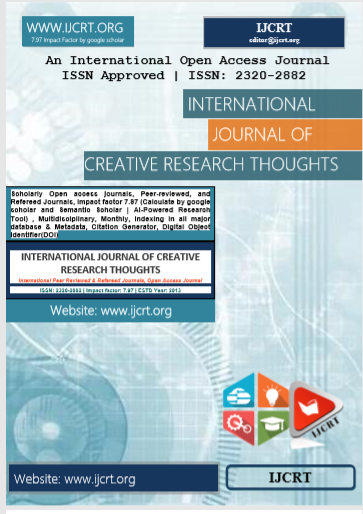
3) Front Page 3) Front Page
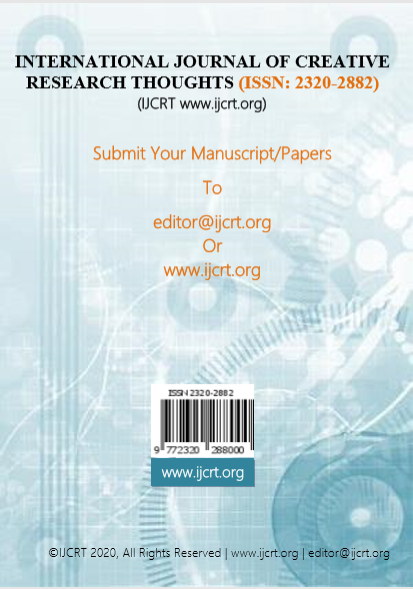
4) Back Page 4) Back Page
5) Editor Board Member 5)Editor Board Member
6) OLD Style Issue 6)OLD Style Issue
 |
 |
|---|---|
| IJCRT Journal front page | IJCRT Journal Back Page |
Paper Title: The Role of Soymida Febrifuga (Roxb.) A. Juss. in Treating Leucorrhea: Qualitative Insights from Traditional Healthcare Practices
Author Name(s): Sarvesh Bandu Raut, Dr. B. M. Rajurkar
Published Paper ID: - IJCRT2602774
Register Paper ID - 302319
Publisher Journal Name: IJPUBLICATION, IJCRT
DOI Member ID: 10.6084/m9.doi.one.IJCRT2602774 and DOI :
Author Country : Indian Author, India, 445302 , Pandhakawada, 445302 , | Research Area: Life Sciences All Published Paper URL: http://ijcrt.org/viewfull.php?&p_id=IJCRT2602774 Published Paper PDF: download.php?file=IJCRT2602774 Published Paper PDF: http://www.ijcrt.org/papers/IJCRT2602774.pdf
Your Paper Publication Details:
Title: THE ROLE OF SOYMIDA FEBRIFUGA (ROXB.) A. JUSS. IN TREATING LEUCORRHEA: QUALITATIVE INSIGHTS FROM TRADITIONAL HEALTHCARE PRACTICES
DOI (Digital Object Identifier) :
Pubished in Volume: 14 | Issue: 2 | Year: February 2026
Publisher Name : IJCRT | www.ijcrt.org | ISSN : 2320-2882
Subject Area: Life Sciences All
Author type: Indian Author
Pubished in Volume: 14
Issue: 2
Pages: g759-g773
Year: February 2026
Downloads: 114
E-ISSN Number: 2320-2882
Abstract
Abstract: - Leucorrhea, a prevalent gynecological condition characterized by abnormal vaginal discharge, significantly impacts women's health globally. This study delves into the traditional healthcare practices surrounding *Soymida febrifuga*(Roxb.) A. Juss., a plant widely recognized in ethnobotanical contexts for its diverse medicinal properties, particularly in managing women's health issues. Through qualitative inquiry, this research documents the specific preparation methods, administration routes, and perceived therapeutic outcomes associated with the use of *Soymida febrifuga* for leucorrhea management among indigenous practitioners. The findings highlight the deep-rooted cultural significance of this botanical resource and provide a foundation for future scientific validation of its bioactive potential in gynecological care.
Licence: creative commons attribution 4.0
License
Creative Commons Attribution 4.0 and The Open Definition

Keywords
Leucorrhea, Soymida febrifuga, ethnobotany, gynecology.
License
Creative Commons Attribution 4.0 and The Open Definition
Paper Title: Effectiveness of Structured Teaching Programme on Knowledge and Practice Regarding Electroconvulsive Therapy (ECT) Machine Among Staff Nurses Working in Psychiatry Ward in Selected Hospital, Ayodhya, Uttar Pradesh
Author Name(s): Rahul Mishra, Dr. Manoj Prajapati
Published Paper ID: - IJCRT2602773
Register Paper ID - 302352
Publisher Journal Name: IJPUBLICATION, IJCRT
DOI Member ID: 10.6084/m9.doi.one.IJCRT2602773 and DOI :
Author Country : Indian Author, India, 452016 , Indore, 452016 , | Research Area: Humanities All Published Paper URL: http://ijcrt.org/viewfull.php?&p_id=IJCRT2602773 Published Paper PDF: download.php?file=IJCRT2602773 Published Paper PDF: http://www.ijcrt.org/papers/IJCRT2602773.pdf
Your Paper Publication Details:
Title: EFFECTIVENESS OF STRUCTURED TEACHING PROGRAMME ON KNOWLEDGE AND PRACTICE REGARDING ELECTROCONVULSIVE THERAPY (ECT) MACHINE AMONG STAFF NURSES WORKING IN PSYCHIATRY WARD IN SELECTED HOSPITAL, AYODHYA, UTTAR PRADESH
DOI (Digital Object Identifier) :
Pubished in Volume: 14 | Issue: 2 | Year: February 2026
Publisher Name : IJCRT | www.ijcrt.org | ISSN : 2320-2882
Subject Area: Humanities All
Author type: Indian Author
Pubished in Volume: 14
Issue: 2
Pages: g750-g758
Year: February 2026
Downloads: 86
E-ISSN Number: 2320-2882
Abstract
Background: Electroconvulsive Therapy (ECT) is a well-established therapeutic intervention used in psychiatry for the management of severe mental disorders such as major depression, schizophrenia, and catatonia. Proper handling of the ECT machine and adherence to procedural standards by nursing personnel are essential to ensure patient safety and treatment effectiveness. However, gaps in knowledge and practice among staff nurses may affect the quality of care provided during ECT procedures. Objectives: 1. To assess the existing knowledge and practice regarding ECT machine among staff nurses working in psychiatry wards. 2. To evaluate the effectiveness of a structured teaching programme on knowledge and practice regarding ECT machine. 3. To find the association between post-test knowledge and practice scores with selected demographic variables. Methods: A quantitative pre-experimental one-group pretest-posttest design was adopted. Staff nurses working in psychiatry wards of a selected hospital in Ayodhya, Uttar Pradesh were selected using a convenient sampling technique. Data were collected using a structured knowledge questionnaire and observational checklist for practice. Following pretest assessment, a structured teaching programme related to ECT machine operation, safety precautions, preparation, and nursing responsibilities was administered. Post-test assessment was conducted after the intervention to determine effectiveness. Results: The findings indicated significant improvement in knowledge and practice scores after administration of the structured teaching programme. The calculated t-value showed statistical significance at p < 0.05, suggesting that the intervention was effective in enhancing nurses' competency related to ECT machine handling. Conclusion: The structured teaching programme significantly improved the knowledge and practice of staff nurses regarding ECT machine, highlighting the importance of continuous nursing education in psychiatric care settings.
Licence: creative commons attribution 4.0
License
Creative Commons Attribution 4.0 and The Open Definition
Keywords
Electroconvulsive Therapy, ECT Machine, Structured Teaching Programme, Staff Nurses, Knowledge, Practice, Psychiatric Nursing.
License
Creative Commons Attribution 4.0 and The Open Definition
Paper Title: ML Driven Health Prediction Model: Enhancing Quality of Care with Superior Patient Outcomes
Author Name(s): Dipmala Bhagwat Trimukhe
Published Paper ID: - IJCRT2602772
Register Paper ID - 302324
Publisher Journal Name: IJPUBLICATION, IJCRT
DOI Member ID: 10.6084/m9.doi.one.IJCRT2602772 and DOI : https://doi.org/10.56975/ijcrt.v14i2.302324
Author Country : Indian Author, India, 412405 , Pune, 412405 , | Research Area: Science and Technology Published Paper URL: http://ijcrt.org/viewfull.php?&p_id=IJCRT2602772 Published Paper PDF: download.php?file=IJCRT2602772 Published Paper PDF: http://www.ijcrt.org/papers/IJCRT2602772.pdf
Your Paper Publication Details:
Title: ML DRIVEN HEALTH PREDICTION MODEL: ENHANCING QUALITY OF CARE WITH SUPERIOR PATIENT OUTCOMES
DOI (Digital Object Identifier) : https://doi.org/10.56975/ijcrt.v14i2.302324
Pubished in Volume: 14 | Issue: 2 | Year: February 2026
Publisher Name : IJCRT | www.ijcrt.org | ISSN : 2320-2882
Subject Area: Science and Technology
Author type: Indian Author
Pubished in Volume: 14
Issue: 2
Pages: g746-g749
Year: February 2026
Downloads: 123
E-ISSN Number: 2320-2882
Abstract
The use of machine learning (ML) in healthcare is transforming how patient data is interpreted, analyzed, and used to support clinical judgment. In order to better predict patient states and enable early intervention and better care practices, this study presents an ML-driven health prediction model. The proposed methodology leverages real-time monitoring, supervised learning algorithms, and prior medical records to enable personalized treatment planning and predictive diagnostics. The goal is to ensure timely, data-driven decisions that lead to better patient outcomes while also raising the standard of care. Experimental results using real-world datasets show how well the model recognizes high-risk cases and intelligently automates healthcare delivery.
Licence: creative commons attribution 4.0
License
Creative Commons Attribution 4.0 and The Open Definition
Keywords
Internet of Things (IoT), Patient data, Supervised Learning, ML driven (Machine Learning) Disease Prediction System, Electronic Health Record(EHR), Encryption, Access Control, Healthcare system.
License
Creative Commons Attribution 4.0 and The Open Definition
Paper Title: THE SHAMAN AS CUSTODIAN OF INTANGIBLE CULTURAL HERITAGE: A CASE STUDY OF KULLU DISTRICT
Author Name(s): Tarun Thakur, Sushma Rewal Chugh
Published Paper ID: - IJCRT2602771
Register Paper ID - 302344
Publisher Journal Name: IJPUBLICATION, IJCRT
DOI Member ID: 10.6084/m9.doi.one.IJCRT2602771 and DOI :
Author Country : Indian Author, India, 175131 , Manali, 175131 , | Research Area: Medical Science All Published Paper URL: http://ijcrt.org/viewfull.php?&p_id=IJCRT2602771 Published Paper PDF: download.php?file=IJCRT2602771 Published Paper PDF: http://www.ijcrt.org/papers/IJCRT2602771.pdf
Your Paper Publication Details:
Title: THE SHAMAN AS CUSTODIAN OF INTANGIBLE CULTURAL HERITAGE: A CASE STUDY OF KULLU DISTRICT
DOI (Digital Object Identifier) :
Pubished in Volume: 14 | Issue: 2 | Year: February 2026
Publisher Name : IJCRT | www.ijcrt.org | ISSN : 2320-2882
Subject Area: Medical Science All
Author type: Indian Author
Pubished in Volume: 14
Issue: 2
Pages: g731-g745
Year: February 2026
Downloads: 83
E-ISSN Number: 2320-2882
Abstract
This paper analyzes the function of shaman (Goor) as the principal guardians of Intangible Cultural Heritage (ICH), specifically within the localized socio-cultural context of Kullu District, Himachal Pradesh, India. There is a lot of research on Himalayan shamanism in anthropology, but not much on how it interacts with the UNESCO ICH domains when looked at only through the eyes of indigenous ritual authorities who run their own communities. This qualitative exploratory study fills in the gaps by focusing on the voices of the Devta institution's functionaries, such as the Goor (shaman), Kardar (administrator), Pujari (priest), and Deulu (ritual assistants). The study utilizes Interpretative Phenomenological Analysis (IPA) and Reflexive Thematic Analysis with NVivo software, based on in-depth interviews with 28 participants from 12 villages, complemented by extensive participant observation at internal community ritual events. The results are fully mapped onto the five UNESCO ICH domains, showing how embodied knowledge, oral traditions, and traditional craftsmanship make up a living, self-sustaining system for preserving heritage. In addition, four main themes come to light: (1) The Shaman as Living Archive, which shows how somatic and emplaced knowledge keeps local history alive; (2) The Sacred Agrarian Economy, which shows how the community's internal gift logic works; (3) Secrecy as Epistemic Sovereignty, which shows how keeping sacred knowledge secret protects it; and (4) Intergenerational Transmission, which shows how people use internal strategies to deal with secular modernity. The idea of "Ritual Stakeholders" adds to stakeholder theory by saying that these actors are legitimate entirely from divine mandate. Policy implications suggest that Devta (Deity) institutions should be included in local heritage preservation plans so that the community can keep full control over its Intangible Cultural Heritage (ICH).
Licence: creative commons attribution 4.0
License
Creative Commons Attribution 4.0 and The Open Definition
Keywords
Shamanism, Intangible Cultural Heritage (ICH), Devta Institution, Indigenous Knowledge Systems, Kullu Valley, Stakeholder Theory, Epistemic Sovereignty, Phenomenology
License
Creative Commons Attribution 4.0 and The Open Definition
Paper Title: Semantic Web Technologies for Smart Libraries
Author Name(s): Dr. Mahesh Donthula
Published Paper ID: - IJCRT2602770
Register Paper ID - 302322
Publisher Journal Name: IJPUBLICATION, IJCRT
DOI Member ID: 10.6084/m9.doi.one.IJCRT2602770 and DOI :
Author Country : Indian Author, India, 506223 , isnapur , Sangareddy district , 506223 , | Research Area: Science All Published Paper URL: http://ijcrt.org/viewfull.php?&p_id=IJCRT2602770 Published Paper PDF: download.php?file=IJCRT2602770 Published Paper PDF: http://www.ijcrt.org/papers/IJCRT2602770.pdf
Your Paper Publication Details:
Title: SEMANTIC WEB TECHNOLOGIES FOR SMART LIBRARIES
DOI (Digital Object Identifier) :
Pubished in Volume: 14 | Issue: 2 | Year: February 2026
Publisher Name : IJCRT | www.ijcrt.org | ISSN : 2320-2882
Subject Area: Science All
Author type: Indian Author
Pubished in Volume: 14
Issue: 2
Pages: g722-g730
Year: February 2026
Downloads: 79
E-ISSN Number: 2320-2882
Abstract
Abstract: Semantic Web Technologies represent the future of smart libraries. By integrating machine-understandable metadata and intelligent retrieval systems, libraries can enhance knowledge discovery, collaboration, and academic excellence. Educational institutions must proactively adapt to this transformation to prepare future-ready information professionals The rapid evolution of digital information environments has transformed traditional libraries into intelligent knowledge systems. Semantic Web technologies enable machine-understandable metadata, improving interoperability, information retrieval, and knowledge organization in smart libraries. This study examines the role of Semantic Web standards such as RDF, OWL, SPARQL, and Linked Data in enhancing library services. Using a descriptive research design, data were collected from 100 users and 20 librarians through structured questionnaires. Statistical analysis indicates significant improvement in retrieval accuracy, interoperability, and user satisfaction through semantic implementation. The study concludes that Semantic Web technologies are foundational for future-ready smart libraries and recommends curriculum reforms, professional training, and infrastructure development
Licence: creative commons attribution 4.0
License
Creative Commons Attribution 4.0 and The Open Definition
Keywords
Semantic Web, Smart Libraries, RDF, OWL, Linked Data, Information Retrieval, Ontology
License
Creative Commons Attribution 4.0 and The Open Definition
Paper Title: How Project-Based Learning Is Developing 21st-Century Skills among Secondary School Students in India: A Secondary Data Review
Author Name(s): Dr.MD. Zakir Hussain
Published Paper ID: - IJCRT2602769
Register Paper ID - 302266
Publisher Journal Name: IJPUBLICATION, IJCRT
DOI Member ID: 10.6084/m9.doi.one.IJCRT2602769 and DOI :
Author Country : Indian Author, India, 502220 , Select City, 502220 , | Research Area: Others area Published Paper URL: http://ijcrt.org/viewfull.php?&p_id=IJCRT2602769 Published Paper PDF: download.php?file=IJCRT2602769 Published Paper PDF: http://www.ijcrt.org/papers/IJCRT2602769.pdf
Your Paper Publication Details:
Title: HOW PROJECT-BASED LEARNING IS DEVELOPING 21ST-CENTURY SKILLS AMONG SECONDARY SCHOOL STUDENTS IN INDIA: A SECONDARY DATA REVIEW
DOI (Digital Object Identifier) :
Pubished in Volume: 14 | Issue: 2 | Year: February 2026
Publisher Name : IJCRT | www.ijcrt.org | ISSN : 2320-2882
Subject Area: Others area
Author type: Indian Author
Pubished in Volume: 14
Issue: 2
Pages: g713-g721
Year: February 2026
Downloads: 96
E-ISSN Number: 2320-2882
Abstract
Project-Based Learning (PBL) has gained renewed relevance in India as schools shift toward competency-based education and experiential pedagogies encouraged by national and board-level policy directions. Yet, despite widespread advocacy, Indian evidence on how and which 21st-century skills are developed through PBL at the secondary level remains scattered across subject areas, school systems, and implementation contexts. This secondary-data review synthesizes policy documents, curriculum guidance, and peer-reviewed empirical and meta-analytic research to examine the link between PBL and 21st-century skills among secondary students in India. Using a structured review approach (identification, screening, eligibility, synthesis), the study maps PBL design features to skill outcomes--critical thinking, collaboration, communication, creativity, self-management, and digital literacy. Findings indicate that PBL is most strongly associated with gains in higher-order thinking, collaborative problem solving, and learner agency when projects are anchored in driving questions, authentic contexts, feedback cycles, and student voice. However, uneven infrastructure, assessment misalignment, teacher preparedness, and superficial "project display" practices often dilute impact. The review proposes a context-sensitive framework--the PBL-to-Skills Pathway Model--for secondary schools in India, along with implementation and evaluation recommendations aligned to policy expectations and board standards.
Licence: creative commons attribution 4.0
License
Creative Commons Attribution 4.0 and The Open Definition
Keywords
project-based learning, 21st-century skills, secondary education, India, experiential learning, competency-based education, review
License
Creative Commons Attribution 4.0 and The Open Definition
Paper Title: The Economics of Weaving: A Study of the Handloom Industry in Assam
Author Name(s): Dr. Minhaj Uddin Barbhuiya
Published Paper ID: - IJCRT2602768
Register Paper ID - 302290
Publisher Journal Name: IJPUBLICATION, IJCRT
DOI Member ID: 10.6084/m9.doi.one.IJCRT2602768 and DOI : https://doi.org/10.56975/ijcrt.v14i2.302290
Author Country : Indian Author, India, 788030 , Silchar, 788030 , | Research Area: Social Science All Published Paper URL: http://ijcrt.org/viewfull.php?&p_id=IJCRT2602768 Published Paper PDF: download.php?file=IJCRT2602768 Published Paper PDF: http://www.ijcrt.org/papers/IJCRT2602768.pdf
Your Paper Publication Details:
Title: THE ECONOMICS OF WEAVING: A STUDY OF THE HANDLOOM INDUSTRY IN ASSAM
DOI (Digital Object Identifier) : https://doi.org/10.56975/ijcrt.v14i2.302290
Pubished in Volume: 14 | Issue: 2 | Year: February 2026
Publisher Name : IJCRT | www.ijcrt.org | ISSN : 2320-2882
Subject Area: Social Science All
Author type: Indian Author
Pubished in Volume: 14
Issue: 2
Pages: g704-g712
Year: February 2026
Downloads: 117
E-ISSN Number: 2320-2882
Abstract
The handloom industry holds immense significance in India's rural economy and culture. This study focuses on the economic aspects of Assam's handloom industry, examining its current production status and major challenges based on existing literature. Assam, the gateway to Northeast India, is rich in cottage industries, among which handloom stands out as the largest. The sector plays a crucial role in rural socio-cultural life by preserving traditions, providing livelihoods, generating supplementary income, and promoting women's economic empowerment. Using secondary data, the study analyzes handloom cloth production in Assam. District-wise data show a significant concentration of production in a few districts, particularly Dhubri, Dhemaji, and Barpeta, which together account for nearly two-thirds of the state's total output. While districts in lower and upper Assam serve as major production hubs, hill and remote districts exhibit very limited production, highlighting the need for targeted government policy interventions and capacity-building programmes to ensure balanced regional development. Existing literature identifies economic hardship, skill gaps, market and infrastructure deficiencies, educational and awareness barriers, and technological limitations as key constraints on the handloom sector's growth. Addressing these interconnected challenges is necessary to enhance productivity, support weavers' livelihoods, and preserve the cultural heritage of traditional handloom weaving in Assam. The sustainability of Assam's handloom industry depends on a combination of financial support, skill development, infrastructure improvement, awareness programs, and technological modernization. Properly implemented policy interventions can significantly boost productivity, innovation, and market competitiveness.
Licence: creative commons attribution 4.0
License
Creative Commons Attribution 4.0 and The Open Definition
Keywords
Handloom, cottage industry, women's economic empowerment, innovation, market competitiveness
License
Creative Commons Attribution 4.0 and The Open Definition
Paper Title: Ayurvedic Management Of Oral Mucocele Of Lip : A Case Study
Author Name(s): Dr. Tanmayee Bhoir, Dr. Mugdha Sawle, Dr. Ashwini Patil, Dr. Geeta Rathi, Dr. Akshata Karale
Published Paper ID: - IJCRT2602767
Register Paper ID - 302107
Publisher Journal Name: IJPUBLICATION, IJCRT
DOI Member ID: 10.6084/m9.doi.one.IJCRT2602767 and DOI :
Author Country : Indian Author, India, 401305 , Virar, 401305 , | Research Area: Health Science All Published Paper URL: http://ijcrt.org/viewfull.php?&p_id=IJCRT2602767 Published Paper PDF: download.php?file=IJCRT2602767 Published Paper PDF: http://www.ijcrt.org/papers/IJCRT2602767.pdf
Your Paper Publication Details:
Title: AYURVEDIC MANAGEMENT OF ORAL MUCOCELE OF LIP : A CASE STUDY
DOI (Digital Object Identifier) :
Pubished in Volume: 14 | Issue: 2 | Year: February 2026
Publisher Name : IJCRT | www.ijcrt.org | ISSN : 2320-2882
Subject Area: Health Science All
Author type: Indian Author
Pubished in Volume: 14
Issue: 2
Pages: g696-g703
Year: February 2026
Downloads: 94
E-ISSN Number: 2320-2882
Abstract
Background- Oral mucocele is a common benign lesion of minor salivary glands, frequently affecting the lower lip. Conventional management mainly involves surgical excision, which may result in recurrence and cosmetic concerns. Ayurveda correlates this condition with Medoja Oshtha Prakopa. Aim- To evaluate the efficacy of Jalaukavacharana along with Ayurvedic oral and local medications in the management of oral mucocele. Materials and Methods- A 36-year-old male patient presenting with lower lip swelling for three months was treated with Jalaukavacharana (leech therapy), internal Ayurvedic medicines, and local application. Clinical assessment was done based on reduction in swelling, pain, itching, and healing response. Results- Significant reduction in swelling and associated symptoms was observed without surgical intervention. Healing occurred without scar formation or recurrence during follow-up. Conclusion- Jalaukavacharana combined with Ayurvedic management proved to be a safe, minimally invasive, and cosmetically acceptable treatment modality for oral mucocele.
Licence: creative commons attribution 4.0
License
Creative Commons Attribution 4.0 and The Open Definition
Keywords
Oral mucocele, Jalaukavacharana, Raktamokshana, Medoja Oshtha Prakopa, Ayurveda
License
Creative Commons Attribution 4.0 and The Open Definition
Paper Title: ASSESSING THE EFECTIVENESS OF LIFE SKILL EDUCATION AMONG SCHOOL DROP OUT CHILDREN
Author Name(s): SRIVENKATESAN P, Dr.L.ESTHER SHALINI
Published Paper ID: - IJCRT2602766
Register Paper ID - 302287
Publisher Journal Name: IJPUBLICATION, IJCRT
DOI Member ID: 10.6084/m9.doi.one.IJCRT2602766 and DOI : https://doi.org/10.56975/ijcrt.v14i2.302287
Author Country : Indian Author, India, 641029 , COIMBATORE , 641029 , | Research Area: Medical Science All Published Paper URL: http://ijcrt.org/viewfull.php?&p_id=IJCRT2602766 Published Paper PDF: download.php?file=IJCRT2602766 Published Paper PDF: http://www.ijcrt.org/papers/IJCRT2602766.pdf
Your Paper Publication Details:
Title: ASSESSING THE EFECTIVENESS OF LIFE SKILL EDUCATION AMONG SCHOOL DROP OUT CHILDREN
DOI (Digital Object Identifier) : https://doi.org/10.56975/ijcrt.v14i2.302287
Pubished in Volume: 14 | Issue: 2 | Year: February 2026
Publisher Name : IJCRT | www.ijcrt.org | ISSN : 2320-2882
Subject Area: Medical Science All
Author type: Indian Author
Pubished in Volume: 14
Issue: 2
Pages: g687-g695
Year: February 2026
Downloads: 109
E-ISSN Number: 2320-2882
Abstract
School dropout remains a serious social and educational issue among socio-economically disadvantaged children. Life Skills Education is implemented in child-care institutions to strengthen psychosocial competencies. This study assesses its effectiveness among 80 school dropout children using LSAS and SDRI scales. Correlation and ANOVA were applied. Findings revealed a weak and non-significant relationship (r = 0.131, p > 0.05).
Licence: creative commons attribution 4.0
License
Creative Commons Attribution 4.0 and The Open Definition
Keywords
Life Skills Education, School Dropout Risk, Psychosocial Competence, Social Work Intervention.
License
Creative Commons Attribution 4.0 and The Open Definition
Paper Title: "Sudha Aroda ke Srijan Sansar men Madhyamvargiy Stree Jivan ka Yatharth"
Author Name(s): SHWETA SHARMA
Published Paper ID: - IJCRT2602765
Register Paper ID - 302284
Publisher Journal Name: IJPUBLICATION, IJCRT
DOI Member ID: 10.6084/m9.doi.one.IJCRT2602765 and DOI :
Author Country : Indian Author, India, 313004 , Udaipur , 313004 , | Research Area: Arts1 All Published Paper URL: http://ijcrt.org/viewfull.php?&p_id=IJCRT2602765 Published Paper PDF: download.php?file=IJCRT2602765 Published Paper PDF: http://www.ijcrt.org/papers/IJCRT2602765.pdf
Your Paper Publication Details:
Title: "SUDHA ARODA KE SRIJAN SANSAR MEN MADHYAMVARGIY STREE JIVAN KA YATHARTH"
DOI (Digital Object Identifier) :
Pubished in Volume: 14 | Issue: 2 | Year: February 2026
Publisher Name : IJCRT | www.ijcrt.org | ISSN : 2320-2882
Subject Area: Arts1 All
Author type: Indian Author
Pubished in Volume: 14
Issue: 2
Pages: g674-g686
Year: February 2026
Downloads: 103
E-ISSN Number: 2320-2882
Abstract
????? ??? ??????? ??? ????? ?????? ?? ????? ???????? ?? ?????? ??????? ?? ????????? ??? ?? ?? ????????? ?? ??????? ???? ?? ???? ????? ?? ???????????? ??? ???? ????? ?? ??? ?????? ?????????? ??? ???? ???????? ????? ??? ?? ??????????? ?????? ?? ???? ??????, ?????? ???????, ??????? ??????, ?????? ???????? ?? ???? ????? ?? ??? ?? ?????????? ?????? ?? ???????? ???? ??? ???????? ??? ???? ?? ???????? ?? ????????? ???? ?? ?? ???? ????? ?? ????????? ??? ??????????? ?????? ???? ?? ?????? ??? ?????? ??????? ??? ??? ?????? ??? ??????? ??????, ????????? ????, ?????? ???????, ?????? ??????, ????????? ???, ???? ?????? ?? ?????? ????? ?? ????? ?? ?????? ???? ????? ??? ??? ?? ??? ???????? ?????? ?? ?????? ?? ?? ????? ???????? ?? ??? ???????? ?? ?????? ??? ?? ??????? ???? ?? ?????? ???? ?? ?? ???? ????? ?? ?????? ? ???? ??????? ?????? ?? ???????? ???, ????? ?? ?????? ???????? ?? ????????? ???????? ?? ???????? ???? ????
Licence: creative commons attribution 4.0
License
Creative Commons Attribution 4.0 and The Open Definition
Keywords
??????????? ????, ?????? ????, ?????????, ?????? ???????, ??????????, ??????? ????, ??????? ????????, ??????????? ????????, ?????? ????????, ????????????, ?????? ???????, ????????? ????,
License
Creative Commons Attribution 4.0 and The Open Definition
Call For Paper June 2026
Call For Papers
June 2026
Volume 14 | Issue 6
Last Date :
31-Jul-2026
Submit Manuscript Online Impact Factor: 7.97 Review Results : Within 02-03 Days Paper Publication : Within 02-03 Days
June 2026
Volume 14 | Issue 6
Last Date :
31-Jul-2026
Submit Manuscript Online Impact Factor: 7.97 Review Results : Within 02-03 Days Paper Publication : Within 02-03 Days
Published Issue Details
For Authors
Forms / Downloads
Other IMP Links
Indexing Partner
Research Area
LICENSE





ISSN and 7.97 Impact Factor Details

ISSN: 2320-2882 Impact Factor: 7.97 and ISSN APPROVED Journal Starting Year (ESTD) : 2013


ISSN and 7.97 Impact Factor Details
ISSN: 2320-2882 Impact Factor: 7.97 and ISSN APPROVED Journal Starting Year (ESTD) : 2013
DOI Details
CONFERENCE
CONFERENCE MANAGMENT & PUBLICATION CONFERENCE PROPOSAL
RECENT CONFERENCE

CONFERENCE PROPOSAL CONFERENCE PROCEEDINGS
CONFERENCE PROPOSAL CONFERENCE PROCEEDINGS
For Reviewer /Referral (RMS) Earn 500 per paper
Important Links
NEWS & Conference
Digital Library
IJCRT RMS | Earn 500 Per Paper.

Open Access


LICENSE
Indexing Partner
Scholarly open access journals, Peer-reviewed, and Refereed Journals, Impact factor 7.97 (Calculate by google scholar and Semantic Scholar | AI-Powered Research Tool) , Multidisciplinary, Monthly, Indexing in all major database & Metadata, Citation Generator, Digital Object Identifier(DOI)