Important Details
IJCRT - International Peer Reviewed, Open Access Journal, Multidisciplinary, Monthly, Nominal(Low) Fees for Professional Research Services International Journal of Creative Research Thoughts - IJCRT Peer Review Journal, Refereed Journal, Peer Reviewed Journal , Referred Journal and Indexed Journal, Open access, Online and Print Journal,international Journal Open Access, Accepted by Indian and foreign university ,IJCRT Followed Norms, guidelines, requirement, listing criteria and methodology of score/point also applied from: Scopus , Web of Science , UGC Approved , UGC CARE, UGC-CARE .
UGC Approved Journal No: 49023 (18)
UGC approval Link
https://ijcrt.org/ugc%20approval.jpg
All Policy and Approval
Please Like Our Facebook Page | CrossRef DOI and Hard copy of Certificate Provide if required. | www.IJCRT.org | editor@IJCRT.org | WhatsApp: 7990172303
Publication Details:
- Paper Submission : 28-Feb-2026. Call For Paper (Volume 14 | Issue 2 | Month- February 2026)
- Acceptance/Rejection Notification: Within 02-04 Days.
- Paper Publish: Within 02-04 Days after submitting all documents.
-
Submit Your Paper Any time There No deadline.
-
Publication fees : 1570 INR for Indian author & 59$ for foreign International author.
Please Like Our Facebook Page | CrossRef DOI and Hard copy of Certificate Provide if required.
Licence and Indexing
Indexing In Google Scholar, SSRN, ResearcherID-Publons, Semantic Scholar | AI-Powered Research Tool, Microsoft Academic, Academia.edu, arXiv.org, Research Gate, CiteSeerX, ResearcherID Thomson Reuters, Mendeley : reference manager, DocStoc, ISSUU, Scribd, and many more | High Impact Factor: 7.97 | Digital object identifier (DOI) and Hard Copy of certificate Provided.




























Licence
DOI
ISSN Approved impact factor: 7.97 
Creative Common 
Valid as per new UGC Gazette regulations 

INTERNATIONAL JOURNAL OF CREATIVE RESEARCH THOUGHTS - IJCRT (IJCRT.ORG)
International Peer Reviewed & Refereed Journals, Open Access Journal
IJCRT Peer-Reviewed (Refereed) Journal as Per New UGC Rules.
ISSN Approved Journal No: 2320-2882 | Impact factor: 7.97 | ESTD Year: 2013
Call For Paper - Volume 14 | Issue 2 | Month- February 2026
Scholarly open access journals, Peer-reviewed, and Refereed Journals, Impact factor 7.97 (Calculate by google scholar and Semantic Scholar | AI-Powered Research Tool) , Multidisciplinary, Monthly, Indexing in all major database & Metadata, Citation Generator, Digital Object Identifier(CrossRef DOI)
Contact Us Click Here
WhatsApp Contact Click Here
IJCRT Search Xplore - Search all paper by Paper Name , Author Name, and Title
Volume 13 | Issue 12 |
Volume 13 | Issue 12 | Month
Downlaod After Publication 1) Table of content index in PDF
2) Table of content index in HTML 2)Table of content index in HTML
3) Front Page 3) Front Page
4) Back Page 4) Back Page
5) Editor Board Member 5)Editor Board Member
6) OLD Style Issue 6)OLD Style Issue
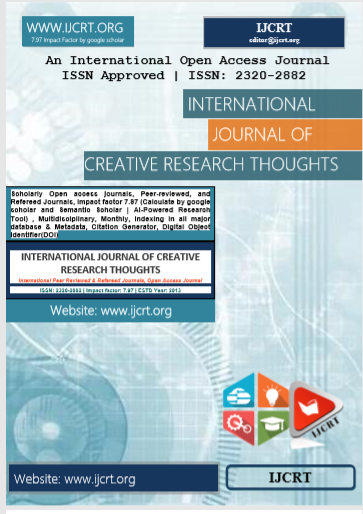 |
 |
|---|---|
| IJCRT Journal front page | IJCRT Journal Back Page |
Paper Title: Legal Implication of Cryptocurrencies
Author Name(s): Shambhavi, Deeksha Chauhan
Published Paper ID: - IJCRT2512641
Register Paper ID - 298761
Publisher Journal Name: IJPUBLICATION, IJCRT
DOI Member ID: 10.6084/m9.doi.one.IJCRT2512641 and DOI :
Author Country : Indian Author, India, - , -, - , | Research Area: Science and Technology Published Paper URL: http://ijcrt.org/viewfull.php?&p_id=IJCRT2512641 Published Paper PDF: download.php?file=IJCRT2512641 Published Paper PDF: http://www.ijcrt.org/papers/IJCRT2512641.pdf
Your Paper Publication Details:
Title: LEGAL IMPLICATION OF CRYPTOCURRENCIES
DOI (Digital Object Identifier) :
Pubished in Volume: 13 | Issue: 12 | Year: December 2025
Publisher Name : IJCRT | www.ijcrt.org | ISSN : 2320-2882
Subject Area: Science and Technology
Author type: Indian Author
Pubished in Volume: 13
Issue: 12
Pages: f692-f700
Year: December 2025
Downloads: 58
E-ISSN Number: 2320-2882
Abstract
Cryptocurrency has emerged as a revolutionary form of digital currency, challenging traditional financial systems and legal frameworks across the world. Its decentralized nature, anonymity in transactions, and borderless functioning raise significant legal implications that demand critical examination. In India, the status of cryptocurrency remains uncertain due to the absence of specific legislation and the fluctuating judicial and regulatory approach. While the Supreme Court in Internet and Mobile Association of India v. Reserve Bank of India (2020) struck down the RBI's banking ban on virtual currencies, the lack of comprehensive regulatory guidelines continues to pose challenges. The legal implications primarily revolve around issues of taxation, money laundering, investor protection, cybersecurity, and the possible conflict with existing financial laws. Moreover, the potential misuse of cryptocurrency in terror financing and illegal trade further complicates the regulatory landscape. This paper seeks to analyze the evolving legal status of cryptocurrency in India, compare it with international frameworks, and suggest reforms that balance innovation with legal certainty and consumer protection.
Licence: creative commons attribution 4.0
License
Creative Commons Attribution 4.0 and The Open Definition

Keywords
Cryptocurrency, Blockchain, Legal Implications, Cyber Security, Regulation
License
Creative Commons Attribution 4.0 and The Open Definition
Paper Title: The Role of Vitamin C in Sepsis: A Systematic Literature Review
Author Name(s): Dr Krittibus Samui, Dr. Aniruddha Rudra, Dr. Anirban Gandhi, Dr. Amrita Ranjan Kundu
Published Paper ID: - IJCRT2512640
Register Paper ID - 299068
Publisher Journal Name: IJPUBLICATION, IJCRT
DOI Member ID: 10.6084/m9.doi.one.IJCRT2512640 and DOI :
Author Country : Indian Author, India, 713103 , BURDWAN, 713103 , | Research Area: Health Science All Published Paper URL: http://ijcrt.org/viewfull.php?&p_id=IJCRT2512640 Published Paper PDF: download.php?file=IJCRT2512640 Published Paper PDF: http://www.ijcrt.org/papers/IJCRT2512640.pdf
Your Paper Publication Details:
Title: THE ROLE OF VITAMIN C IN SEPSIS: A SYSTEMATIC LITERATURE REVIEW
DOI (Digital Object Identifier) :
Pubished in Volume: 13 | Issue: 12 | Year: December 2025
Publisher Name : IJCRT | www.ijcrt.org | ISSN : 2320-2882
Subject Area: Health Science All
Author type: Indian Author
Pubished in Volume: 13
Issue: 12
Pages: f680-f691
Year: December 2025
Downloads: 54
E-ISSN Number: 2320-2882
Abstract
Sepsis, a life-threatening organ dysfunction due to a dysregulated host response to infection, continues to pose a significant clinical challenge despite advances in supportive care. The review synthesizes findings from randomized controlled trials and cohort studies to evaluate the impact of vitamin C--administered alone or in combination with thiamine and hydrocortisone--on key outcomes such as mortality, organ dysfunction (SOFA scores), vasopressor requirements, and safety profiles. The evidence regarding vitamin C monotherapy is mixed: several meta-analyses suggest possible reductions in mortality and improvements in SOFA scores and vasopressor duration, but these findings are not consistently statistically significant, and some large trials even indicate potential harm. Combination therapies, particularly the "metabolic resuscitation cocktail" (vitamin C, thiamine, hydrocortisone), have not demonstrated significant mortality benefit in high-quality trials, though modest improvements in organ dysfunction metrics are observed. Vitamin C is generally well tolerated, but rare adverse effects--such as increased renal replacement therapy or hypernatremia--have been reported in certain studies, warranting caution in patients with specific comorbidities. Substantial heterogeneity in dosing regimens, timing, patient populations, and study design complicates interpretation, and the overall certainty of evidence for major outcomes remains low to moderate according to GRADE criteria. Current guidelines do not recommend routine intravenous vitamin C use in sepsis outside of clinical trials. The review underscores the need for large, well-designed randomized studies to identify patient subgroups most likely to benefit, determine optimal dosing strategies, and clarify the role of vitamin C--alone or in combination--in improving clinically significant outcomes in sepsis. This systematic literature review critically examines the efficacy and safety of intravenous vitamin C administration in the management of sepsis and septic shock.
Licence: creative commons attribution 4.0
License
Creative Commons Attribution 4.0 and The Open Definition
Keywords
vitamin C; sepsis; literature; mortality; hydrocortisone
License
Creative Commons Attribution 4.0 and The Open Definition
Paper Title: Decoding the Harshad Mehta Scam: Legal Loopholes and Financial Irregularities in India's Securities Market
Author Name(s): Vikas Verma, Harsh Chaudhary
Published Paper ID: - IJCRT2512639
Register Paper ID - 298904
Publisher Journal Name: IJPUBLICATION, IJCRT
DOI Member ID: 10.6084/m9.doi.one.IJCRT2512639 and DOI :
Author Country : Indian Author, India, - , -, - , | Research Area: Science and Technology Published Paper URL: http://ijcrt.org/viewfull.php?&p_id=IJCRT2512639 Published Paper PDF: download.php?file=IJCRT2512639 Published Paper PDF: http://www.ijcrt.org/papers/IJCRT2512639.pdf
Your Paper Publication Details:
Title: DECODING THE HARSHAD MEHTA SCAM: LEGAL LOOPHOLES AND FINANCIAL IRREGULARITIES IN INDIA'S SECURITIES MARKET
DOI (Digital Object Identifier) :
Pubished in Volume: 13 | Issue: 12 | Year: December 2025
Publisher Name : IJCRT | www.ijcrt.org | ISSN : 2320-2882
Subject Area: Science and Technology
Author type: Indian Author
Pubished in Volume: 13
Issue: 12
Pages: f670-f679
Year: December 2025
Downloads: 37
E-ISSN Number: 2320-2882
Abstract
The scam of 1992 by Harshad Mehta remains one of the most infamous financial scandals in India's history, exposing deep-rooted flaws in the country's financial and legal regulatory systems during the 90's era. This Incident was marked as the biggest setback in Indian financial governance and market transparency in which Harshad Mehta, a prominent stockbroker, orchestrated a sophisticated scheme to manipulate stock prices and misappropriate funds from banks by exploiting gaps in the banking and security markets ecosystem resulting in the occurrence of an white collar crime which involved the embezzlement of Rs 1439 crore [$3 billion], leading to an profound financial crisis and the heartbreaking loss of life savings and assets for countless investors, with the total economic fallout reaching to Rs 3542 crore [approximately $7 billion]. This paper takes an in-depth dive into the legal intricacies of the 1992 scam, analyzing how the fraud was executed, the evidence presented, and the judicial response that followed. It also analyses the gaps in financial investment laws of that time and the regulatory loopholes that Mehta exploited, leading to much-needed urgent reforms in India's financial and legal framework by bringing robust legal safeguards and more stringent regulatory oversight to preserve market integrity, steering India towards a more transparent and accountable economic and financial system.
Licence: creative commons attribution 4.0
License
Creative Commons Attribution 4.0 and The Open Definition
Keywords
Scam-1992, Financial-Governance, Market-Transparency, Stock-Broker, Manipulating Stock Prices, Misappropriation of Funds, White Collar Crime, Financial Crisis, Economic Fallout
License
Creative Commons Attribution 4.0 and The Open Definition
Paper Title: REPORT ON HEPATITIS B VIRUS: COMPREHNSIVE REVIEW OF EPIDERMIOLOGY, PATHOGENESIS AND TREATMENT
Author Name(s): Rutuja Rajendra kokare, Mr. vaibhav narwade, Dr. Vijayakumar kale, Dr.Mahesh M thakare
Published Paper ID: - IJCRT2512638
Register Paper ID - 299047
Publisher Journal Name: IJPUBLICATION, IJCRT
DOI Member ID: 10.6084/m9.doi.one.IJCRT2512638 and DOI :
Author Country : Indian Author, India, 413130 , Pune, 413130 , | Research Area: Pharmacy All Published Paper URL: http://ijcrt.org/viewfull.php?&p_id=IJCRT2512638 Published Paper PDF: download.php?file=IJCRT2512638 Published Paper PDF: http://www.ijcrt.org/papers/IJCRT2512638.pdf
Your Paper Publication Details:
Title: REPORT ON HEPATITIS B VIRUS: COMPREHNSIVE REVIEW OF EPIDERMIOLOGY, PATHOGENESIS AND TREATMENT
DOI (Digital Object Identifier) :
Pubished in Volume: 13 | Issue: 12 | Year: December 2025
Publisher Name : IJCRT | www.ijcrt.org | ISSN : 2320-2882
Subject Area: Pharmacy All
Author type: Indian Author
Pubished in Volume: 13
Issue: 12
Pages: f661-f669
Year: December 2025
Downloads: 40
E-ISSN Number: 2320-2882
Abstract
When Hepatitis-B is diagnosed, the quest for a reliable curative treatment in any medical system starts. Which physician should I see? Which doctor specializes in treating Hepatitis B or C infections, or the gastroenterologist with the largest list of alphabets after his name? How is the doctor chosen? Excellent question as well. You should see a physician with extensive clinical experience in treating infections caused by Hepatitis B or C. Instead of choosing someone with book knowledge of Hepatitis B or C, look for a physician with a long history of treating Hepatitis B and C cases alone. Practice is only focused on clinical abilities and knowledge, whereas study allows one to earn more degrees. Hepatitis B virus (HBV) remains a major global health challenge, affecting millions of individuals and contributing significantly to chronic liver disease, cirrhosis, and hepatocellular carcinoma. This comprehensive review summarizes current knowledge on HBV epidemiology, virology, modes of transmission, clinical manifestations, and diagnostic approaches. It highlights recent advances in understanding the viral life cycle, host immune responses, and mechanisms of persistence that complicate therapeutic eradication. Current prevention strategies--including universal vaccination, maternal screening, and antiviral prophylaxis--are discussed alongside available antiviral therapies that suppress viral replication and reduce long-term complications. Despite substantial progress, HBV cure remains elusive due to the stability of covalently closed circular DNA (ccc DNA) and viral integration into host genomes.
Licence: creative commons attribution 4.0
License
Creative Commons Attribution 4.0 and The Open Definition
Keywords
: Hepatitis B Virus, Hepadnaviridae, DNA Virus, Acute Hepatitis, Chronic Hepatitis
License
Creative Commons Attribution 4.0 and The Open Definition
Paper Title: Miniaturized and Portable Analytical Devices for On-Site Chemical Analysis
Author Name(s): Sanika S. Navale, Prajakta B. Mhaske
Published Paper ID: - IJCRT2512637
Register Paper ID - 299065
Publisher Journal Name: IJPUBLICATION, IJCRT
DOI Member ID: 10.6084/m9.doi.one.IJCRT2512637 and DOI :
Author Country : Indian Author, India, 412220 , Pune, 412220 , | Research Area: Chemistry All Published Paper URL: http://ijcrt.org/viewfull.php?&p_id=IJCRT2512637 Published Paper PDF: download.php?file=IJCRT2512637 Published Paper PDF: http://www.ijcrt.org/papers/IJCRT2512637.pdf
Your Paper Publication Details:
Title: MINIATURIZED AND PORTABLE ANALYTICAL DEVICES FOR ON-SITE CHEMICAL ANALYSIS
DOI (Digital Object Identifier) :
Pubished in Volume: 13 | Issue: 12 | Year: December 2025
Publisher Name : IJCRT | www.ijcrt.org | ISSN : 2320-2882
Subject Area: Chemistry All
Author type: Indian Author
Pubished in Volume: 13
Issue: 12
Pages: f640-f660
Year: December 2025
Downloads: 40
E-ISSN Number: 2320-2882
Abstract
Modern technological advancements have accelerated the development of miniaturized and portable analytical devices, enabling on-site, real-time, and decentralized chemical analysis. Traditional laboratory instruments, although highly accurate and sensitive, are often bulky, expensive, and require skilled personnel. Portable analytical devices overcome these limitations through miniaturization of components, integration of microfluidics, smartphone- assisted detection, point-of-care diagnostics, and the use of nanomaterials. These devices allow rapid screening of chemicals in environmental monitoring, food safety, forensic investigations, pharmaceuticals, toxicology, and biomedical diagnostics. The increasing demand for low-cost, fast, and user-friendly analytical solutions has driven innovations in lab-on-a-chip (LOC), paper-based microfluidics, portable spectrometers, electrochemical sensors, and handheld chromatographic systems. This review provides an extensive overview of the types, working principles, fabrication methods, influencing factors, advantages, limitations, and future prospects of miniaturized analytical systems.
Licence: creative commons attribution 4.0
License
Creative Commons Attribution 4.0 and The Open Definition
Keywords
Portable sensors, lab-on-a-chip, on-site analysis, microfluidics, handheld spectrometers
License
Creative Commons Attribution 4.0 and The Open Definition
Paper Title: Goods And Services Tax In India:Structure Evolution And Challenges For The Manufacturing Sector
Author Name(s): Varsha Rajkumar
Published Paper ID: - IJCRT2512636
Register Paper ID - 299061
Publisher Journal Name: IJPUBLICATION, IJCRT
DOI Member ID: 10.6084/m9.doi.one.IJCRT2512636 and DOI :
Author Country : Indian Author, India, 572104 , Tumakuru, 572104 , | Research Area: Medical Science All Published Paper URL: http://ijcrt.org/viewfull.php?&p_id=IJCRT2512636 Published Paper PDF: download.php?file=IJCRT2512636 Published Paper PDF: http://www.ijcrt.org/papers/IJCRT2512636.pdf
Your Paper Publication Details:
Title: GOODS AND SERVICES TAX IN INDIA:STRUCTURE EVOLUTION AND CHALLENGES FOR THE MANUFACTURING SECTOR
DOI (Digital Object Identifier) :
Pubished in Volume: 13 | Issue: 12 | Year: December 2025
Publisher Name : IJCRT | www.ijcrt.org | ISSN : 2320-2882
Subject Area: Medical Science All
Author type: Indian Author
Pubished in Volume: 13
Issue: 12
Pages: f629-f639
Year: December 2025
Downloads: 47
E-ISSN Number: 2320-2882
Abstract
The introduction of the Goods and Services Tax (GST) in India represents one of the most significant indirect tax reforms aimed at creating a unified national market and improving tax efficiency. By subsuming multiple central and state-level indirect taxes into a single tax framework, GST sought to eliminate cascading effects, simplify compliance, and enhance transparency in the taxation system. The manufacturing sector, being a major contributor to India's GDP, employment, and exports, occupies a crucial position in assessing the effectiveness of this reform. This paper provides a conceptual and analytical review of the structure and evolution of GST in India, with specific emphasis on its implications for the manufacturing sector. Using secondary data and an extensive review of existing literature, policy documents, and government reports, the study examines the dual GST model, rate structure, input tax credit mechanism, and institutional framework governing GST. The paper also identifies key challenges faced by the manufacturing sector under the GST regime, including rate complexity, compliance burden, working capital pressures, and transitional issues. The study concludes by highlighting the need for continued policy refinement to ensure that GST achieves its intended objectives of efficiency, competitiveness, and sustainable industrial growth.
Licence: creative commons attribution 4.0
License
Creative Commons Attribution 4.0 and The Open Definition
Keywords
Goods and Services Tax, Manufacturing Sector, Indirect Tax Reform, GST Structure, India
License
Creative Commons Attribution 4.0 and The Open Definition
Paper Title: Adivasi Kshetratil Shikshan Yojanancha Samajik Badalavar Parinam
Author Name(s): Kiran Kailas Kokane
Published Paper ID: - IJCRT2512635
Register Paper ID - 299039
Publisher Journal Name: IJPUBLICATION, IJCRT
DOI Member ID: 10.6084/m9.doi.one.IJCRT2512635 and DOI :
Author Country : Indian Author, India, - , -, - , | Research Area: Science and Technology Published Paper URL: http://ijcrt.org/viewfull.php?&p_id=IJCRT2512635 Published Paper PDF: download.php?file=IJCRT2512635 Published Paper PDF: http://www.ijcrt.org/papers/IJCRT2512635.pdf
Your Paper Publication Details:
Title: ADIVASI KSHETRATIL SHIKSHAN YOJANANCHA SAMAJIK BADALAVAR PARINAM
DOI (Digital Object Identifier) :
Pubished in Volume: 13 | Issue: 12 | Year: December 2025
Publisher Name : IJCRT | www.ijcrt.org | ISSN : 2320-2882
Subject Area: Science and Technology
Author type: Indian Author
Pubished in Volume: 13
Issue: 12
Pages: f622-f628
Year: December 2025
Downloads: 41
E-ISSN Number: 2320-2882
Abstract
Adivasi Kshetratil Shikshan Yojanancha Samajik Badalavar Parinam
Licence: creative commons attribution 4.0
License
Creative Commons Attribution 4.0 and The Open Definition
Keywords
Adivasi Kshetratil Shikshan Yojanancha Samajik Badalavar Parinam
License
Creative Commons Attribution 4.0 and The Open Definition
Paper Title: REVIEW ON: POLYMERS USED IN FLOATING DRUG DELIVERY SYSTEM
Author Name(s): Mr. Vijay Bhosale, Dr. Vijaykumar M. Kale, Dr. Mahesh Thakare, Mr. Vaibhav Narwade, Ms. Mamata Pavale
Published Paper ID: - IJCRT2512634
Register Paper ID - 299026
Publisher Journal Name: IJPUBLICATION, IJCRT
DOI Member ID: 10.6084/m9.doi.one.IJCRT2512634 and DOI :
Author Country : Indian Author, India, 415539 , Karad, 415539 , | Research Area: Pharmacy All Published Paper URL: http://ijcrt.org/viewfull.php?&p_id=IJCRT2512634 Published Paper PDF: download.php?file=IJCRT2512634 Published Paper PDF: http://www.ijcrt.org/papers/IJCRT2512634.pdf
Your Paper Publication Details:
Title: REVIEW ON: POLYMERS USED IN FLOATING DRUG DELIVERY SYSTEM
DOI (Digital Object Identifier) :
Pubished in Volume: 13 | Issue: 12 | Year: December 2025
Publisher Name : IJCRT | www.ijcrt.org | ISSN : 2320-2882
Subject Area: Pharmacy All
Author type: Indian Author
Pubished in Volume: 13
Issue: 12
Pages: f616-f621
Year: December 2025
Downloads: 33
E-ISSN Number: 2320-2882
Abstract
For medications that are mostly absorbed in the upper gastrointestinal (GI) tract segments the stomach, duodenum, and jejunum floating drug delivery systems (FDDS) offer an extra benefit. The quantitative effectiveness of floating delivery systems in the fed and fasted states, the contribution of buoyancy to improving FDDS's gastro residence time (GRT), and the relationship between extended GRT and sustained release/pharmacokinetic features are some of the important, unresolved issues surrounding the logical development of FDDS. The polymers employed in floating drug delivery formulations and systems have advanced significantly, and they can now accomplish more than just prolong a drug's effective release period. It is detailed how polymeric excipients (Es) are referred to in the technology utilized to create floating drug delivery systems (FDDS). The most popular polymer groups, their characteristics, and their function in different technical techniques to attaining buoyancy have been identified based on the information provided in research articles. Furthermore, methods for altering the API release in these systems are explained, along with the Es that are employed. The present developments in the application of polymers in floating dosage form (FDF) technology are described, together with broad conclusions regarding the future of this field.
Licence: creative commons attribution 4.0
License
Creative Commons Attribution 4.0 and The Open Definition
Keywords
Floating Drug Delivery Systems (FDDS), Gastroretentive Drug Delivery, Polymers, Natural Polymers, Synthetic Polymers, Buoyancy Mechanism, Controlled Drug Release, Gastric Retention Time, Swellable Polymers, Low-Density Systems, Mucoadhesive Polymers, Floating Tablets, Hollow Microspheres, Nanopolymers, 3D-Printed FDDS, Sustained Release Formulations, Effervescent Systems, Polymer Blends, Biodegradable Polymers, Targeted Gastric Delivery
License
Creative Commons Attribution 4.0 and The Open Definition
Paper Title: TRACING ANITA DESAI'S TRAUMATIC CHILDHOOD IN HER WORKS
Author Name(s): Hitkaran Ranawat, Neha
Published Paper ID: - IJCRT2512633
Register Paper ID - 299052
Publisher Journal Name: IJPUBLICATION, IJCRT
DOI Member ID: 10.6084/m9.doi.one.IJCRT2512633 and DOI :
Author Country : Indian Author, India, 311001 , bhilwara, 311001 , | Research Area: Arts All Published Paper URL: http://ijcrt.org/viewfull.php?&p_id=IJCRT2512633 Published Paper PDF: download.php?file=IJCRT2512633 Published Paper PDF: http://www.ijcrt.org/papers/IJCRT2512633.pdf
Your Paper Publication Details:
Title: TRACING ANITA DESAI'S TRAUMATIC CHILDHOOD IN HER WORKS
DOI (Digital Object Identifier) :
Pubished in Volume: 13 | Issue: 12 | Year: December 2025
Publisher Name : IJCRT | www.ijcrt.org | ISSN : 2320-2882
Subject Area: Arts All
Author type: Indian Author
Pubished in Volume: 13
Issue: 12
Pages: f609-f615
Year: December 2025
Downloads: 38
E-ISSN Number: 2320-2882
Abstract
Anita Desai's short story A Devoted Son offers a poignant exploration of the intricate dynamics between familial duty and personal autonomy within the Indian cultural context. This paper delves into the nuanced portrayal of the parent-child relationship. It focuses on the evolving bond between Rakesh, a dutiful son and accomplished doctor, and his ageing father, Varma. Through a critical analysis, the study examines how Desai articulates the tensions arising from generational expectations, the shifting roles within the family structure, and the psychological complexities that accompany ageing and caregiving. By integrating textual evidence and scholarly interpretations, the paper elucidates the delicate balance between respect, control, and compassion, ultimately questioning the true essence of devotion in familial relationships. In doing so, the paper not only underscores the emotional burden that filial piety can impose but also highlights the unspoken emotional rift that can develop within families when love becomes obligation and care transforms into control. , he story begins with Rakesh achieving academic excellence and his family celebrating his success. As Rakesh's career progresses, he becomes a renowned doctor, but his father's health deteriorates, leading to a shift in their dynamics. Rakesh, once an obedient and loving son, transforms into a controlling figure, imposing strict dietary restrictions and medication on his father. Despite the elderly Varma's pleas for a more relaxed approach to his health, Rakesh remains adamant. The story concludes with a poignant scene where Varma rejects Rakesh's medication, symbolizing his desire for a peaceful departure.
Licence: creative commons attribution 4.0
License
Creative Commons Attribution 4.0 and The Open Definition
Keywords
: Familial duty, parent-child relationship, ageing, filial piety, Indian culture
License
Creative Commons Attribution 4.0 and The Open Definition
Paper Title: Force Degradation And Stability Indicating Method For Impurity Profiling
Author Name(s): Todkar Dhanashree Gopinath, Prajakta Mhaske
Published Paper ID: - IJCRT2512632
Register Paper ID - 299022
Publisher Journal Name: IJPUBLICATION, IJCRT
DOI Member ID: 10.6084/m9.doi.one.IJCRT2512632 and DOI :
Author Country : Indian Author, India, 412208 , Pune, 412208 , | Research Area: Pharmacy All Published Paper URL: http://ijcrt.org/viewfull.php?&p_id=IJCRT2512632 Published Paper PDF: download.php?file=IJCRT2512632 Published Paper PDF: http://www.ijcrt.org/papers/IJCRT2512632.pdf
Your Paper Publication Details:
Title: FORCE DEGRADATION AND STABILITY INDICATING METHOD FOR IMPURITY PROFILING
DOI (Digital Object Identifier) :
Pubished in Volume: 13 | Issue: 12 | Year: December 2025
Publisher Name : IJCRT | www.ijcrt.org | ISSN : 2320-2882
Subject Area: Pharmacy All
Author type: Indian Author
Pubished in Volume: 13
Issue: 12
Pages: f598-f608
Year: December 2025
Downloads: 40
E-ISSN Number: 2320-2882
Abstract
Pharmaceutical products are vulnerable to degradation during manufacturing, storage, and distribution, which can adversely affect their safety, efficacy, and quality. Forced degradation (stress testing) is a systematic approach used during drug development to deliberately degrade active pharmaceutical ingredients (APIs) and drug products under exaggerated conditions such as hydrolytic, oxidative, photolytic, thermal, and humidity stress. Data generated from these studies support the development of stability-indicating analytical methods (SIAMs) that can selectively quantify the intact drug in the presence of its degradation products and impurities. Impurity profiling, which involves the detection, identification, characterization, and quantification of process- and degradation-related impurities, is essential to comply with International Council for Harmonisation (ICH) impurity guidelines and to ensure patient safety. This review summarizes the scientific principles of forced degradation, typical stress conditions, degradation mechanisms, and their relevance in understanding the intrinsic stability of drug substances. It further discusses the development and validation of stability-indicating methods, with emphasis on high-performance liquid chromatography (HPLC), liquid chromatography-mass spectrometry (LC-MS), nuclear magnetic resonance (NMR), Fourier transform infrared (FTIR) spectroscopy, and other hyphenated techniquesforimpurity profiling.Regulatory expectations from ICH Q1A(R2), Q1B, Q2(R1), Q3A(R2), and Q3B(R2), as well as USFDA and pharmacopeial recommendations, are highlighted. Concepts of mass balance and case studies on stability- indicating method development are also presented. Emerging trends such as high-resolution mass spectrometry, two-dimensional chromatography, chemometrics, and risk-based impurity assessment are briefly reviewed. Forced degradation and robust stability-indicating methods together form the backbone of impurity profiling strategies that ensure safe, effective, and stable pharmaceutical products throughout their shelf life.
Licence: creative commons attribution 4.0
License
Creative Commons Attribution 4.0 and The Open Definition
Keywords
Forced degradation; stress testing; stability-indicating method; impurity profiling; degradation products; HPLC; LC-MS; ICH guidelines; mass balance; drug stability
License
Creative Commons Attribution 4.0 and The Open Definition
Call For Paper February 2026
Call For Papers
February 2026
Volume 14 | Issue 2
Last Date :
28-Feb-2026
Submit Manuscript Online Impact Factor: 7.97 Review Results : Within 02-03 Days Paper Publication : Within 02-03 Days
February 2026
Volume 14 | Issue 2
Last Date :
28-Feb-2026
Submit Manuscript Online Impact Factor: 7.97 Review Results : Within 02-03 Days Paper Publication : Within 02-03 Days
Published Issue Details
For Authors
Forms / Downloads
Other IMP Links
Indexing Partner
Research Area
LICENSE





ISSN and 7.97 Impact Factor Details

ISSN: 2320-2882 Impact Factor: 7.97 and ISSN APPROVED Journal Starting Year (ESTD) : 2013


ISSN and 7.97 Impact Factor Details
ISSN: 2320-2882 Impact Factor: 7.97 and ISSN APPROVED Journal Starting Year (ESTD) : 2013
DOI Details
CONFERENCE
CONFERENCE MANAGMENT & PUBLICATION CONFERENCE PROPOSAL
RECENT CONFERENCE

CONFERENCE PROPOSAL CONFERENCE PROCEEDINGS
CONFERENCE PROPOSAL CONFERENCE PROCEEDINGS
For Reviewer /Referral (RMS) Earn 500 per paper
Important Links
NEWS & Conference
Digital Library
IJCRT RMS | Earn 500 Per Paper.

Open Access


LICENSE
Indexing Partner
Scholarly open access journals, Peer-reviewed, and Refereed Journals, Impact factor 7.97 (Calculate by google scholar and Semantic Scholar | AI-Powered Research Tool) , Multidisciplinary, Monthly, Indexing in all major database & Metadata, Citation Generator, Digital Object Identifier(DOI)