Important Details
IJCRT - International Peer Reviewed, Open Access Journal, Multidisciplinary, Monthly, Nominal(Low) Fees for Professional Research Services International Journal of Creative Research Thoughts - IJCRT Peer Review Journal, Refereed Journal, Peer Reviewed Journal , Referred Journal and Indexed Journal, Open access, Online and Print Journal,international Journal Open Access, Accepted by Indian and foreign university ,IJCRT Followed Norms, guidelines, requirement, listing criteria and methodology of score/point also applied from: Scopus , Web of Science , UGC Approved , UGC CARE, UGC-CARE .
UGC Approved Journal No: 49023 (18)
UGC approval Link
https://ijcrt.org/ugc%20approval.jpg
All Policy and Approval
Please Like Our Facebook Page | CrossRef DOI and Hard copy of Certificate Provide if required. | www.IJCRT.org | editor@IJCRT.org | WhatsApp: 7990172303
Publication Details:
- Paper Submission : 28-Feb-2026. Call For Paper (Volume 14 | Issue 2 | Month- February 2026)
- Acceptance/Rejection Notification: Within 02-04 Days.
- Paper Publish: Within 02-04 Days after submitting all documents.
-
Submit Your Paper Any time There No deadline.
-
Publication fees : 1570 INR for Indian author & 59$ for foreign International author.
Please Like Our Facebook Page | CrossRef DOI and Hard copy of Certificate Provide if required.
Licence and Indexing
Indexing In Google Scholar, SSRN, ResearcherID-Publons, Semantic Scholar | AI-Powered Research Tool, Microsoft Academic, Academia.edu, arXiv.org, Research Gate, CiteSeerX, ResearcherID Thomson Reuters, Mendeley : reference manager, DocStoc, ISSUU, Scribd, and many more | High Impact Factor: 7.97 | Digital object identifier (DOI) and Hard Copy of certificate Provided.




























Licence
DOI
ISSN Approved impact factor: 7.97 
Creative Common 
Valid as per new UGC Gazette regulations 

INTERNATIONAL JOURNAL OF CREATIVE RESEARCH THOUGHTS - IJCRT (IJCRT.ORG)
International Peer Reviewed & Refereed Journals, Open Access Journal
IJCRT Peer-Reviewed (Refereed) Journal as Per New UGC Rules.
ISSN Approved Journal No: 2320-2882 | Impact factor: 7.97 | ESTD Year: 2013
Call For Paper - Volume 14 | Issue 2 | Month- February 2026
Scholarly open access journals, Peer-reviewed, and Refereed Journals, Impact factor 7.97 (Calculate by google scholar and Semantic Scholar | AI-Powered Research Tool) , Multidisciplinary, Monthly, Indexing in all major database & Metadata, Citation Generator, Digital Object Identifier(CrossRef DOI)
Contact Us Click Here
WhatsApp Contact Click Here
IJCRT Search Xplore - Search all paper by Paper Name , Author Name, and Title
Volume 13 | Issue 12 |
Volume 13 | Issue 12 | Month
Downlaod After Publication 1) Table of content index in PDF
2) Table of content index in HTML 2)Table of content index in HTML
3) Front Page 3) Front Page
4) Back Page 4) Back Page
5) Editor Board Member 5)Editor Board Member
6) OLD Style Issue 6)OLD Style Issue
 |
 |
|---|---|
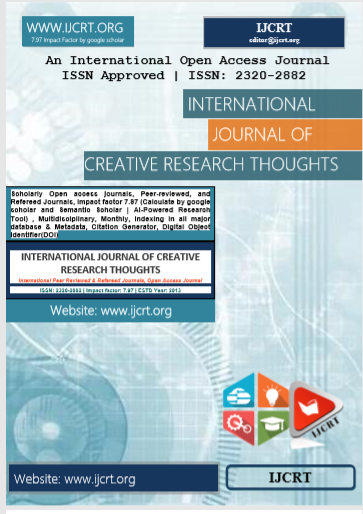
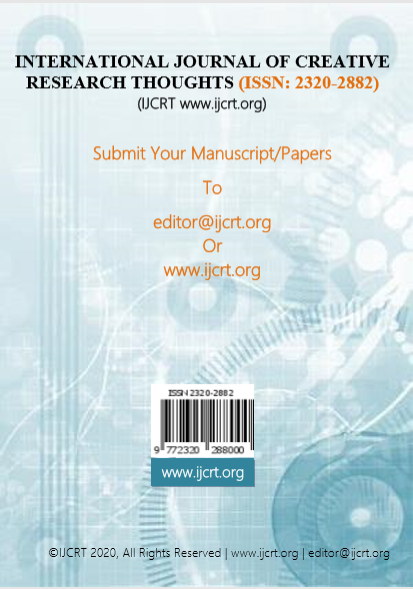
| IJCRT Journal front page | IJCRT Journal Back Page |
Paper Title: Public vs Private Banks in the Digital Era Analysing Mobile Banking Complexity
Author Name(s): Dr. Sonika Gupta, Vaikhari N. Joshi
Published Paper ID: - IJCRT2512897
Register Paper ID - 299302
Publisher Journal Name: IJPUBLICATION, IJCRT
DOI Member ID: 10.6084/m9.doi.one.IJCRT2512897 and DOI :
Author Country : Indian Author, India, 400067 , MUMBAI, 400067 , | Research Area: Social Science All Published Paper URL: http://ijcrt.org/viewfull.php?&p_id=IJCRT2512897 Published Paper PDF: download.php?file=IJCRT2512897 Published Paper PDF: http://www.ijcrt.org/papers/IJCRT2512897.pdf
Your Paper Publication Details:
Title: PUBLIC VS PRIVATE BANKS IN THE DIGITAL ERA ANALYSING MOBILE BANKING COMPLEXITY
DOI (Digital Object Identifier) :
Pubished in Volume: 13 | Issue: 12 | Year: December 2025
Publisher Name : IJCRT | www.ijcrt.org | ISSN : 2320-2882
Subject Area: Social Science All
Author type: Indian Author
Pubished in Volume: 13
Issue: 12
Pages: h878-h887
Year: December 2025
Downloads: 41
E-ISSN Number: 2320-2882
Abstract
The global rise of mobile banking has seen a widespread adoption of this technology amongst all age groups from various financial backgrounds and expertise. From them, the individuals ranging from age 18 to 60 are most pertinent as those individuals are amongst the highest users of mobile banking to fulfill their daily financial needs. The goal of this research is to explore the role of mobile banking app designs in shaping user experience and influencing their choice on whether to use the mobile banking platform more often or not. As part of this research, a survey was conducted, collecting data from 92 respondents, both male and female; aged between 18 and 60 years; who use mobile banking services. The responses gathered serve as a primary data source for analysing the relationship between the design aspects of mobile banking applications and their influence on user behaviour. The research affirms that design elements such as colour dynamics, homepage design, security features, and transparency are integral in determining the usability of mobile banking applications.
Licence: creative commons attribution 4.0
License
Creative Commons Attribution 4.0 and The Open Definition

Keywords
Private Banks, ICICI bank, IDFC First, Public Banks, YONO SBI, PNB One, Mobile Banking, Application Design
License
Creative Commons Attribution 4.0 and The Open Definition
Paper Title: Effectiveness of Wellness Tutelage on Knowledge, Attitude and Willingness to Change regarding Healthy Lifestyle among Adolescents
Author Name(s): C.Jayasree, S.Yuvarani, Dr.D.Celina, Dr.S. Kanchana
Published Paper ID: - IJCRT2512896
Register Paper ID - 299534
Publisher Journal Name: IJPUBLICATION, IJCRT
DOI Member ID: 10.6084/m9.doi.one.IJCRT2512896 and DOI :
Author Country : Indian Author, India, 600066 , Chennai, 600066 , | Research Area: Others area Published Paper URL: http://ijcrt.org/viewfull.php?&p_id=IJCRT2512896 Published Paper PDF: download.php?file=IJCRT2512896 Published Paper PDF: http://www.ijcrt.org/papers/IJCRT2512896.pdf
Your Paper Publication Details:
Title: EFFECTIVENESS OF WELLNESS TUTELAGE ON KNOWLEDGE, ATTITUDE AND WILLINGNESS TO CHANGE REGARDING HEALTHY LIFESTYLE AMONG ADOLESCENTS
DOI (Digital Object Identifier) :
Pubished in Volume: 13 | Issue: 12 | Year: December 2025
Publisher Name : IJCRT | www.ijcrt.org | ISSN : 2320-2882
Subject Area: Others area
Author type: Indian Author
Pubished in Volume: 13
Issue: 12
Pages: h869-h877
Year: December 2025
Downloads: 52
E-ISSN Number: 2320-2882
Abstract
The study aimed at assessing the effectiveness of Wellness Tutelage on knowledge, attitude and willingness to change healthy lifestyles among adolescents.Background: lifestyle diseases is the most common reason for today's death. Lifestyle and behaviors during adolescents have life-long consequences to the health and onset of lifestyle diseases in later life. Adolescents phase establish patterns of behavior lifestyle in healthy way. Aim and objective: To assess the effectiveness of Wellness Tutelage on knowledge, attitude and willingness to change among adolescents. Methodology: Quantitative approach, quasi experimental non- equivalent control group pretest, posttest research design was adopted to assess the effectiveness of Wellness Tutelage among 60adolescents at selected communities in Vellore. Probability convenient sampling technique was used to select the samples. Wellness Tutelage was administered and level of knowledge, attitude and willingness to change was assessed by using structured knowledge questionnaire, four point likert scale and structured rating scale for both the experimental and control group. Results: The findings of the study revealed that the calculated student paired "t" value for the post test level of knowledge among experimental group adolescents was t=7.86, for attitude t=10.84 and for willingness to change t=4.58 which showed that a very high statistical significance at p<0.001 level. Conclusion: The results revealed that Wellness Tutelage was effective in improving knowledge, attitude and willingness to change among adolescents which can enhance their healthy lifestyle in their day today life.
Licence: creative commons attribution 4.0
License
Creative Commons Attribution 4.0 and The Open Definition
Keywords
Wellness Tutelage, Willingness to change, Buzz group
License
Creative Commons Attribution 4.0 and The Open Definition
Paper Title: Assessment Of Knowledge, Attitude And Level Of Satisfaction Of Health Care Consumers In Utilization Of Health Care Services Rendered By Omayal Achi Community Health Centre, Arakkampakkam
Author Name(s): C.Jayasree, Dr.D. Celina, Dr.S. Kanchana
Published Paper ID: - IJCRT2512895
Register Paper ID - 299535
Publisher Journal Name: IJPUBLICATION, IJCRT
DOI Member ID: 10.6084/m9.doi.one.IJCRT2512895 and DOI :
Author Country : Indian Author, India, 600066 , Chennai, 600066 , | Research Area: Others area Published Paper URL: http://ijcrt.org/viewfull.php?&p_id=IJCRT2512895 Published Paper PDF: download.php?file=IJCRT2512895 Published Paper PDF: http://www.ijcrt.org/papers/IJCRT2512895.pdf
Your Paper Publication Details:
Title: ASSESSMENT OF KNOWLEDGE, ATTITUDE AND LEVEL OF SATISFACTION OF HEALTH CARE CONSUMERS IN UTILIZATION OF HEALTH CARE SERVICES RENDERED BY OMAYAL ACHI COMMUNITY HEALTH CENTRE, ARAKKAMPAKKAM
DOI (Digital Object Identifier) :
Pubished in Volume: 13 | Issue: 12 | Year: December 2025
Publisher Name : IJCRT | www.ijcrt.org | ISSN : 2320-2882
Subject Area: Others area
Author type: Indian Author
Pubished in Volume: 13
Issue: 12
Pages: h863-h868
Year: December 2025
Downloads: 54
E-ISSN Number: 2320-2882
Abstract
Abstract: Quality assurance is getting higher importance in the health care system as there is a heavy investment in the health system on structure and resources. So it is essential to know how for it is accessible to the remote area people and whether the community people are aware of the health care services available for them and the people are satisfied out of health sector's services. Aim & Objective: To assess the knowledge, attitude and level of satisfaction of health care consumers towards OACHC's health services, to correlate between knowledge, attitude and level of satisfaction of health care consumers towards OACHC's health services and to associate the selected background variables with the mean level of knowledge, attitude and level of satisfaction of health services among health care consumers. Methods and Materials: Non experimental descriptive research design to assess the knowledge, attitude and level of satisfaction of health care consumers in utilization of OACHC health services, 50 consumers(15-60) who fulfilled the inclusion criteria were selected by purposive sampling technique. A structured questionnaire method was used to assess the knowledge and 5 point likert scale used to assess the attitude and level of satisfaction was assessed by using 4 point likert scale which was devised and collected by the investigator through interview technique. Results: The findings revealed that none of them having adequate knowledge and majority of the consumers were having moderate level of knowledge whereas few of the having inadequate level of knowledge. While considering the attitude majority of them having moderate level of attitude and all of the health care consumers having high level of satisfaction towards OACHC's health care services. Chi-square reveals that most of the consumers were frequently attended the centre, with reasonable visit, by getting information about OACHC, all these were significantly associated with the knowledge, attitude and level of satisfaction score. Conclusion: Majority of health care consumers are having moderate level of knowledge (56.00%) whereas few of the having inadequate level of knowledge(44.00%) while considering the attitude majority of them having moderate level of attitude (52.00%) and all of the health care consumers having high level of satisfaction(100%) towards OACHC's health care services.
Licence: creative commons attribution 4.0
License
Creative Commons Attribution 4.0 and The Open Definition
Keywords
Quality Assurance, Heavy Investment, Health care consumers, utilization of OACHC's health service, heavy investment
License
Creative Commons Attribution 4.0 and The Open Definition
Paper Title: Reconfiguring Agrarian Relations: Travancore Under Ayilyam Thirunal Ramavarma
Author Name(s): Dr AMBILI S
Published Paper ID: - IJCRT2512894
Register Paper ID - 299529
Publisher Journal Name: IJPUBLICATION, IJCRT
DOI Member ID: 10.6084/m9.doi.one.IJCRT2512894 and DOI :
Author Country : Indian Author, India, 695543 , VELLANAD, 695543 , | Research Area: Social Science All Published Paper URL: http://ijcrt.org/viewfull.php?&p_id=IJCRT2512894 Published Paper PDF: download.php?file=IJCRT2512894 Published Paper PDF: http://www.ijcrt.org/papers/IJCRT2512894.pdf
Your Paper Publication Details:
Title: RECONFIGURING AGRARIAN RELATIONS: TRAVANCORE UNDER AYILYAM THIRUNAL RAMAVARMA
DOI (Digital Object Identifier) :
Pubished in Volume: 13 | Issue: 12 | Year: December 2025
Publisher Name : IJCRT | www.ijcrt.org | ISSN : 2320-2882
Subject Area: Social Science All
Author type: Indian Author
Pubished in Volume: 13
Issue: 12
Pages: h857-h862
Year: December 2025
Downloads: 50
E-ISSN Number: 2320-2882
Abstract
The ancient kingdom of Travancore forms the southernmost potion of west cost of India. The kingdom also known as the state of Travancore was an earlier Hindu primitive kingdom up to 1858, and the princely state of India was ruled by royal family of Travancore. Ayilyam Thirunal RamaVarma ruled Travancore from 1860 to 1880. The agrarian reforms introduced during the reign of Ayilyam Thirunal marked a significant transformation in the land relations of the princely state of Travancore. Prior to these reforms, the agrarian structure was characterised by feudal dominance, insecure tenancy, and heavy revenue demands on cultivators. Recognizing the need for administrative modernization and social justice, Ayilyam Thirunal implemented policies aimed at protecting tenants and rationalizing land revenue administration. The reforms not only improved the economic condition of peasants but also weakened the feudal land system that had constrained rural society in Travancore. Collectively, these agrarian measures laid the foundation for later land reforms in Kerala and contributed to the emergence of a more equitable and stable agrarian order.
Licence: creative commons attribution 4.0
License
Creative Commons Attribution 4.0 and The Open Definition
Keywords
Diwan, Jenmis, Kudiyans, Pandara Lands, Ryots.
License
Creative Commons Attribution 4.0 and The Open Definition
Paper Title: Emotional Deterioration as A Culturally Sustained Process in Shobha Rao's Girls Burn Brighter
Author Name(s): Anjana. J
Published Paper ID: - IJCRT2512893
Register Paper ID - 299490
Publisher Journal Name: IJPUBLICATION, IJCRT
DOI Member ID: 10.6084/m9.doi.one.IJCRT2512893 and DOI : https://doi.org/10.56975/ijcrt.v13i12.299490
Author Country : Indian Author, India, 629177 , Marthandam, 629177 , | Research Area: Medical Science All Published Paper URL: http://ijcrt.org/viewfull.php?&p_id=IJCRT2512893 Published Paper PDF: download.php?file=IJCRT2512893 Published Paper PDF: http://www.ijcrt.org/papers/IJCRT2512893.pdf
Your Paper Publication Details:
Title: EMOTIONAL DETERIORATION AS A CULTURALLY SUSTAINED PROCESS IN SHOBHA RAO'S GIRLS BURN BRIGHTER
DOI (Digital Object Identifier) : https://doi.org/10.56975/ijcrt.v13i12.299490
Pubished in Volume: 13 | Issue: 12 | Year: December 2025
Publisher Name : IJCRT | www.ijcrt.org | ISSN : 2320-2882
Subject Area: Medical Science All
Author type: Indian Author
Pubished in Volume: 13
Issue: 12
Pages: h853-h856
Year: December 2025
Downloads: 73
E-ISSN Number: 2320-2882
Abstract
This paper examines emotional deterioration as a process shaped and sustained by cultural forces in the fictional writings of Shobha Rao, with particular attention to Girls Burn Brighter (2018). Rather than presenting suffering as sudden or exceptional, the study reveals how distress develops gradually through everyday practices, inherited norms and unequal power relations. Rao's narratives portray women whose inner lives are steadily worn down by social expectations, economic dependence and restricted mobility, making emotional decline both continuous and normalized. The analysis highlights how cultural frameworks teach endurance while discouraging expression, causing pain to be absorbed inward rather than resisted outward. At the same time, the paper observes how human connection, especially between women, emerges as a fragile yet meaningful response to prolonged hardship. Emotional survival in these texts does not appear as triumph but as persistence shaped by care, memory and shared presence. By focusing on lived experience rather than dramatic violence, this study offers a nuanced understanding of how culture quietly participates in the making of emotional vulnerability. The paper contributes to contemporary literary criticism by foregrounding emotional deterioration as an ongoing, socially maintained condition, thereby inviting readers to reconsider suffering not as an individual failure but as a collective cultural outcome.
Licence: creative commons attribution 4.0
License
Creative Commons Attribution 4.0 and The Open Definition
Keywords
Quiet trauma, Relational survival, Female interiority, Gendered suffering and Human vulnerability.
License
Creative Commons Attribution 4.0 and The Open Definition
Paper Title: Special Intensive Revision by the Election Commission of India (ECI)
Author Name(s): Arvind Tiwari, Arpit Kumar Sharma
Published Paper ID: - IJCRT2512892
Register Paper ID - 299521
Publisher Journal Name: IJPUBLICATION, IJCRT
DOI Member ID: 10.6084/m9.doi.one.IJCRT2512892 and DOI : https://doi.org/10.56975/ijcrt.v13i12.299521
Author Country : Indian Author, India, 303007 , Jaipur, 303007 , | Research Area: Arts1 All Published Paper URL: http://ijcrt.org/viewfull.php?&p_id=IJCRT2512892 Published Paper PDF: download.php?file=IJCRT2512892 Published Paper PDF: http://www.ijcrt.org/papers/IJCRT2512892.pdf
Your Paper Publication Details:
Title: SPECIAL INTENSIVE REVISION BY THE ELECTION COMMISSION OF INDIA (ECI)
DOI (Digital Object Identifier) : https://doi.org/10.56975/ijcrt.v13i12.299521
Pubished in Volume: 13 | Issue: 12 | Year: December 2025
Publisher Name : IJCRT | www.ijcrt.org | ISSN : 2320-2882
Subject Area: Arts1 All
Author type: Indian Author
Pubished in Volume: 13
Issue: 12
Pages: h846-h852
Year: December 2025
Downloads: 115
E-ISSN Number: 2320-2882
Abstract
The Special Intensive Revision is a noteworthy, targeted electoral roll cleaning and re-enumeration work done by the Election Commission of India (ECI) to establish that electoral rolls are both comprehensive and correct ahead of major elections or when organized inadequacies are detected. This paper studies the legitimate and official basis for SIR, functional design, current deployments (2023-2025), results, challenges and policy suggestions. Tapping into ECI documents, Press Information Bureau publications, State Chief Electoral Officer notifications and national media reporting, this paper states that SIRs have provably enhanced roll standard where executed with requisite precautions, but risks of disqualify and logistical pressure continues. To increase democratic incorporation, SIR must amalgamate procedural precautions, increased BLO capacity, vigorous grievance redress, transparent public communication and strong data-protection steps.
Licence: creative commons attribution 4.0
License
Creative Commons Attribution 4.0 and The Open Definition
Keywords
Special Intensive Revision; SIR; Election Commission of India; electoral rolls; Booth Level Officer; voter registration; electoral integrity
License
Creative Commons Attribution 4.0 and The Open Definition
Paper Title: Negotiating Indianness: Cultural Identity, Gender, And Language In Nissim Ezekiel's "Night Of The Scorpion" And Kamala Das's "An Introduction"
Author Name(s): Lavanya S, Dr. Meera Kumar
Published Paper ID: - IJCRT2512891
Register Paper ID - 299528
Publisher Journal Name: IJPUBLICATION, IJCRT
DOI Member ID: 10.6084/m9.doi.one.IJCRT2512891 and DOI : https://doi.org/10.56975/ijcrt.v13i12.299528
Author Country : Indian Author, India, 620006 , Trichy, 620006 , | Research Area: Medical Science All Published Paper URL: http://ijcrt.org/viewfull.php?&p_id=IJCRT2512891 Published Paper PDF: download.php?file=IJCRT2512891 Published Paper PDF: http://www.ijcrt.org/papers/IJCRT2512891.pdf
Your Paper Publication Details:
Title: NEGOTIATING INDIANNESS: CULTURAL IDENTITY, GENDER, AND LANGUAGE IN NISSIM EZEKIEL'S "NIGHT OF THE SCORPION" AND KAMALA DAS'S "AN INTRODUCTION"
DOI (Digital Object Identifier) : https://doi.org/10.56975/ijcrt.v13i12.299528
Pubished in Volume: 13 | Issue: 12 | Year: December 2025
Publisher Name : IJCRT | www.ijcrt.org | ISSN : 2320-2882
Subject Area: Medical Science All
Author type: Indian Author
Pubished in Volume: 13
Issue: 12
Pages: h836-h845
Year: December 2025
Downloads: 62
E-ISSN Number: 2320-2882
Abstract
This paper undertakes a comparative literary study of Kamala Das's "An Introduction" and Nissim Ezekiel's "Night of the Scorpion" to examine how Indian English poetry negotiates identity, gender, and cultural consciousness within postcolonial contexts. Rather than approaching the poems as isolated expressions of feminist confession or cultural realism, the study places them in dialogue to explore how poetic voice mediates between individual self-articulation and communal belief. Employing qualitative literary analysis and close reading, the paper draws on feminist and postcolonial theoretical frameworks to investigate how language, embodiment, and belief systems shape differing modes of subjectivity. Das's poem is examined as a linguistic assertion of female selfhood that resists social and cultural regulation, while Ezekiel's poem is analysed as a narrative of collective response in which suffering is absorbed into communal ethics and inherited belief. The study argues that reading these poems comparatively reveals the coexistence of divergent yet interrelated postcolonial sensibilities within Indian English poetry. By foregrounding both individual and communal modes of experience, the paper contributes to a more nuanced understanding of how gender, culture, and identity are articulated through poetic form in postcolonial Indian writing.
Licence: creative commons attribution 4.0
License
Creative Commons Attribution 4.0 and The Open Definition
Keywords
Comparative analysis, Cultural belief, Female subjectivity, Indian English poetry, Poetic voice, Postcolonial identity
License
Creative Commons Attribution 4.0 and The Open Definition
Paper Title: Healthscape: A Gis Exploration of Social Determinants
Author Name(s): Shreya L Gowda, Shreya H S, Roshan Aadithya, Spoorthi M, Smitha B A
Published Paper ID: - IJCRT2512890
Register Paper ID - 299514
Publisher Journal Name: IJPUBLICATION, IJCRT
DOI Member ID: 10.6084/m9.doi.one.IJCRT2512890 and DOI :
Author Country : Indian Author, India, 560098 , Bengaluru, 560098 , | Research Area: Science and Technology Published Paper URL: http://ijcrt.org/viewfull.php?&p_id=IJCRT2512890 Published Paper PDF: download.php?file=IJCRT2512890 Published Paper PDF: http://www.ijcrt.org/papers/IJCRT2512890.pdf
Your Paper Publication Details:
Title: HEALTHSCAPE: A GIS EXPLORATION OF SOCIAL DETERMINANTS
DOI (Digital Object Identifier) :
Pubished in Volume: 13 | Issue: 12 | Year: December 2025
Publisher Name : IJCRT | www.ijcrt.org | ISSN : 2320-2882
Subject Area: Science and Technology
Author type: Indian Author
Pubished in Volume: 13
Issue: 12
Pages: h829-h835
Year: December 2025
Downloads: 43
E-ISSN Number: 2320-2882
Abstract
The health inequities across Indian districts have roots in Social Determinants of Health inclusive of maternal care, child nutrition, sanitation, education, and access to healthcare[4]. While datasets like NFHS-5 [1] are rich in information on these indicators, the high dimensionality coupled with inconsistent administrative formats causes serious challenge in systematic vulnerability assessment[14]. This paper presents HealthScape, a data-driven unified analytics framework that integrates PCAbased dimensionality reduction[14], [15], machine learning-based classification[6], [8], and geospatial visualization[7], [10] for generating district-level SDOH vulnerability maps. Standardized data cleaning and feature engineering, dimensionality reduction based on PCA, vulnerability scoring, and classification by XGBoost form the pipeline. District boundaries are spatially joined using GeoJSON files; hence, interactive choropleth maps can be generated to highlight high-risk clusters and regional disparities[15]. Experimental results confirm strong predictive performance and accurate spatial representation by identifying the top vulnerable districts and subsequently yielding interpretable insights for policymakers. Complex survey data will now be transformed into actionable intelligence, and the model proposed is scalable for population-health monitoring across India.
Licence: creative commons attribution 4.0
License
Creative Commons Attribution 4.0 and The Open Definition
Keywords
SDOH, NFHS-5, PCA, Machine Learning, GIS, Vulnerability Index, Spatial Analysis
License
Creative Commons Attribution 4.0 and The Open Definition
Paper Title: Digital Literacy and Responsible Technology Use in Primary Education
Author Name(s): RASEL SK
Published Paper ID: - IJCRT2512889
Register Paper ID - 299493
Publisher Journal Name: IJPUBLICATION, IJCRT
DOI Member ID: 10.6084/m9.doi.one.IJCRT2512889 and DOI :
Author Country : Indian Author, India, 732207 , MALDA, 732207 , | Research Area: Social Science All Published Paper URL: http://ijcrt.org/viewfull.php?&p_id=IJCRT2512889 Published Paper PDF: download.php?file=IJCRT2512889 Published Paper PDF: http://www.ijcrt.org/papers/IJCRT2512889.pdf
Your Paper Publication Details:
Title: DIGITAL LITERACY AND RESPONSIBLE TECHNOLOGY USE IN PRIMARY EDUCATION
DOI (Digital Object Identifier) :
Pubished in Volume: 13 | Issue: 12 | Year: December 2025
Publisher Name : IJCRT | www.ijcrt.org | ISSN : 2320-2882
Subject Area: Social Science All
Author type: Indian Author
Pubished in Volume: 13
Issue: 12
Pages: h826-h828
Year: December 2025
Downloads: 48
E-ISSN Number: 2320-2882
Abstract
Digital literacy has become an essential component of contemporary primary education as technology increasingly shapes children's learning environments, communication patterns, and social behavior. This paper examines the role of digital literacy education in developing responsible technology use among primary school learners. It explores how early exposure to guided digital practices enhances cognitive skills, ethical awareness, information discernment, online safety, creativity, and collaborative learning. Key dimensions discussed include foundational digital skills, cyber safety awareness, critical media literacy, balanced screen habits, teacher-mediated technology integration, parental involvement, inclusive digital access, value-based digital citizenship, age-appropriate digital competencies, monitoring mechanisms, and institutional strategies for sustainable implementation. Findings suggest that structured digital literacy education at the primary level promotes safe, ethical, and productive engagement with technology, preparing learners for future academic and social demands.
Licence: creative commons attribution 4.0
License
Creative Commons Attribution 4.0 and The Open Definition
Keywords
Digital Literacy, Primary Education, Responsible Technology Use, Cyber Safety, Media Literacy, Digital Citizenship, ICT in Education
License
Creative Commons Attribution 4.0 and The Open Definition
Paper Title: Pedagogical Content Knowledge as Mediating Construct Between Teacher Expertise and Students' Conceptual Understanding: A Theoretical Framework
Author Name(s): Thienkholal Guite, Vikedunu Savi
Published Paper ID: - IJCRT2512888
Register Paper ID - 299519
Publisher Journal Name: IJPUBLICATION, IJCRT
DOI Member ID: 10.6084/m9.doi.one.IJCRT2512888 and DOI : https://doi.org/10.56975/ijcrt.v13i12.299519
Author Country : Indian Author, India, 795128 , Lamka, 795128 , | Research Area: Medical Science All Published Paper URL: http://ijcrt.org/viewfull.php?&p_id=IJCRT2512888 Published Paper PDF: download.php?file=IJCRT2512888 Published Paper PDF: http://www.ijcrt.org/papers/IJCRT2512888.pdf
Your Paper Publication Details:
Title: PEDAGOGICAL CONTENT KNOWLEDGE AS MEDIATING CONSTRUCT BETWEEN TEACHER EXPERTISE AND STUDENTS' CONCEPTUAL UNDERSTANDING: A THEORETICAL FRAMEWORK
DOI (Digital Object Identifier) : https://doi.org/10.56975/ijcrt.v13i12.299519
Pubished in Volume: 13 | Issue: 12 | Year: December 2025
Publisher Name : IJCRT | www.ijcrt.org | ISSN : 2320-2882
Subject Area: Medical Science All
Author type: Indian Author
Pubished in Volume: 13
Issue: 12
Pages: h818-h825
Year: December 2025
Downloads: 55
E-ISSN Number: 2320-2882
Abstract
The problem of cultivating conceptual knowledge in the students is still a major challenge in the secondary level education regardless of the fact that the teachers are highly disciplined and trained in pedagogical knowledge. According to the existing research, it has been proposed that content knowledge or general pedagogical knowledge does not explain the differences in meaningful learning of students. This is an abstracted concept paper, and it advances theoretically based framework to denominate Pedagogical Content Knowledge (PCK) as mediating factor between teacher knowledge and the conceptual knowledge of the students in the learners. As the paper is built on the existing theories about teacher knowledge and learning, it synthesises the scholarly literature and describes how teachers convert the subject matter into pedagogically empowering representations that respond to existing knowledge, misunderstandings, and need of the learners in their minds. The suggested framework explains the processes in which teacher quality impacts conceptual knowledge, such as the nature of instructional representation, order of content, and responsive pedagogic thinking. The implication of PCK as the key predictive variable of the paper is provided in terms of teacher education, the professional development, and curriculum design, and represents the basis of the future empirical and theoretical research on teaching in understanding.
Licence: creative commons attribution 4.0
License
Creative Commons Attribution 4.0 and The Open Definition
Keywords
Pedagogical Content Knowledge, teacher expertise, conceptual understanding, secondary education, instructional mediation
License
Creative Commons Attribution 4.0 and The Open Definition
Call For Paper February 2026
Call For Papers
February 2026
Volume 14 | Issue 2
Last Date :
28-Feb-2026
Submit Manuscript Online Impact Factor: 7.97 Review Results : Within 02-03 Days Paper Publication : Within 02-03 Days
February 2026
Volume 14 | Issue 2
Last Date :
28-Feb-2026
Submit Manuscript Online Impact Factor: 7.97 Review Results : Within 02-03 Days Paper Publication : Within 02-03 Days
Published Issue Details
For Authors
Forms / Downloads
Other IMP Links
Indexing Partner
Research Area
LICENSE





ISSN and 7.97 Impact Factor Details

ISSN: 2320-2882 Impact Factor: 7.97 and ISSN APPROVED Journal Starting Year (ESTD) : 2013


ISSN and 7.97 Impact Factor Details
ISSN: 2320-2882 Impact Factor: 7.97 and ISSN APPROVED Journal Starting Year (ESTD) : 2013
DOI Details
CONFERENCE
CONFERENCE MANAGMENT & PUBLICATION CONFERENCE PROPOSAL
RECENT CONFERENCE

CONFERENCE PROPOSAL CONFERENCE PROCEEDINGS
CONFERENCE PROPOSAL CONFERENCE PROCEEDINGS
For Reviewer /Referral (RMS) Earn 500 per paper
Important Links
NEWS & Conference
Digital Library
IJCRT RMS | Earn 500 Per Paper.

Open Access


LICENSE
Indexing Partner
Scholarly open access journals, Peer-reviewed, and Refereed Journals, Impact factor 7.97 (Calculate by google scholar and Semantic Scholar | AI-Powered Research Tool) , Multidisciplinary, Monthly, Indexing in all major database & Metadata, Citation Generator, Digital Object Identifier(DOI)