Important Details
IJCRT - International Peer Reviewed, Open Access Journal, Multidisciplinary, Monthly, Nominal(Low) Fees for Professional Research Services International Journal of Creative Research Thoughts - IJCRT Peer Review Journal, Refereed Journal, Peer Reviewed Journal , Referred Journal and Indexed Journal, Open access, Online and Print Journal,international Journal Open Access, Accepted by Indian and foreign university ,IJCRT Followed Norms, guidelines, requirement, listing criteria and methodology of score/point also applied from: Scopus , Web of Science , UGC Approved , UGC CARE, UGC-CARE .
UGC Approved Journal No: 49023 (18)
UGC approval Link
https://ijcrt.org/ugc%20approval.jpg
All Policy and Approval
Please Like Our Facebook Page | CrossRef DOI and Hard copy of Certificate Provide if required. | www.IJCRT.org | editor@IJCRT.org | WhatsApp: 7990172303
Publication Details:
- Paper Submission : 31-Mar-2026. Call For Paper (Volume 14 | Issue 3 | Month- March 2026)
- Acceptance/Rejection Notification: Within 02-04 Days.
- Paper Publish: Within 02-04 Days after submitting all documents.
-
Submit Your Paper Any time There No deadline.
-
Publication fees : 1570 INR for Indian author & 59$ for foreign International author.
Please Like Our Facebook Page | CrossRef DOI and Hard copy of Certificate Provide if required.
Licence and Indexing
Indexing In Google Scholar, SSRN, ResearcherID-Publons, Semantic Scholar | AI-Powered Research Tool, Microsoft Academic, Academia.edu, arXiv.org, Research Gate, CiteSeerX, ResearcherID Thomson Reuters, Mendeley : reference manager, DocStoc, ISSUU, Scribd, and many more | High Impact Factor: 7.97 | Digital object identifier (DOI) and Hard Copy of certificate Provided.




























Licence
DOI
ISSN Approved impact factor: 7.97 
Creative Common 
Valid as per new UGC Gazette regulations 

INTERNATIONAL JOURNAL OF CREATIVE RESEARCH THOUGHTS - IJCRT (IJCRT.ORG)
International Peer Reviewed & Refereed Journals, Open Access Journal
IJCRT Peer-Reviewed (Refereed) Journal as Per New UGC Rules.
ISSN Approved Journal No: 2320-2882 | Impact factor: 7.97 | ESTD Year: 2013
Call For Paper - Volume 14 | Issue 3 | Month- March 2026
Scholarly open access journals, Peer-reviewed, and Refereed Journals, Impact factor 7.97 (Calculate by google scholar and Semantic Scholar | AI-Powered Research Tool) , Multidisciplinary, Monthly, Indexing in all major database & Metadata, Citation Generator, Digital Object Identifier(CrossRef DOI)
Contact Us Click Here
WhatsApp Contact Click Here
IJCRT Search Xplore - Search all paper by Paper Name , Author Name, and Title
Volume 13 | Issue 11 |
Volume 13 | Issue 11 | Month
Downlaod After Publication 1) Table of content index in PDF
2) Table of content index in HTML 2)Table of content index in HTML
3) Front Page 3) Front Page
4) Back Page 4) Back Page
5) Editor Board Member 5)Editor Board Member
6) OLD Style Issue 6)OLD Style Issue
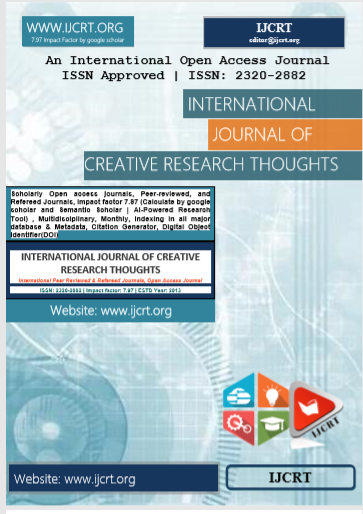 |
 |
|---|---|
| IJCRT Journal front page | IJCRT Journal Back Page |
Paper Title: Understanding Vandhyatva and It's Ayurvedic Management
Author Name(s): Dr Sneha Waghmode, Dr Vinayak Shinde
Published Paper ID: - IJCRT2511555
Register Paper ID - 296489
Publisher Journal Name: IJPUBLICATION, IJCRT
DOI Member ID: 10.6084/m9.doi.one.IJCRT2511555 and DOI :
Author Country : Indian Author, India, 411044 , Pune, 411044 , | Research Area: Humanities All Published Paper URL: http://ijcrt.org/viewfull.php?&p_id=IJCRT2511555 Published Paper PDF: download.php?file=IJCRT2511555 Published Paper PDF: http://www.ijcrt.org/papers/IJCRT2511555.pdf
Your Paper Publication Details:
Title: UNDERSTANDING VANDHYATVA AND IT'S AYURVEDIC MANAGEMENT
DOI (Digital Object Identifier) :
Pubished in Volume: 13 | Issue: 11 | Year: November 2025
Publisher Name : IJCRT | www.ijcrt.org | ISSN : 2320-2882
Subject Area: Humanities All
Author type: Indian Author
Pubished in Volume: 13
Issue: 11
Pages: e739-e743
Year: November 2025
Downloads: 87
E-ISSN Number: 2320-2882
Abstract
Vandhyatva ( infertility) is conditions when a female is unable to conceive within 1 year of regular unprotected intercourse. There are 2 types of infertility primary infertility refers to couple who have not become after at least 1 years having sex without using birth control method, And secondary infertility as couple who have been able to get pregnant at least once, but are now usable. Description of Vandhyatva ( infertility) has been mentioned in Charaka Samhita, Sushruta Samhita, Harita Samhita, Kashyap Samhita, Ashtang Sangraha Madhava Nidana, Bhavprakasha Rasa ratna Samucchay. Beeja, artava, and pushpa can be correlation with ovum which is one of most important factor for conception and infertility. So this study describe leads to infertility it's causes, symptoms, pathology, and it's management.
Licence: creative commons attribution 4.0
License
Creative Commons Attribution 4.0 and The Open Definition

Keywords
Vandhyatva, infertility, Charaka Samhita, ovum, Beeja, pushpa etc.
License
Creative Commons Attribution 4.0 and The Open Definition
Paper Title: Ethnomedicinal flora deployed in the therapeutic intervenation of snakebite within the Pachamalai Hills, Tiruchirappalli District, Tamil Nadu, India.
Author Name(s): M. Manoranjitham
Published Paper ID: - IJCRT2511554
Register Paper ID - 296773
Publisher Journal Name: IJPUBLICATION, IJCRT
DOI Member ID: 10.6084/m9.doi.one.IJCRT2511554 and DOI :
Author Country : Indian Author, India, - , -, - , | Research Area: Science and Technology Published Paper URL: http://ijcrt.org/viewfull.php?&p_id=IJCRT2511554 Published Paper PDF: download.php?file=IJCRT2511554 Published Paper PDF: http://www.ijcrt.org/papers/IJCRT2511554.pdf
Your Paper Publication Details:
Title: ETHNOMEDICINAL FLORA DEPLOYED IN THE THERAPEUTIC INTERVENATION OF SNAKEBITE WITHIN THE PACHAMALAI HILLS, TIRUCHIRAPPALLI DISTRICT, TAMIL NADU, INDIA.
DOI (Digital Object Identifier) :
Pubished in Volume: 13 | Issue: 11 | Year: November 2025
Publisher Name : IJCRT | www.ijcrt.org | ISSN : 2320-2882
Subject Area: Science and Technology
Author type: Indian Author
Pubished in Volume: 13
Issue: 11
Pages: e729-e738
Year: November 2025
Downloads: 84
E-ISSN Number: 2320-2882
Abstract
Snake bite is one of the neglected public health problems which could lead to acute iatrogenic effects including the nervous system leading to paralysis, drooping eyelids, tingling. The cardiovascular system causing bleeding disorders. The renal system resulting kidney failure. The local tissue causing damage and dysfunction. It also causes pain, swelling, redness, systemic effects like nausea, weakness, and respiratory distress. Plant-derived traditional herbal remedies have served as a prolific reservoir of therapeutic compounds, employed worldwide to forestall and manage a plethora of human maladies since the dawn of civilization, The present investigation, conducted within the Pachamalai hills of the Tiruchirappalli district, sought to explore the expansive potential of medicinal flora in the treatment of ophidian envenomation. Thorough surveys and inquiries -glycemic equilibrium documented a total of 95 plant species, representing 91 distinct families, utilized by local communities for the management of glycemic equilibrium. This study meticulously delineates these botanicals, furnishing their binomial nomenclature and vernacular appellations, alongside precise descriptions of the specific plant components employed in medicinal preparations for snakebites. Saliently, prominent families identified in the survey encompassed Fabaceae, Mimosaceae, Apocynaceae, Amaranthaceae, and Asteraceae.
Licence: creative commons attribution 4.0
License
Creative Commons Attribution 4.0 and The Open Definition
Keywords
Snake bites, traditional medicine, indigenous groups, medicinal plants, Pachamalai.
License
Creative Commons Attribution 4.0 and The Open Definition
Paper Title: Manual Scavenging Around the World: A Human Rights and Legal Perspective
Author Name(s): Anamitra G Nambiar, Abhisha K
Published Paper ID: - IJCRT2511553
Register Paper ID - 296847
Publisher Journal Name: IJPUBLICATION, IJCRT
DOI Member ID: 10.6084/m9.doi.one.IJCRT2511553 and DOI :
Author Country : Indian Author, India, 560049 , Bangalore, 560049 , | Research Area: Medical Science All Published Paper URL: http://ijcrt.org/viewfull.php?&p_id=IJCRT2511553 Published Paper PDF: download.php?file=IJCRT2511553 Published Paper PDF: http://www.ijcrt.org/papers/IJCRT2511553.pdf
Your Paper Publication Details:
Title: MANUAL SCAVENGING AROUND THE WORLD: A HUMAN RIGHTS AND LEGAL PERSPECTIVE
DOI (Digital Object Identifier) :
Pubished in Volume: 13 | Issue: 11 | Year: November 2025
Publisher Name : IJCRT | www.ijcrt.org | ISSN : 2320-2882
Subject Area: Medical Science All
Author type: Indian Author
Pubished in Volume: 13
Issue: 11
Pages: e716-e728
Year: November 2025
Downloads: 95
E-ISSN Number: 2320-2882
Abstract
Manual scavenging -- the practice of manually cleaning, carrying, disposing, or handling human excreta from insanitary latrines, sewers, and septic tanks -- is one of the most degrading forms of labor known to humanity. Despite being legally banned in multiple countries, including India, it continues to persist in different forms, reflecting deep-rooted social inequality, caste-based discrimination, and state failure to ensure human dignity. The practice violates fundamental human rights, including the right to life, dignity, equality, and safe working conditions. This research paper examines manual scavenging from a global legal perspective, analyzing the human-rights dimensions, the international legal framework, and the national legislations addressing this issue -- with India as the central focus. It discusses the historical and social roots of the practice, the legal evolution of prohibitions and rehabilitation measures, the gaps in implementation, and the global parallels where unsafe sanitation work continues. The paper argues that the persistence of manual scavenging represents not just a failure of law enforcement but a failure of moral and constitutional duty. The conclusion emphasizes the urgent need for holistic reform combining legal enforcement, social change, mechanization, and rehabilitation to restore dignity to affected communities and eradicate the practice permanently.
Licence: creative commons attribution 4.0
License
Creative Commons Attribution 4.0 and The Open Definition
Keywords
manual scavenging, human rights, caste discrimination, sanitation workers, India, forced labor, law and dignity, rehabilitation, human-rights violations
License
Creative Commons Attribution 4.0 and The Open Definition
Paper Title: Seeing Through AI Eyes: Cultural Meaning and Acceptance of Surveillance
Author Name(s): Aarti Pathade
Published Paper ID: - IJCRT2511552
Register Paper ID - 296842
Publisher Journal Name: IJPUBLICATION, IJCRT
DOI Member ID: 10.6084/m9.doi.one.IJCRT2511552 and DOI :
Author Country : Indian Author, India, 412114 , Pune, 412114 , | Research Area: Science and Technology Published Paper URL: http://ijcrt.org/viewfull.php?&p_id=IJCRT2511552 Published Paper PDF: download.php?file=IJCRT2511552 Published Paper PDF: http://www.ijcrt.org/papers/IJCRT2511552.pdf
Your Paper Publication Details:
Title: SEEING THROUGH AI EYES: CULTURAL MEANING AND ACCEPTANCE OF SURVEILLANCE
DOI (Digital Object Identifier) :
Pubished in Volume: 13 | Issue: 11 | Year: November 2025
Publisher Name : IJCRT | www.ijcrt.org | ISSN : 2320-2882
Subject Area: Science and Technology
Author type: Indian Author
Pubished in Volume: 13
Issue: 11
Pages: e707-e715
Year: November 2025
Downloads: 97
E-ISSN Number: 2320-2882
Abstract
This research investigates the influence of cultural values, trust in institutions, and moral principles on the public's acceptance of AI surveillance technologies. As AI-based monitoring systems become more integrated into various aspects of life, their interpretation and legitimacy differ significantly across different cultures. Utilizing cross-cultural theory and case studies, this study explores how societies view the trade-offs between security and privacy, efficiency and autonomy, and trust and control. It examines how cultural meanings shape the perception of AI surveillance as either a protective measure or a threat to civil liberties, and how institutional narratives support these views. The findings indicate that societies with higher levels of institutional trust and collectivist values tend to be more accepting of AI surveillance, whereas individualistic and low-trust environments show greater resistance and ethical concerns. The paper concludes by discussing the implications for global AI governance and culturally sensitive technology policies.
Licence: creative commons attribution 4.0
License
Creative Commons Attribution 4.0 and The Open Definition
Keywords
AI surveillance, cultural values, institutional trust, privacy, ethics, cross-cultural analysis, technology acceptance, governance.
License
Creative Commons Attribution 4.0 and The Open Definition
Paper Title: Clinical Management of Cardiac Arrhythmia
Author Name(s): Shaikh AbdulBaree Shaikh Sagiroddin, Shradha Rajput, Dr. Vanita B. Wadewale
Published Paper ID: - IJCRT2511551
Register Paper ID - 296371
Publisher Journal Name: IJPUBLICATION, IJCRT
DOI Member ID: 10.6084/m9.doi.one.IJCRT2511551 and DOI :
Author Country : Indian Author, India, 413520 , Latur, 413520 , | Research Area: Pharmacy All Published Paper URL: http://ijcrt.org/viewfull.php?&p_id=IJCRT2511551 Published Paper PDF: download.php?file=IJCRT2511551 Published Paper PDF: http://www.ijcrt.org/papers/IJCRT2511551.pdf
Your Paper Publication Details:
Title: CLINICAL MANAGEMENT OF CARDIAC ARRHYTHMIA
DOI (Digital Object Identifier) :
Pubished in Volume: 13 | Issue: 11 | Year: November 2025
Publisher Name : IJCRT | www.ijcrt.org | ISSN : 2320-2882
Subject Area: Pharmacy All
Author type: Indian Author
Pubished in Volume: 13
Issue: 11
Pages: e702-e706
Year: November 2025
Downloads: 124
E-ISSN Number: 2320-2882
Abstract
Abstract: Cardiac arrhythmias constitute a heterogeneous spectrum of rhythm disturbances arising from abnormalities in the initiation or propagation of electrical impulses within the heart. These disorders range from benign ectopic beats to malignant ventricular tachyarrhythmias capable of causing sudden cardiac death. Their management continues to challenge clinicians due to complex underlying mechanisms, multifactorial etiologies, and variable prognostic outcomes. The growing global burden of arrhythmias, particularly atrial fibrillation, underscores the urgent need for evidence-based strategies that integrate diagnostic precision with personalized therapeutic interventions. This comprehensive review explores the epidemiological trends, risk determinants, and pathophysiological mechanisms contributing to arrhythmogenesis. It critically evaluates conventional and advanced diagnostic modalities, including electrocardiography, electrophysiological mapping, cardiac imaging, and the emerging role of artificial intelligence and wearable technologies in rhythm monitoring. Pharmacological management is discussed within the framework of the Vaughan-Williams classification, emphasizing antiarrhythmic drug selection, rate and rhythm control, and anticoagulation strategies for thromboembolic prevention. Equally important, non-pharmacological interventions such as catheter ablation, implantable cardioverter-defibrillators (ICDs), and pacemaker therapy are reviewed for their pivotal roles in rhythm stabilization and mortality reduction. Current guideline recommendations from the A??, ACC, and ESC are summarized, highlighting the paradigm shift toward early rhythm control, precision cardiology, and integration of genetic testing for inherited arrhythmia syndromes. Emerging innovations, including gene-editing technologies, stem-cell-based myocardial repair, and machine-learning algorithms for risk stratification, represent the future of arrhythmia management. Ultimately, optimizing patient outcomes requires a multidisciplinary approach encompassing accurate diagnosis, individualized treatment planning, lifestyle modification, and continuous follow-up. With ongoing advancements in biomedical technology and data-driven medicine, the future of cardiac arrhythmia management is poised for significant transformation toward safer, more effective, and patient-centered care.
Licence: creative commons attribution 4.0
License
Creative Commons Attribution 4.0 and The Open Definition
Keywords
Keywords: Atrial fibrillation, Ventricular arrhythmia, Catheter ablation, Electrophysiology, Cardiac arrhythmia management, Brugada syndrome, Genetic testing.
License
Creative Commons Attribution 4.0 and The Open Definition
Paper Title: BEHIND THE SCENES- MAKING STEAM WORK IN SCHOOLS
Author Name(s): Ms. Mridu Prakash Saxena, Dr. Sudeshi Bala Jain
Published Paper ID: - IJCRT2511550
Register Paper ID - 294790
Publisher Journal Name: IJPUBLICATION, IJCRT
DOI Member ID: 10.6084/m9.doi.one.IJCRT2511550 and DOI :
Author Country : Indian Author, India, - , -, - , | Research Area: Science and Technology Published Paper URL: http://ijcrt.org/viewfull.php?&p_id=IJCRT2511550 Published Paper PDF: download.php?file=IJCRT2511550 Published Paper PDF: http://www.ijcrt.org/papers/IJCRT2511550.pdf
Your Paper Publication Details:
Title: BEHIND THE SCENES- MAKING STEAM WORK IN SCHOOLS
DOI (Digital Object Identifier) :
Pubished in Volume: 13 | Issue: 11 | Year: November 2025
Publisher Name : IJCRT | www.ijcrt.org | ISSN : 2320-2882
Subject Area: Science and Technology
Author type: Indian Author
Pubished in Volume: 13
Issue: 11
Pages: e694-e701
Year: November 2025
Downloads: 125
E-ISSN Number: 2320-2882
Abstract
Making Education skill oriented by adding different subjects in a harmonious way. NEP 2020 is endeavoring to make students independent and skill enriched when they move out of the portals of their school system. Integration of different subjects have lead the learning procedures a different dimension. STEAM is the abbreviation of Science, Technology, Engineering, Arts and Mathematics and its inclusion in school curriculum is going to be a great milestone in developing the personality of our students and making them self-reliant, independent and skill oriented. My paper presentation on the above topic, actually gave me an opportunity to unravel a research done a few years back in the Session 2016-17 with a group of twenty two interested and enthusiastic students. The research endeavor was titled The Nachiketa Project, after the famous mythological character, known for his inquisitiveness. The study of The Nachiketa Project revealed that academic performance of students can be improved by its implementation. Research work is suitably supported with relevant data for reference purposes. The analogy of The Nachiketa Project and Integration of STEAM is very interesting. Both the models ultimately result into the development of skill, collaboration and empowerment of our students. Both the techniques to develop the personality of our students are in accordance with our new National Education Policy 2020. I would like to admit that the presentation is a maiden work of research and it would also enlighten us how Integration of STEAM can be oriented in Schools. The submission also attempts to demonstrate integration in Middle School Curriculum. The feasibility of Integration of STEAM with cross curricular approach would make students critical thinkers and analyzers.
Licence: creative commons attribution 4.0
License
Creative Commons Attribution 4.0 and The Open Definition
Keywords
BEHIND THE SCENES- MAKING STEAM WORK IN SCHOOLS
License
Creative Commons Attribution 4.0 and The Open Definition
Paper Title: EMPOWERING SMART HOMES: AI-BASED ANALYSIS OF RESIDENTIAL SMART METERS
Author Name(s): Potumudi Abshalom, B .Komala Priya, P Devi Supriya
Published Paper ID: - IJCRT2511549
Register Paper ID - 296640
Publisher Journal Name: IJPUBLICATION, IJCRT
DOI Member ID: 10.6084/m9.doi.one.IJCRT2511549 and DOI :
Author Country : Indian Author, India, 533244 , RAZOLE, 533244 , | Research Area: Science and Technology Published Paper URL: http://ijcrt.org/viewfull.php?&p_id=IJCRT2511549 Published Paper PDF: download.php?file=IJCRT2511549 Published Paper PDF: http://www.ijcrt.org/papers/IJCRT2511549.pdf
Your Paper Publication Details:
Title: EMPOWERING SMART HOMES: AI-BASED ANALYSIS OF RESIDENTIAL SMART METERS
DOI (Digital Object Identifier) :
Pubished in Volume: 13 | Issue: 11 | Year: November 2025
Publisher Name : IJCRT | www.ijcrt.org | ISSN : 2320-2882
Subject Area: Science and Technology
Author type: Indian Author
Pubished in Volume: 13
Issue: 11
Pages: e683-e693
Year: November 2025
Downloads: 102
E-ISSN Number: 2320-2882
Abstract
The increasing demand for efficient energy usage in residential areas has driven the evolution of conventional energy meters into intelligent smart metering systems. This project focuses on the analysis and implementation of Artificial Intelligence (AI) technologies in residential smart meters to enhance energy monitoring, consumption forecasting, and load optimization. By leveraging machine learning algorithms such as LSTM and XGBoost, smart meters can not only record real-time data but also predict future energy usage patterns, enabling users and utility providers to make informed decisions. The study explores the role of AI in enabling demand-side management, anomaly detection, and personalized energy recommendations. Through the use of historical consumption data, AI models are trained to identify trends, peak hours, and potential inefficiencies in the system. The results demonstrate the effectiveness of AI-based smart meters in reducing energy wastage, lowering electricity bills, and promoting sustainable living. This project highlights the potential of integrating AI into residential energy systems and sets the foundation for future developments in smart grid technologies .The increasing demand for efficient energy usage in residential areas has driven the evolution of conventional energy meters into intelligent smart metering systems. This project focuses on the analysis and implementation of Artificial Intelligence (AI) technologies in residential smart meters to enhance energy monitoring, consumption forecasting, and load optimization. By leveraging machine learning algorithms such as LSTM and XGBoost, smart meters can not only record real-time data but also predict future energy usage patterns, enabling users and utility providers to make informed decisions. The study explores the role of AI in enabling demand-side management, anomaly detection, and personalized energy recommendations. Through the use of historical consumption data, AI models are trained to identify trends, peak hours, and potential inefficiencies in the system. The results demonstrate the effectiveness of AI-based smart meters in reducing energy wastage, lowering electricity bills, and promoting sustainable living. This project highlights the potential of integrating AI into residential energy systems and sets the foundation for future developments in smart grid technologies
Licence: creative commons attribution 4.0
License
Creative Commons Attribution 4.0 and The Open Definition
Keywords
Smart meters, Artificial Intelligence, Energy forecasting, LSTM, XGBoost, Smart homes, Load optimization
License
Creative Commons Attribution 4.0 and The Open Definition
Paper Title: How and why have divorce rates changed over time?
Author Name(s): R. BHARATHI, ANNAPOORNESHWARI C G
Published Paper ID: - IJCRT2511548
Register Paper ID - 296744
Publisher Journal Name: IJPUBLICATION, IJCRT
DOI Member ID: 10.6084/m9.doi.one.IJCRT2511548 and DOI :
Author Country : Indian Author, India, - , -, - , | Research Area: Science and Technology Published Paper URL: http://ijcrt.org/viewfull.php?&p_id=IJCRT2511548 Published Paper PDF: download.php?file=IJCRT2511548 Published Paper PDF: http://www.ijcrt.org/papers/IJCRT2511548.pdf
Your Paper Publication Details:
Title: HOW AND WHY HAVE DIVORCE RATES CHANGED OVER TIME?
DOI (Digital Object Identifier) :
Pubished in Volume: 13 | Issue: 11 | Year: November 2025
Publisher Name : IJCRT | www.ijcrt.org | ISSN : 2320-2882
Subject Area: Science and Technology
Author type: Indian Author
Pubished in Volume: 13
Issue: 11
Pages: e676-e682
Year: November 2025
Downloads: 106
E-ISSN Number: 2320-2882
Abstract
Divorce rates have experienced notable fluctuations throughout history, shaped by legal, social, cultural, and economic developments. In earlier centuries, divorce was rare due to religious restrictions, legal barriers, and societal stigma. The twentieth century marked a turning point with the introduction of no-fault divorce laws, the rise of women's economic independence, and the growing acceptance of individual choice, all of which contributed to a sharp increase in divorce rates. In recent decades, however, many societies have witnessed stabilization or even a decline in divorce, influenced by delayed marriages, cohabitation, and evolving family structures. Understanding these shifts highlights how divorce trends mirror broader transformations in societal values, gender roles, and the meaning of marriage itself.
Licence: creative commons attribution 4.0
License
Creative Commons Attribution 4.0 and The Open Definition
Keywords
How and why have divorce rates changed over time?
License
Creative Commons Attribution 4.0 and The Open Definition
Paper Title: A STUDY ON ANALYSIS OF AFLATOXIN B1 IN RAGI FLOUR IN INDIA
Author Name(s): DR.ASHISH MUKHERJEE, DR.MANVI SHARMA, Y.S.CHAKRAHAR, R.INDRA, Subhodh Anil Nagdeve
Published Paper ID: - IJCRT2511547
Register Paper ID - 295455
Publisher Journal Name: IJPUBLICATION, IJCRT
DOI Member ID: 10.6084/m9.doi.one.IJCRT2511547 and DOI :
Author Country : Indian Author, India, 440010 , NAGPUR, 440010 , | Research Area: Other area not in list Published Paper URL: http://ijcrt.org/viewfull.php?&p_id=IJCRT2511547 Published Paper PDF: download.php?file=IJCRT2511547 Published Paper PDF: http://www.ijcrt.org/papers/IJCRT2511547.pdf
Your Paper Publication Details:
Title: A STUDY ON ANALYSIS OF AFLATOXIN B1 IN RAGI FLOUR IN INDIA
DOI (Digital Object Identifier) :
Pubished in Volume: 13 | Issue: 11 | Year: November 2025
Publisher Name : IJCRT | www.ijcrt.org | ISSN : 2320-2882
Subject Area: Other area not in list
Author type: Indian Author
Pubished in Volume: 13
Issue: 11
Pages: e670-e675
Year: November 2025
Downloads: 100
E-ISSN Number: 2320-2882
Abstract
Ragi (Finger millet) is a nutrient rich millet and one of the staples in India. Postharvest handling of the grains may lead to contamination with various mycotoxins especially Aflatoxin B1. Aflatoxin B1 (AFB1) is the most common carcinogen of Aflatoxins, produced by Aspergillus flavus and Aspergillus parasiticus of fungi, which contaminates many agricultural products in the daily diet of humans. A study was conducted with 34 ragi flour samples collected from various region of India. A maximum of 29% of the collected samples showed a contamination of AflatoxinB1 between 3.01 to 4.00 ppb by HPTLC. The analysed samples were within the limits of AflatoxinB1 contamination standards laid by FSSAI.
Licence: creative commons attribution 4.0
License
Creative Commons Attribution 4.0 and The Open Definition
Keywords
Aflatoxin B1, HPTLC, Method validation, Ragi, Finger Millet
License
Creative Commons Attribution 4.0 and The Open Definition
Paper Title: The Role of Gut Microbiota in Human Nutrition and Metabolic Health
Author Name(s): Ms. Tina Chauhan, Dr. Neetu Yadav, Dr. Shalu Nehra, Prof. Jyoti Gour
Published Paper ID: - IJCRT2511546
Register Paper ID - 296548
Publisher Journal Name: IJPUBLICATION, IJCRT
DOI Member ID: 10.6084/m9.doi.one.IJCRT2511546 and DOI :
Author Country : Indian Author, India, 250005 , Meerut, 250005 , | Research Area: Arts1 All Published Paper URL: http://ijcrt.org/viewfull.php?&p_id=IJCRT2511546 Published Paper PDF: download.php?file=IJCRT2511546 Published Paper PDF: http://www.ijcrt.org/papers/IJCRT2511546.pdf
Your Paper Publication Details:
Title: THE ROLE OF GUT MICROBIOTA IN HUMAN NUTRITION AND METABOLIC HEALTH
DOI (Digital Object Identifier) :
Pubished in Volume: 13 | Issue: 11 | Year: November 2025
Publisher Name : IJCRT | www.ijcrt.org | ISSN : 2320-2882
Subject Area: Arts1 All
Author type: Indian Author
Pubished in Volume: 13
Issue: 11
Pages: e664-e669
Year: November 2025
Downloads: 118
E-ISSN Number: 2320-2882
Abstract
Gut microbiota plays a central role in human nutrition, metabolism, and overall health. This review provides a comprehensive overview of the composition, development, and functional aspects of the gut microbiota, emphasizing its influence on nutrient metabolism, energy homeostasis, and metabolic disorders. The review also explores diet-induced modulation, probiotics, prebiotics, and the gut-brain axis. Advances in metagenomic tools and personalized nutrition approaches offer promising insights into microbiota-based interventions for metabolic health.
Licence: creative commons attribution 4.0
License
Creative Commons Attribution 4.0 and The Open Definition
Keywords
Keywords: Gut microbiota, nutrition, metabolism, probiotics, metabolic disorders, gut-brain axis
License
Creative Commons Attribution 4.0 and The Open Definition
Call For Paper March 2026
Call For Papers
March 2026
Volume 14 | Issue 3
Last Date :
31-Mar-2026
Submit Manuscript Online Impact Factor: 7.97 Review Results : Within 02-03 Days Paper Publication : Within 02-03 Days
March 2026
Volume 14 | Issue 3
Last Date :
31-Mar-2026
Submit Manuscript Online Impact Factor: 7.97 Review Results : Within 02-03 Days Paper Publication : Within 02-03 Days
Published Issue Details
For Authors
Forms / Downloads
Other IMP Links
Indexing Partner
Research Area
LICENSE





ISSN and 7.97 Impact Factor Details

ISSN: 2320-2882 Impact Factor: 7.97 and ISSN APPROVED Journal Starting Year (ESTD) : 2013


ISSN and 7.97 Impact Factor Details
ISSN: 2320-2882 Impact Factor: 7.97 and ISSN APPROVED Journal Starting Year (ESTD) : 2013
DOI Details
CONFERENCE
CONFERENCE MANAGMENT & PUBLICATION CONFERENCE PROPOSAL
RECENT CONFERENCE

CONFERENCE PROPOSAL CONFERENCE PROCEEDINGS
CONFERENCE PROPOSAL CONFERENCE PROCEEDINGS
For Reviewer /Referral (RMS) Earn 500 per paper
Important Links
NEWS & Conference
Digital Library
IJCRT RMS | Earn 500 Per Paper.

Open Access


LICENSE
Indexing Partner
Scholarly open access journals, Peer-reviewed, and Refereed Journals, Impact factor 7.97 (Calculate by google scholar and Semantic Scholar | AI-Powered Research Tool) , Multidisciplinary, Monthly, Indexing in all major database & Metadata, Citation Generator, Digital Object Identifier(DOI)