Important Details
IJCRT - International Peer Reviewed, Open Access Journal, Multidisciplinary, Monthly, Nominal(Low) Fees for Professional Research Services International Journal of Creative Research Thoughts - IJCRT Peer Review Journal, Refereed Journal, Peer Reviewed Journal , Referred Journal and Indexed Journal, Open access, Online and Print Journal,international Journal Open Access, Accepted by Indian and foreign university ,IJCRT Followed Norms, guidelines, requirement, listing criteria and methodology of score/point also applied from: Scopus , Web of Science , UGC Approved , UGC CARE, UGC-CARE .
UGC Approved Journal No: 49023 (18)
UGC approval Link
https://ijcrt.org/ugc%20approval.jpg
All Policy and Approval
Please Like Our Facebook Page | CrossRef DOI and Hard copy of Certificate Provide if required. | www.IJCRT.org | editor@IJCRT.org | IJCRT WhatsApp +91 7990172303
Publication Details:
- Paper Submission : 31-Jul-2026. Call For Paper (Volume 14 | Issue 7 | Month- July 2026)
- Acceptance/Rejection Notification: Within 02-04 Days.
- Paper Publish: Within 02-04 Days after submitting all documents.
-
Submit Your Paper Any time There No deadline.
-
Publication fees : 1570 INR for Indian author & 59$ for foreign International author.
Please Like Our Facebook Page | CrossRef DOI and Hard copy of Certificate Provide if required.
Licence and Indexing
Indexing In Google Scholar, SSRN, ResearcherID-Publons, Semantic Scholar | AI-Powered Research Tool, Microsoft Academic, Academia.edu, arXiv.org, Research Gate, CiteSeerX, ResearcherID Thomson Reuters, Mendeley : reference manager, DocStoc, ISSUU, Scribd, and many more | High Impact Factor: 7.97 | Digital object identifier (DOI) and Hard Copy of certificate Provided.




























Licence
DOI
ISSN Approved impact factor: 7.97 
Creative Common 
Valid as per new UGC Gazette regulations 

INTERNATIONAL JOURNAL OF CREATIVE RESEARCH THOUGHTS - IJCRT (IJCRT.ORG)
International Peer Reviewed & Refereed Journals, Open Access Journal
IJCRT Peer-Reviewed (Refereed) Journal as Per New UGC Rules.
ISSN Approved Journal No: 2320-2882 | Impact factor: 7.97 | ESTD Year: 2013
Call For Paper - Volume 14 | Issue 7 | Month- July 2026
Scholarly open access journals, Peer-reviewed, and Refereed Journals, Impact factor 7.97 (Calculate by google scholar and Semantic Scholar | AI-Powered Research Tool) , Multidisciplinary, Monthly, Indexing in all major database & Metadata, Citation Generator, Digital Object Identifier(CrossRef DOI)
IJCRT WhatsApp Contact
IJCRT Search Xplore - Search all paper by Paper Name , Author Name, and Title
Volume 11 | Issue 10 |
Volume 11 | Issue 10 | Month
Downlaod After Publication 1) Table of content index in PDF
2) Table of content index in HTML 2)Table of content index in HTML
3) Front Page 3) Front Page
4) Back Page 4) Back Page
5) Editor Board Member 5)Editor Board Member
6) OLD Style Issue 6)OLD Style Issue
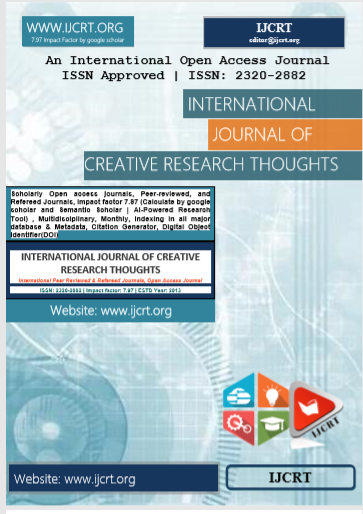 |
 |
|---|---|
| IJCRT Journal front page | IJCRT Journal Back Page |
Paper Title: "ADVANCING DRUG DELIVERY TECHNOLOGIES TO ENHANCED EFFECTIVENESS AND MINIMIZED SIDE EFFECTS"
Author Name(s): Mr. Saqlain Khan Gaffar Khan, Ms. Payal Janardhan Shelare, Ms. Swarupa Vyankatesh Guddetwar, Ms. Sakshi Dilip Chavhan, Ms. Sakshi Prabhakar Bhogekar
Published Paper ID: - IJCRT21X0135
Register Paper ID - 245273
Publisher Journal Name: IJPUBLICATION, IJCRT
DOI Member ID: 10.6084/m9.doi.one.IJCRT21X0135 and DOI :
Author Country : Indian Author, India, 445204 , Pusad (445204), 445204 , | Research Area: Pharmacy All Published Paper URL: http://ijcrt.org/viewfull.php?&p_id=IJCRT21X0135 Published Paper PDF: download.php?file=IJCRT21X0135 Published Paper PDF: http://www.ijcrt.org/papers/IJCRT21X0135.pdf
Your Paper Publication Details:
Title: "ADVANCING DRUG DELIVERY TECHNOLOGIES TO ENHANCED EFFECTIVENESS AND MINIMIZED SIDE EFFECTS"
DOI (Digital Object Identifier) :
Pubished in Volume: 11 | Issue: 10 | Year: October 2023
Publisher Name : IJCRT | www.ijcrt.org | ISSN : 2320-2882
Subject Area: Pharmacy All
Author type: Indian Author
Pubished in Volume: 11
Issue: 10
Pages: i168-i213
Year: October 2023
Downloads: 640
E-ISSN Number: 2320-2882
Abstract
Medicine delivery systems are developed to maximize medicine efficacy and minimize side goods. As medicine delivery technologies ameliorate, the medicine becomes safer and more comfortable for cases to use. During the last seven decades, extraordinary progress has been made in medicine delivery technologies, similar as systems for long- term delivery for months and times, localized delivery, and targeted delivery. The advances, still, will face a coming phase considering the unborn technologies we need to overcome numerous physicochemical walls for new expression development and natural unknowns for treating colorful conditions. For immediate and long- term progress into the future, the medicine delivery field should use time and coffers for further translatable exploration ideas. The medicine delivery discipline has to continue working on introductory, applied, translational, and clinical exploration in a combined manner to produce medicine delivery systems that work for cases. It's a time to concentrate our attention on effects that count. It's also a time to develop realistic exploration pretensions and issues, diversify medicine delivery technologies, and take the collaborative responsibility for our conduct. Nanotechnology has eventually and forcefully entered the realm of medicine delivery. Performances of intelligent medicine delivery systems are continuously bettered with the purpose to maximize remedial exertion and to minimize undesirable side- goods. This review describes the advanced medicine delivery systems grounded on micelles, polymeric nanoparticles, and Dendrimers. Polymeric carbon nanotubes and numerous others demonstrate a broad variety of useful parcels. This review emphasizes the main conditions for developing new nanotech- nology- grounded medicine delivery systems. Medicine targeting to specific organs and apkins has come one of the critical trials of the century since the use of free medicines in conventional lozenge forms generally involves difficulties in achieving the target point at the applicable cure after or during a proper time period. Accordingly, the hunt for new medicine delivery approaches and new modes of action represent one of the frontier exploration areas. New medicine delivery systems include Lepidic, proteic and polymeric technologies to give new sustained medicine delivery with better body distribution, medicine protection from harsh external terrain and avoidance of medicine concurrence. Numerous of these technologies have reached the request thus proving the benefits of these new carriers. This review covers the generalities of those new carriers and their new advances in medicine delivery.
Licence: creative commons attribution 4.0
License
Creative Commons Attribution 4.0 and The Open Definition

Keywords
Advancing Drug delivery , Technologies ,Effectiveness , Minimized Side Effects , Nanotechnology ,Liposomal Drug Delivery, Microneedles, Implantable Devices, Biodegradable Polymers, Gene Therapy, Smart Drug Delivery, 3D Printing, Inhalable Drug Delivery, Targeted Drug Delivery, Oral Drug Delivery, Microparticles and Microspheres.
License
Creative Commons Attribution 4.0 and The Open Definition
Paper Title: A Study on Artificial Intelligence in Ecommerce Industry
Author Name(s): Dr.K.Sangeetha
Published Paper ID: - IJCRT21X0134
Register Paper ID - 244907
Publisher Journal Name: IJPUBLICATION, IJCRT
DOI Member ID: 10.6084/m9.doi.one.IJCRT21X0134 and DOI :
Author Country : Indian Author, India, 638107 , Erode, 638107 , | Research Area: Commerce All Published Paper URL: http://ijcrt.org/viewfull.php?&p_id=IJCRT21X0134 Published Paper PDF: download.php?file=IJCRT21X0134 Published Paper PDF: http://www.ijcrt.org/papers/IJCRT21X0134.pdf
Your Paper Publication Details:
Title: A STUDY ON ARTIFICIAL INTELLIGENCE IN ECOMMERCE INDUSTRY
DOI (Digital Object Identifier) :
Pubished in Volume: 11 | Issue: 10 | Year: October 2023
Publisher Name : IJCRT | www.ijcrt.org | ISSN : 2320-2882
Subject Area: Commerce All
Author type: Indian Author
Pubished in Volume: 11
Issue: 10
Pages: i135-i167
Year: October 2023
Downloads: 852
E-ISSN Number: 2320-2882
Abstract
Artificial intelligence isn't just a novel technology implemented for its "cool factor." Implementing AI has the potential to impact any number of business functions across your organization. .At its core, Artificial Intelligence is a constellation of many different technologies that are capable of performing tasks requiring human intelligence. When applied to the usual business tasks, these technologies can learn, act, and perform with human-like levels of intelligence. It is used to simulate human intelligence in machines, saving us a lot of time and money in doing business. To understand how it could impact your business, it helps to have an understanding of the components of artificial intelligence. Besides product recommendations, online merchants use ecommerce intelligence to provide Chabot services, analyze customer comments, and offer personalized services to online shoppers. AI plays a crucial role in e commerce by enabling businesses to analyze and understand customer behavior patterns, enhance the shopping experience, and streamline various process.
Licence: creative commons attribution 4.0
License
Creative Commons Attribution 4.0 and The Open Definition
Keywords
Intelligence,Processsing,Technology,Behaviour,Industry
License
Creative Commons Attribution 4.0 and The Open Definition
Paper Title: A STUDY OF INTEROPERABILITY BETWEEN BIM AND FEM FOR IMPROVED STRUCTURAL ANALYSIS AND DESIGN
Author Name(s): GILBERT ROSHAN PAUL I, KARTHIKEYAN M
Published Paper ID: - IJCRT21X0133
Register Paper ID - 244762
Publisher Journal Name: IJPUBLICATION, IJCRT
DOI Member ID: 10.6084/m9.doi.one.IJCRT21X0133 and DOI :
Author Country : Indian Author, India, 609806 , 4-Kadalangudi, Kuttalam TK, Mayiladuthurai, 609806 , | Research Area: Science and Technology Published Paper URL: http://ijcrt.org/viewfull.php?&p_id=IJCRT21X0133 Published Paper PDF: download.php?file=IJCRT21X0133 Published Paper PDF: http://www.ijcrt.org/papers/IJCRT21X0133.pdf
Your Paper Publication Details:
Title: A STUDY OF INTEROPERABILITY BETWEEN BIM AND FEM FOR IMPROVED STRUCTURAL ANALYSIS AND DESIGN
DOI (Digital Object Identifier) :
Pubished in Volume: 11 | Issue: 10 | Year: October 2023
Publisher Name : IJCRT | www.ijcrt.org | ISSN : 2320-2882
Subject Area: Science and Technology
Author type: Indian Author
Pubished in Volume: 11
Issue: 10
Pages: i100-i134
Year: October 2023
Downloads: 806
E-ISSN Number: 2320-2882
Abstract
Building Information Modelling (BIM) has the potential to significantly improve productivity, coordination, visualization, documentation, and waste reduction in the field of structural engineering. However, achieving these benefits requires smooth data transfer from the BIM platform to structural analysis or Finite Element Modelling (FEM) software, which can be hindered by challenges in interoperability. This thesis aims to examine the possibilities of converting from the Tekla Structures BIM platform to commonly used FEM programs, including Staad.Pro, Etabs, SAP2000, SOFiSTiK, Dlubal (RFEM), SCIA (SCIA Engineer), and Robot (Autodesk), for improved structural analysis and design. The study includes three case studies, one each in concrete, steel, and composite structures, where load-bearing data is added to the central Tekla models to enable interoperability. We first review the use of BIM in structural engineering, including the impacts on structural design and workflow, key benefits, and challenges during use. We then define and theoretically research the three main levels of interoperability between BIM and FEM software: direct native file exchange, direct link or bi-directional data exchange, and IFC (Industry Foundation Class). Our case studies demonstrate the benefits of using BIM and FEM interoperability for improved structural analysis and design, including the early detection and correction of design errors, and improved collaboration between architects, engineers, and contractors. Overall, this thesis contributes to the field of structural engineering by providing practical guidance on the use of BIM and FEM interoperability for improved structural analysis and design.
Licence: creative commons attribution 4.0
License
Creative Commons Attribution 4.0 and The Open Definition
Keywords
Building Information Modelling, BIM, interoperability, Tekla Structures, FEM, structural analysis, Staad.Pro, Etabs, SAP2000, SOFiSTiK, Dlubal (RFEM), SCIA (SCIA Engineer), Robot (Autodesk), concrete structures, steel structures, productivity, coordination, visualization, documentation, waste reduction, early detection, design errors, collaboration, architects, engineers, contractors, Industry Foundation Class, IFC.
License
Creative Commons Attribution 4.0 and The Open Definition
Call For Paper July 2026
Call For Papers
July 2026
Volume 14 | Issue 7
Last Date :
31-Jul-2026
Submit Manuscript Online Impact Factor: 7.97 Review Results : Within 02-03 Days Paper Publication : Within 02-03 Days
July 2026
Volume 14 | Issue 7
Last Date :
31-Jul-2026
Submit Manuscript Online Impact Factor: 7.97 Review Results : Within 02-03 Days Paper Publication : Within 02-03 Days
Published Issue Details
For Authors
Forms / Downloads
Other IMP Links
Indexing Partner
Research Area
LICENSE





ISSN and 7.97 Impact Factor Details

ISSN: 2320-2882 Impact Factor: 7.97 and ISSN APPROVED Journal Starting Year (ESTD) : 2013


ISSN and 7.97 Impact Factor Details
ISSN: 2320-2882 Impact Factor: 7.97 and ISSN APPROVED Journal Starting Year (ESTD) : 2013
DOI Details
CONFERENCE
CONFERENCE MANAGMENT & PUBLICATION CONFERENCE PROPOSAL
RECENT CONFERENCE

CONFERENCE PROPOSAL CONFERENCE PROCEEDINGS
CONFERENCE PROPOSAL CONFERENCE PROCEEDINGS
For Reviewer /Referral (RMS) Earn 500 per paper
Important Links
NEWS & Conference
Digital Library
IJCRT RMS | Earn 500 Per Paper.

Open Access


LICENSE
Indexing Partner
Scholarly open access journals, Peer-reviewed, and Refereed Journals, Impact factor 7.97 (Calculate by google scholar and Semantic Scholar | AI-Powered Research Tool) , Multidisciplinary, Monthly, Indexing in all major database & Metadata, Citation Generator, Digital Object Identifier(DOI)